
Wikimedia Commons / Public domain, via Wikimedia Commons
Himalayan manna ash: complete guide
Fraxinus floribunda
Want to see Himalayan manna ash: complete guide in your garden?
1 minute, no credit card
Overview
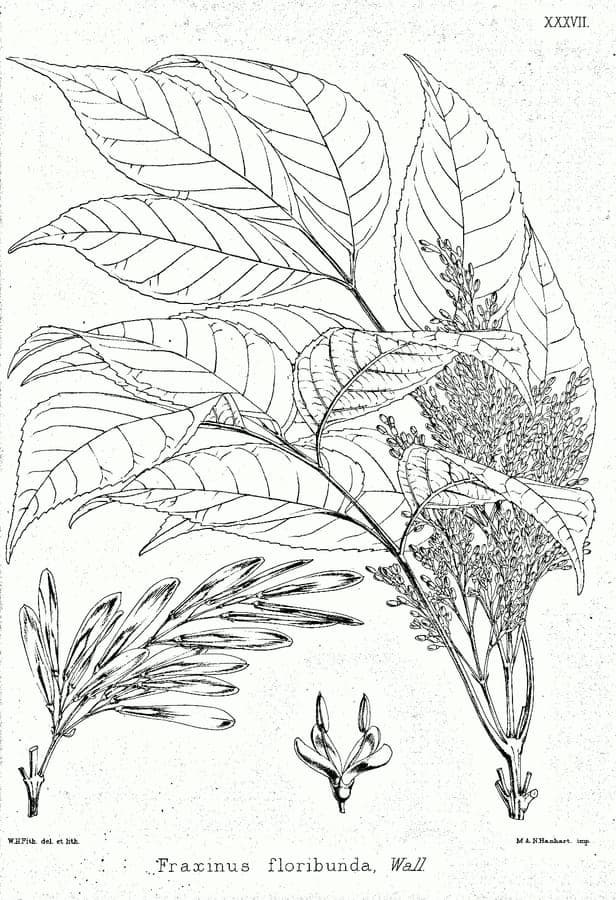
Himalayan manna ash (Fraxinus floribunda), also known as East Indian ash, is an elegant deciduous tree from the Oleaceae family native to the Himalayas and Southeast Asia. This stately tree stands out for its lush summer foliage and numerous small flowers. In its natural habitat, it reaches impressive proportions and forms an important component of mountain forests. With its fine leafwork and elegant form, this Asian ash offers unique value for larger gardens and parkland settings.
Appearance and bloom
Himalayan manna ash grows as a medium to large deciduous tree, typically 15-20 meters tall in cultivation (more in natural habitat). The trunk displays smooth grey-brown bark. The leaves are large and pinnate, composed of 7-11 leaflets, each 5-10 cm long. Fall color ranges from yellow to brown. From May to June, numerous small cream to yellow-green flowers appear in striking, dense flower clusters. The flowers attract many pollinators. After bloom, winged fruits (samaras) develop and spread via wind.
Ideal location
Select a sunny to lightly shaded location for this Himalayan ash. At least 4-6 hours of direct sunlight daily is ideal. Protect from strong winds in young years; once established, the tree tolerates moderate wind well. This is a tree that adapts to both full sun and dappled shade. In warm climates, light afternoon shade is beneficial. Planting location with ample growing space is essential; this tree needs room to develop its canopy.
Soil
Himalayan manna ash grows on diverse soils but prefers well-drained, moderately moist, nutrient-rich soil. pH can be neutral to slightly acidic. Ensure good drainage without extreme dryness. In young years, organic matter (leaf mold, compost) stimulates growth. This tree thrives on forest-type soils with fine texture. Heavy clay soils can be improved with sand and organic matter. Once established, this tree is relatively tolerant.
Watering
Regular watering is important in early years. Apply approximately 2-3 cm of water weekly during the growing period (May to September), distributed over one to two occasions. In extremely dry periods, supplemental water may be needed. Once established (after 2-3 years), this tree is relatively drought-tolerant and requires minimal supplemental watering. Winter: no watering needed. Avoid waterlogging at all times; drainage is crucial.
Free design
Want to see Himalayan manna ash: complete guide in your garden? Make a free design now.
Pruning
Minimal pruning is usually required for healthy form. In young years, you may remove some lower branches to form a clean trunk. Regularly remove crossing branches and dead wood. Heavy pruning should be avoided; this tree does not respond well to drastic cutting back. After establishment, maintain a natural form. Pruning is best done in winter when the tree is leafless.
Maintenance calendar
January-March: Winter dormancy, no action. April-May: Leaf emergence, light shaping. May-June: Flowering period, regular watering. July-September: Growing period, adjust watering according to rainfall. October-November: Fall color, preparation for dormancy. Year-round: Remove dead branches, inspect for damage.
Winter hardiness
Himalayan manna ash is moderately hardy to USDA zones 6-7 (minimum temperatures around -18 to -12 degrees Celsius). In very cold regions, young tree protection may be useful. Mulch around the base in first winters with 5-10 cm of leaf mold. In temperate climates, this tree thrives without protection. In extremely cold areas, this species is less suitable; other ash species are recommended.
Companion plants
Himalayan manna ash provides excellent shade for underplanting. Beneath its canopy, shade-tolerant plants grow well: Hellebores, Hosta, Ferns, Epimedium, and woodland Astilbe. Large understory planting is also possible. Avoid heavy root competition between this tree and densely planted groundcovers. Other large trees can be planted together for parkland effects.
Closing thoughts
Himalayan manna ash is a stately tree for larger gardens, parks, and landscape planting. The elegant, feathered leaves and rich flowering make it exceptional. This is not a tree for small urban gardens, but for planting areas with space and patience. Once established, this Himalayan beauty will provide decades of value, shade, and pollinator food. Start with young trees and invest in regular watering in the first years; you'll see an impressive stately tree develop.
Want to see Himalayan manna ash: complete guide in your garden? Make a free design now.
Upload a photo, pick a style, and get a photorealistic design with plant list in under a minute.
No credit card required


Similar plants
Rough menodora: complete guide
Menodora scabra
Full guide to Menodora scabra: a drought-tolerant desert subshrub with bright yellow flowers, ideal for rock gardens and xeriscapes.
Fraxinus dipetala: complete guide
Fraxinus dipetala
California ash or two-petal ash from southwestern USA. Beautiful spring flowers, drought-tolerant. Experimental choice for warm Mediterranean front gardens.
Syringa komarowii: complete guide
Syringa komarowii
Syringa komarowii is a striking lilac from central China with elegant flower spikes and lovely foliage. Discover the complete care guide here.