
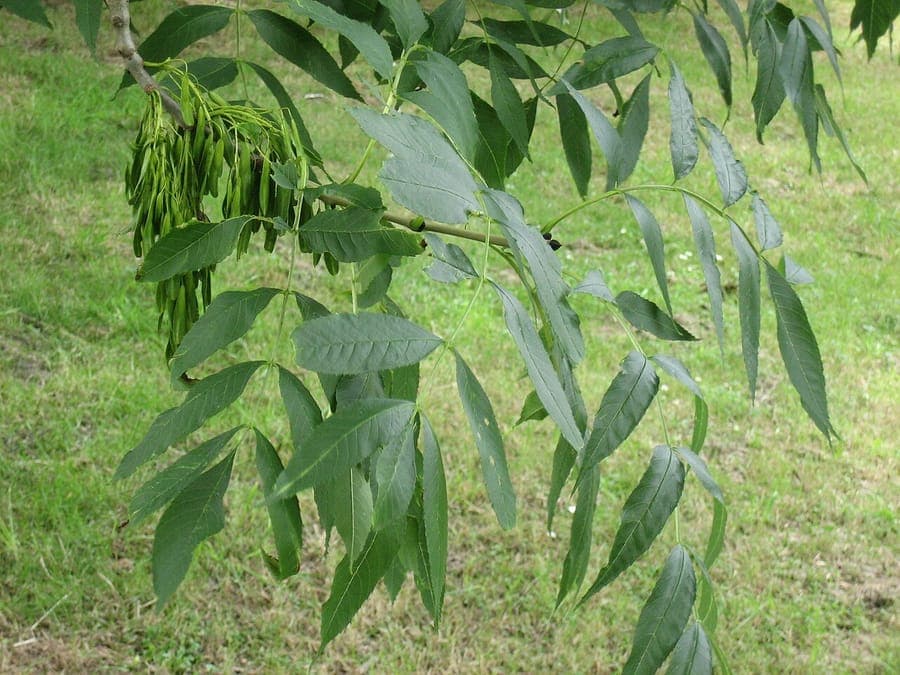
No machine-readable author provided. MPF assumed (based on copyright claims). / CC BY 2.5, via Wikimedia Commons
European ash: complete guide
Fraxinus excelsior
Want to see European ash: complete guide in your garden?
1 minute, no credit card
Overview
Fraxinus excelsior, commonly known as the European ash, is a towering deciduous tree native to much of Europe, including the UK, France, and Central Europe. Reaching heights of 30 to 40 meters, it's one of the fastest-growing large trees in temperate regions. With a straight trunk, open crown, and pinnate leaves, it brings a graceful presence to parks, avenues, and spacious gardens. Despite challenges from ash dieback (caused by Hymenoscyphus fraxineus), it remains a key species for biodiversity and landscape character.
On gardenworld.app you can create a garden layout that accommodates a European ash, factoring in future spread, root competition, and seasonal shade patterns.
Appearance & bloom cycle
The European ash features smooth, grey bark when young, which develops diamond-shaped fissures as the tree matures. Its leaves are pinnately compound, typically with 9–13 leaflets arranged opposite each other. They emerge late in spring, usually in May, and turn yellow before falling in autumn.
The tree blooms from April to May, producing small, brownish-purple flowers before the leaves appear. These wind-pollinated blossoms are inconspicuous but ecologically vital, offering early-season pollen for insects. After flowering, clusters of winged samaras (keys) develop, ripening in late summer and dispersing in autumn winds.
Ideal location
European ash thrives in full sun to light shade (light requirement: 7/10). It performs best with at least 6 hours of direct sunlight daily. Choose a site with ample space-minimum 8–10 meters from buildings, driveways, or underground utilities-due to its mature size and surface-rooting habit. It's ideal for large lawns, woodland edges, or as a specimen tree in country estates.
Avoid exposed, windy sites, especially on shallow or sandy soils, as the root system can be prone to rocking. On gardenworld.app, use the 3D garden planner to visualise how an ash tree will influence light and space over time.
Soil requirements
This tree prefers neutral to slightly alkaline soils with a pH of 7.0–7.5. It grows well in loam, clay-loam, or sandy loam, as long as drainage is adequate and moisture retention is moderate. Avoid waterlogged or highly acidic soils (below pH 6.0), which increase susceptibility to root rot and nutrient deficiencies.
The ash benefits from humus-rich, fertile ground, especially in the first 3–5 years. Mulch annually with leaf mould or composted bark to maintain moisture and suppress weeds.
Free design
Want to see European ash: complete guide in your garden? Make a free design now.
Watering
Young trees require consistent watering during dry spells in the first two to three growing seasons. Give 20–30 litres weekly during prolonged droughts. Once established, mature trees are drought-tolerant but may benefit from deep soaking during extended dry periods (e.g., four weeks without rain).
Use rainwater when possible-ash trees dislike high levels of chlorine or fluoride in tap water. Avoid frequent shallow watering; instead, water deeply and infrequently to encourage deep rooting.
Pruning
Pruning is generally unnecessary for healthy European ash trees. If structural shaping is needed, do so in late winter (February) when the tree is dormant. Remove dead, broken, or crossing branches, but avoid heavy pruning-ash trees heal slowly and are vulnerable to fungal infections like ash dieback through open wounds.
Never prune between March and September to reduce disease risk. Always sterilise tools before and after use.
Maintenance calendar
- Jan: Inspect for deadwood, check stability after winter storms
- Feb: Light structural pruning, apply mulch if not done in autumn
- Mar: No action-tree begins to wake
- Apr: Monitor flowering, avoid soil compaction under canopy
- May: Observe leaf emergence, watch for signs of dieback
- Jun: Water young trees if rainfall is below 25mm/week
- Jul: Repeat watering if needed
- Aug: No pruning-sap flow is high
- Sep: Seed keys mature; collect or allow natural dispersal
- Oct: Leaf fall begins; rake and compost leaves
- Nov: Prepare soil with organic matter
- Dec: Final inspection, secure young trees if windy
Winter hardiness
European ash is hardy in USDA zones 5 to 8, tolerating winter lows down to -20°C. Young trees may need protection from sunscald on the south-facing trunk in harsh winters-consider tree guards or whitewashing.
Mulch around the base to insulate roots, especially in exposed sites. Avoid road salt runoff-ash trees are sensitive to soil salinity.
Companion plants
Under mature ash trees, the soil is often dry and shaded due to canopy cover and root competition. Choose drought-tolerant, shade-loving plants such as: wood anemone (Anemone nemorosa), winter aconite (Eranthis hyemalis), lungwort (Pulmonaria officinalis), and sweet woodruff (Galium odoratum).
Avoid planting deep-rooted species or heavy feeders. Shallow-rooted perennials and native woodland groundcovers work best.
Closing
The European ash is a cornerstone of British and European landscapes. With its elegant form, rapid growth, and ecological value, it's a worthy addition to any large garden-provided there's room to grow. While ash dieback is a serious concern, selecting healthy, disease-resistant saplings from reputable sources improves success.
Buy from trusted garden centres like B&Q, Wyevale, or local nurseries. Look for trees with straight trunks, no cankers, and well-developed root balls. On gardenworld.app, simulate long-term growth and plan companion planting to maximise your garden's potential.
Want to see European ash: complete guide in your garden? Make a free design now.
Upload a photo, pick a style, and get a photorealistic design with plant list in under a minute.
No credit card required


Similar plants
Rough menodora: complete guide
Menodora scabra
Full guide to Menodora scabra: a drought-tolerant desert subshrub with bright yellow flowers, ideal for rock gardens and xeriscapes.
Fraxinus dipetala: complete guide
Fraxinus dipetala
California ash or two-petal ash from southwestern USA. Beautiful spring flowers, drought-tolerant. Experimental choice for warm Mediterranean front gardens.
Syringa komarowii: complete guide
Syringa komarowii
Syringa komarowii is a striking lilac from central China with elegant flower spikes and lovely foliage. Discover the complete care guide here.