
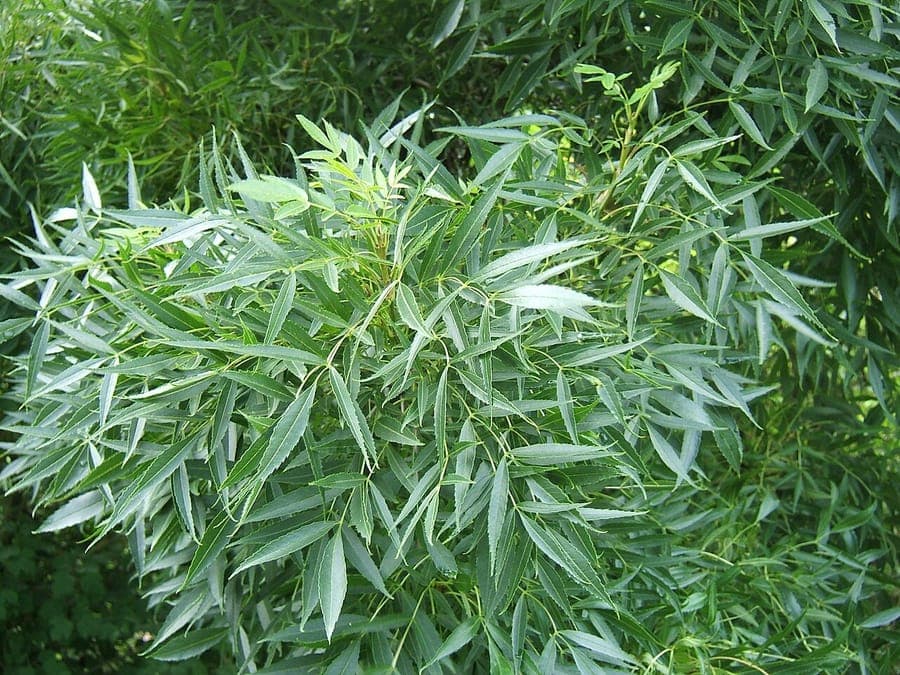
No machine-readable author provided. MPF assumed (based on copyright claims). / CC BY 2.5, via Wikimedia Commons
Desert ash: complete guide
Fraxinus angustifolia
Want to see Desert ash: complete guide in your garden?
1 minute, no credit card
Overview
Fraxinus angustifolia, commonly known as desert ash, is a graceful deciduous tree native to southern and central Europe, thriving from Albania to Austria and parts of North Africa. It's a member of the Oleaceae family and stands out for its narrow, lance-shaped leaflets and tolerance for dry, sunny conditions. Reaching 15–20 meters at maturity, it's a medium to large tree best suited for spacious gardens, parks, or as an avenue specimen.
Unlike the broader-leaved Fraxinus excelsior, this species has a more refined, airy canopy that casts light, dappled shade-ideal for underplanting. It's semi-evergreen in milder climates, often holding onto its leaves through winter before shedding them in early spring. If you're planning a long-term landscape, the desert ash offers structure without overwhelming bulk.
On gardenworld.app, you can visualize how this tree fits into your garden layout, especially when considering spacing for future crown spread.
Appearance & bloom cycle
Young desert ash trees grow with a pyramidal habit, gradually becoming broadly oval or rounded with age. The bark starts smooth and pale grey, developing shallow fissures over decades. Mature trees develop a dignified, open silhouette.
Each compound leaf carries 5 to 9 narrow leaflets, 3–8 cm long, with a pointed tip. They're dark green above, paler underneath, and arranged oppositely along the stem-typical of the ash family. In autumn, foliage turns a soft, buttery yellow, not showy but pleasant in a naturalistic garden.
Flowering occurs from April to May. The blooms are small, brownish, and lack petals, appearing in dense clusters before or with the new leaves. While not ornamental, they support early pollinators. Female trees produce slender samaras (keys), which disperse in late autumn and can self-seed in loose soil.
Ideal location
This tree thrives in full sun-rate 8 out of 10 for light needs-meaning at least 6 hours of direct sunlight daily. Partial shade is tolerated, but growth slows and the crown becomes sparse. Choose a site with ample space: allow a minimum of 4 meters from buildings, driveways, or underground utilities.
It's an excellent choice for urban avenues, woodland edges, or as a standalone focal point in a lawn. Avoid tight corners or areas with root competition from hardscaping. On gardenworld.app, you can map out spacing and sunlight patterns to see if your garden suits this tree's long-term needs.
Soil requirements
Desert ash is adaptable but prefers deep, well-drained loam with a neutral to slightly alkaline pH (7.0–7.5). It tolerates clay if not waterlogged, and even sandy soils if irrigated during establishment. Avoid acidic, compacted, or constantly wet ground-these lead to root rot and poor growth.
If planting in heavy clay, amend the hole with compost and grit to improve drainage. A 50 cm wide mulch ring of bark or wood chips helps retain moisture and suppresses grass, which competes with shallow roots.
Free design
Want to see Desert ash: complete guide in your garden? Make a free design now.
Watering
Young trees need consistent watering for the first 3–4 years. During dry spells, give 20 liters weekly in summer. Once established, desert ash is highly drought-tolerant and rarely needs supplemental irrigation.
In extreme drought (6+ weeks without rain), deep soak the root zone to prevent stress. Avoid frequent shallow watering, which encourages weak surface roots. A slow drip or soaker hose is ideal for deep penetration.
Pruning
Minimal pruning is required. Focus on removing dead, damaged, or crossing branches in late winter or early spring. Avoid heavy topping-ash trees don't recover well from large cuts and are prone to fungal infections.
When shaping young trees, preserve a central leader and remove lower limbs gradually to raise the crown. Always cut just outside the branch collar to promote healing. Sterilize tools between trees to prevent spreading pathogens like ash dieback.
Maintenance calendar
- Jan: Inspect for winter damage, plan pruning
- Feb: Light structural pruning if needed
- Mar: Apply compost around base, avoid stem contact
- Apr: Monitor for flowering and pests
- May: Check for leaf discoloration or fungal spots
- Jun: No action unless drought stress appears
- Jul: Observe foliage health in heat
- Aug: Deep water if prolonged drought
- Sep: Seeds ripen; watch for early leaf drop
- Oct: Leaves turn yellow and fall; leave as mulch
- Nov: Keep grass away from trunk
- Dec: Final inspection for broken branches
Winter hardiness
Hardy in USDA zones 6–9 (-23°C to -7°C), the desert ash handles cold winters well. In zone 6, young trees may suffer tip dieback in severe cold, but mature specimens are resilient. Protect saplings with burlap wraps during their first two winters in harsh climates.
Avoid piling snow against the trunk, which can promote rot. Mulch helps insulate roots during freeze-thaw cycles.
Companion plants
Underplant with shade-tolerant, non-invasive species. Try wood anemone (Anemone nemorosa), sweet woodruff (Galium odoratum), or native sedges (Carex spp.). For spring interest, pair with daffodils or crocus that bloom before canopy closure.
Avoid aggressive groundcovers like ivy or mint, which can strangle young roots. Keep lawn mowers and strimmers away from the trunk-use a mulch ring to prevent mechanical damage.
Closing
The desert ash is a low-maintenance, drought-resistant tree that brings elegance and structure to the garden. With careful siting and initial care, it becomes a long-lived asset. Its narrow form makes it ideal where space is limited but height is desired.
You can find Fraxinus angustifolia at garden centres across the UK and US. For design inspiration, visit gardenworld.app to explore how this tree complements other drought-tolerant species and modern landscape styles.
Want to see Desert ash: complete guide in your garden? Make a free design now.
Upload a photo, pick a style, and get a photorealistic design with plant list in under a minute.
No credit card required


Similar plants
Rough menodora: complete guide
Menodora scabra
Full guide to Menodora scabra: a drought-tolerant desert subshrub with bright yellow flowers, ideal for rock gardens and xeriscapes.
Fraxinus dipetala: complete guide
Fraxinus dipetala
California ash or two-petal ash from southwestern USA. Beautiful spring flowers, drought-tolerant. Experimental choice for warm Mediterranean front gardens.
Syringa komarowii: complete guide
Syringa komarowii
Syringa komarowii is a striking lilac from central China with elegant flower spikes and lovely foliage. Discover the complete care guide here.