
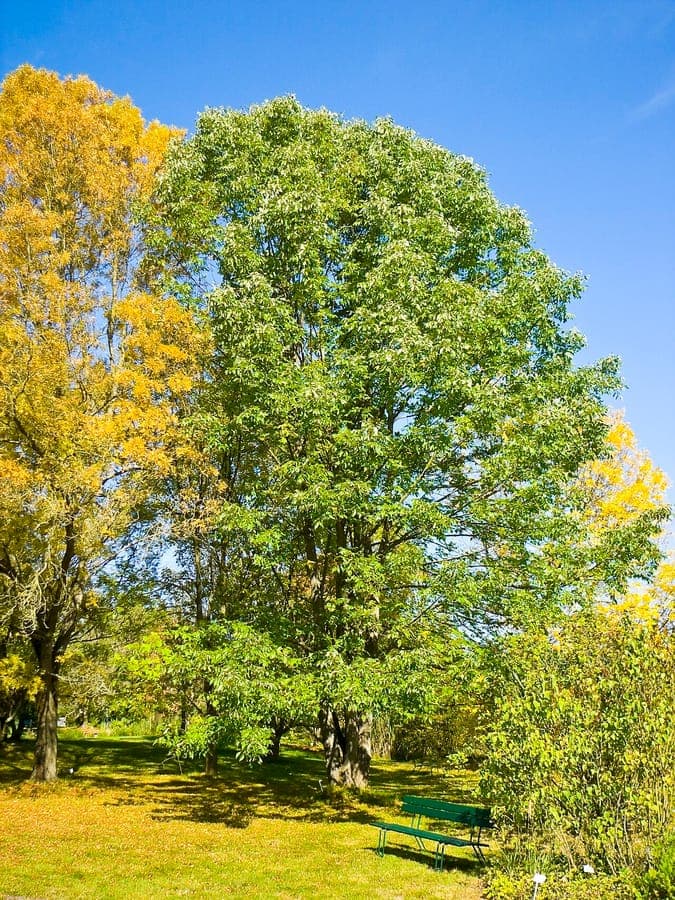
Willow / CC BY 2.5, via Wikimedia Commons
American ash: complete guide
Fraxinus americana
Want to see American ash: complete guide in your garden?
1 minute, no credit card
Overview
Fraxinus americana, commonly known as the American ash, is a stately deciduous tree native to eastern North America, thriving from Alabama to Iowa and into southern Canada. It's a long-lived, fast-growing species that can reach 20–30 metres in height with a spread of 12–18 metres at maturity, making it best suited for large gardens, parks, and open landscapes. If you're planning to introduce one into your garden, use gardenworld.app to visualise how its mature canopy and root zone will influence your layout-especially important when avoiding underground utilities or planning for future shade patterns.
Belonging to the Oleaceae family, the same as olives and lilacs, American ash stands out for its strong wood, upright habit, and clean branching structure. It's often confused with white ash (Fraxinus americana) and green ash (Fraxinus pennsylvanica), but its bark is smoother when young, turning into distinct diamond-shaped ridges as it ages. While historically widespread, this species is now under threat in North America from the emerald ash borer (Agrilus planipennis), an invasive beetle that has killed millions of trees. In Europe and the UK, the pest is still limited, but vigilance is key-inspect for D-shaped exit holes and canopy dieback.
Appearance & bloom cycle
The American ash features compound leaves up to 35 cm long, composed of 5 to 9 opposite, lance-shaped leaflets with finely serrated edges. New growth emerges a pale green in April, deepening to a glossy dark green by midsummer. One of its most striking features is the autumn colour: a brilliant golden yellow, sometimes edged with orange or russet, lasting well into November in mild climates.
Flowering occurs in April to early May, just before or alongside leaf emergence. The flowers are small, purplish-green, and not particularly showy, but they are an early nectar source for pollinators. Trees are dioecious, meaning male and female flowers grow on separate individuals. Female trees produce clusters of winged samaras ('keys') 2.5–5 cm long that ripen in late summer and disperse in autumn. These can self-seed in ideal conditions, though germination rates vary.
Ideal location
Plant your American ash in full sun (6+ hours of direct light) for optimal growth and dense canopy development. It tolerates partial shade, but growth slows and the crown becomes more open and less structured. Due to its size, allow at least 8–10 metres clearance from buildings, driveways, and underground pipes. Avoid planting under power lines-mature trees can interfere with overhead cables.
This species adapts well to urban conditions, including compacted soils and air pollution, making it suitable for streetscapes. However, it needs space for root expansion, so avoid tight tree pits. Use gardenworld.app to simulate mature tree spacing and ensure your garden design accommodates future growth without crowding other plants.
Free design
Want to see American ash: complete guide in your garden? Make a free design now.
Soil requirements
American ash thrives in moist, well-drained loam rich in organic matter, but it's adaptable to clay, sand, and even slightly alkaline soils. The ideal pH range is 4.7–7.5, so it grows well in both acidic and neutral conditions. Avoid waterlogged sites-prolonged saturation leads to root rot. In sandy soils, add compost at planting time to improve moisture retention.
When planting, dig a hole twice as wide as the root ball and mix in compost or well-rotted manure. Apply a 5–7 cm mulch ring around the base, keeping it 10 cm from the trunk to prevent collar rot. Mulching helps retain moisture and suppress weeds, especially critical in the first three years.
Watering
Young trees need consistent moisture-provide 20 litres per week during dry spells in their first two to three growing seasons. Use a slow-trickle hose or drip irrigation to encourage deep rooting. Once established, American ash is moderately drought-tolerant but benefits from deep watering during prolonged dry periods (4+ weeks without rain), particularly in USDA zones 6–9 during summer.
Signs of drought stress include premature leaf drop, browning leaf margins, and reduced growth. Avoid frequent shallow watering, which promotes weak surface roots.
Pruning
Pruning is minimal. Remove dead, damaged, or crossing branches in late winter or early spring before bud break. Avoid summer pruning to reduce the risk of attracting emerald ash borer. Use clean, sharp tools and make clean cuts just outside the branch collar.
For structural training, prune young trees to establish a strong central leader and remove competing leaders. Gradually raise the crown by removing lower branches over several years, especially if used as a street tree.
Maintenance calendar
- January: Inspect for damaged branches; light pruning if needed
- February: Check trunk for insect damage or cankers
- March: Final pruning before bud swell
- April: Monitor for new growth and pests
- May: No action unless drought stress appears
- June: Observe for signs of borer activity or leaf discoloration
- July: Deep water during extended dry periods
- August: Continue monitoring; avoid fertilising
- September: Let fallen leaves decompose-natural mulch
- October: Collect excess debris; check for seed dispersal
- November: Protect young trunks with tree wrap if in deer-prone areas
- December: Winter inspection; ensure mulch is in place
Winter hardiness
American ash is hardy in USDA zones 3–9, surviving temperatures down to -40°C. In the UK (zones 7–8), it withstands winter with no issues. Young trees may benefit from tree guards to prevent rodent bark damage. Snow load rarely harms mature trees, but ice storms can break brittle limbs-prune weak crotches proactively.
Companion plants
Under the dense canopy, choose shade-tolerant, non-competitive species: epimedium, barrenwort, hosta, and native ferns like Dryopteris erythrosora. Avoid aggressive groundcovers like ivy, which can girdle the trunk. Plant companions at least 1.5 metres from the trunk to reduce root competition.
Closing
The American ash is a resilient, attractive tree that brings structure, shade, and seasonal drama to large landscapes. While threats like the emerald ash borer require caution, healthy trees with good cultural practices can thrive for decades. Purchase from reputable garden centres that certify pest-free stock-look for suppliers with clean plant passports. With proper placement and care, this tree will become a garden landmark. Plan wisely, and let gardenworld.app help you design around its future presence.
Want to see American ash: complete guide in your garden? Make a free design now.
Upload a photo, pick a style, and get a photorealistic design with plant list in under a minute.
No credit card required


Similar plants
Rough menodora: complete guide
Menodora scabra
Full guide to Menodora scabra: a drought-tolerant desert subshrub with bright yellow flowers, ideal for rock gardens and xeriscapes.
Fraxinus dipetala: complete guide
Fraxinus dipetala
California ash or two-petal ash from southwestern USA. Beautiful spring flowers, drought-tolerant. Experimental choice for warm Mediterranean front gardens.
Syringa komarowii: complete guide
Syringa komarowii
Syringa komarowii is a striking lilac from central China with elegant flower spikes and lovely foliage. Discover the complete care guide here.