
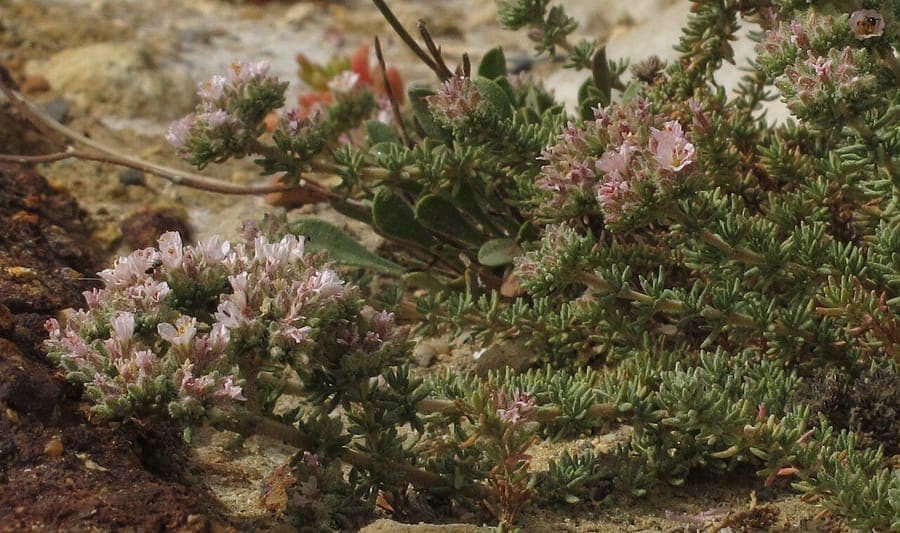
Robert Flogaus-Faust / CC BY 4.0, via Wikimedia Commons
Hairy Sea-heath: complete guide
Frankenia hirsuta
Want to see Hairy Sea-heath: complete guide in your garden?
1 minute, no credit card
Hairy sea-heath (Frankenia hirsuta) is an elegant Mediterranean dwarf shrub belonging to the Frankeniaceae family, originally native to the Mediterranean region through West Siberia. Reaching 30-60 cm in height, this remarkable plant is prized for its exceptional salt and drought tolerance, making it ideal for challenging garden locations. Its distinctive fine, hairy foliage creates a soft grey-green mound that contrasts beautifully with bolder-textured plants in your design.
The plant flowers from June through August, producing small, delicate pink to purple blossoms. Despite their modest size, these flowers attract pollinators and provide an extended blooming season. The hairy texture of the foliage serves a practical purpose, helping the plant conserve moisture during hot, dry periods.
Frankenia hirsuta thrives in coastal gardens and sandy, saline soils. It prefers very acidic to neutral sand with a pH between 7.5 and 8.0. This makes it exceptionally valuable for seaside properties or areas prone to salt spray. The plant requires full sun (9 hours of direct light) and thrives in very low humidity (3 on a 10-point scale), perfectly suited to Mediterranean garden schemes.
Soil preparation is crucial for success. Ensure excellent drainage by incorporating additional sand or shell fragments. This plant tolerates moderately poor soils (nutrient score 6) and moderately saline conditions (salinity score 6), meaning it performs well in many less-than-ideal garden situations without supplemental feeding.
Once established, watering needs are minimal. Frankenia hirsuta requires very little moisture due to its xeric adaptations. During the growing season (spring through early autumn), water only when soil is completely dry. Always avoid waterlogged conditions that can cause root rot in poorly drained locations.
Pruning is optional but light trimming after flowering encourages bushiness and fuller growth. Remove any dead or damaged wood in early spring. This low-maintenance approach suits modern garden management.
Hardiness: This plant survives in USDA zones 7-10, meaning it thrives in the Netherlands, Belgium, and southern Germany outdoors, though extremely cold winters may require protection. In France and Mediterranean regions, it grows without winter protection. Growth is very slow initially, so do not expect rapid development in the first seasons.
Companion planting works beautifully with other Mediterranean xerophytes such as lavender, rosemary, santolina, and dwarf citrus. This combination creates harmonious, water-efficient Mediterranean scenes perfect for gardenworld.app design projects.
Availability: Garden centres occasionally stock Frankenia species at Dutch retailers like Intratuin and Gamma, though Frankenia hirsuta is less common. Ask for "hairy sea-heath" or request it by botanical name. German retailers such as OBI and Hornbach occasionally source Mediterranean xerophytes through specialty suppliers. In France, check Truffaut or Jardiland, though stock varies. Gardenworld.app can help you source this rare plant and incorporate it meaningfully into your garden design.
Want to see Hairy Sea-heath: complete guide in your garden? Make a free design now.
Upload a photo, pick a style, and get a photorealistic design with plant list in under a minute.
No credit card required


Similar plants
Acer pycnanthum: complete guide
Acer pycnanthum
Acer pycnanthum, the Japanese swamp maple, is a fast-growing tree with early red flowers and brilliant autumn color, ideal for damp garden settings.
Freeman maple: complete guide
Acer × freemanii
Everything about the Freeman maple (Acer x freemanii): a fast-growing shade tree with spectacular autumn colour for large gardens.
Silver vine: complete guide
Actinidia polygama
Discover silver vine (Actinidia polygama): a hardy climbing plant with silvery foliage, loved by gardeners and cats alike.