
Sten Porse / CC BY-SA 3.0, via Wikimedia Commons
Alder buckthorn: complete guide
Frangula alnus
Want to see Alder buckthorn: complete guide in your garden?
1 minute, no credit card
Overview
Frangula alnus, commonly known as alder buckthorn, is a resilient native shrub or small tree that thrives in damp, shady spots across Europe. Growing 3 to 6 meters tall with a spread of 2 to 4 meters, it suits both formal and wild garden settings. Often found in wet woodlands, hedgerows, and stream banks, this plant brings quiet strength rather than flashy appeal. It's not a showstopper in bloom, but its ecological value is undeniable.
Alder buckthorn is fully hardy (USDA zones 4-8) and grows as a densely branched, upright shrub. While technically deciduous, it sometimes holds onto its leaves into early winter, especially in milder climates. The plant supports a wide range of insects and birds, making it a smart choice for gardeners aiming to boost biodiversity.
On gardenworld.app, you can design a planting scheme that integrates alder buckthorn seamlessly into damp corners or woodland edges.
Appearance & bloom cycle
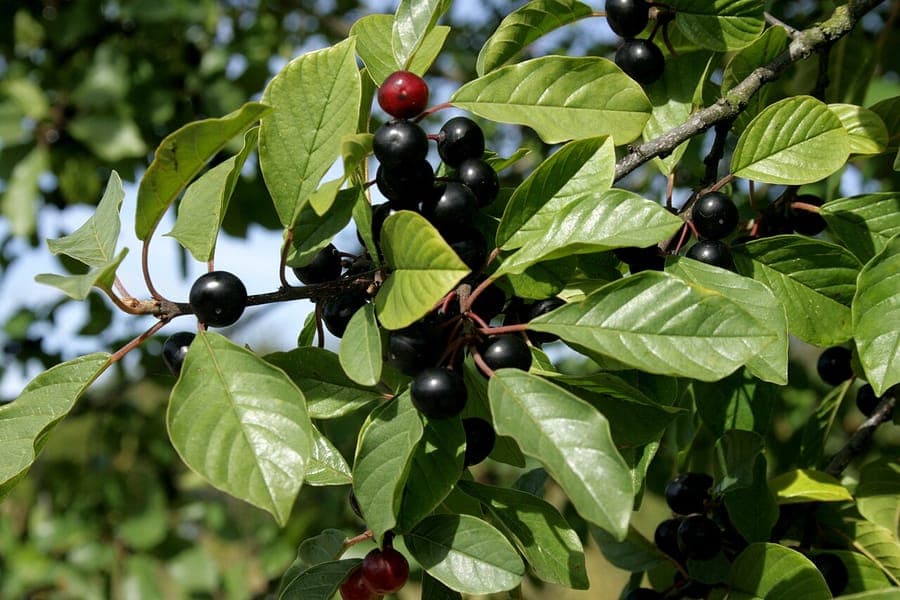
The plant features oval to lance-shaped leaves, dark green above and paler underneath, with distinctive curved lateral veins pointing toward the tip. New growth in spring shows a reddish tinge, adding subtle contrast.
From June to July, small, greenish-white flowers appear in clusters along the stems. Though inconspicuous, they attract bees, hoverflies, and small moths. After pollination, berries form-starting green, turning bright red, and finally maturing to a glossy black by late summer. These berries are mildly toxic to humans but are a favourite food for thrushes, blackbirds, and warblers.
In autumn, foliage may turn a soft yellow, though this isn't guaranteed. The bark is smooth and grey-brown, with distinctive lenticels and subtle ridges that become more pronounced with age.
Ideal location
Alder buckthorn prefers partial to full shade but tolerates full sun if soil moisture remains consistent. It's ideal for low-lying areas, pond margins, or under open-canopy trees. Avoid hot, dry south-facing spots.
For naturalistic planting, use it in wildlife hedges or as a background shrub in a damp mixed border. Allow at least 1.5 meters between plants for proper air circulation and growth. It can be pruned into a formal hedge, but left untrimmed, it develops a bushy, informal shape.
Soil requirements
This species thrives in moist, humus-rich soil with a pH between 5.0 and 6.5. It grows well in loam, silt, or sandy soils as long as they retain moisture. Avoid chalky or dry alkaline soils-these will stunt growth or kill the plant over time.
Heavy clay is acceptable if it doesn't remain waterlogged for weeks. Incorporate compost or well-rotted manure at planting to improve soil structure and nutrient content. Mulch annually in spring with leaf mould or bark chips to retain moisture and suppress weeds.
Free design
Want to see Alder buckthorn: complete guide in your garden? Make a free design now.
Watering
Water newly planted specimens weekly during the first two growing seasons, giving 10–15 litres per plant during dry spells. Once established, alder buckthorn relies on natural rainfall, though supplemental watering helps during prolonged droughts, especially in sandy soils.
Mulching is key in sunny or exposed sites to reduce evaporation. Check soil moisture by pushing your finger 5–10 cm deep-dry at that level means it's time to water.
Pruning
Pruning isn't required unless you're shaping a hedge. If so, trim in late winter or early spring (March) before new growth starts. Avoid cutting into old wood, as it may not resprout well.
For rejuvenation, cut one-third of the oldest stems down to 30 cm every few years. This encourages fresh, vigorous growth. Never prune between March and July to protect nesting birds.
Maintenance calendar
- Jan: inspect for winter damage
- Feb: prepare for pruning; check for bird nests
- Mar: prune if needed; apply mulch
- Apr: monitor new growth; water if dry
- May: growth accelerates; watch for aphids
- Jun: flowering begins; pollinators active
- Jul: fruit development; avoid pruning
- Aug: berries turn red, then black; keep clear of children
- Sep: birds feed on ripe berries; water during dry spells
- Oct: berry drop; leave some for wildlife
- Nov: leaf fall; mulch root zone
- Dec: final check for structural issues
Winter hardiness
Alder buckthorn is hardy to -30°C (USDA zone 4). It handles snow, ice, and wind well. Young plants may benefit from a thick mulch layer to protect shallow roots in exposed areas. No winter protection is needed beyond that.
Companion plants
Pair with moisture-loving natives like guelder rose (Viburnum opulus), dogwood (Cornus sanguinea), ferns (e.g., Dryopteris filix-mas), and meadowsweet (Filipendula ulmaria). Underplant with bluebells (Hyacinthoides non-scripta) or wood anemone (Anemone nemorosa) for spring interest.
For structure, combine with elder (Sambucus nigra) or willow (Salix spp.). On gardenworld.app, use the companion planner to match alder buckthorn with plants that share its soil and light needs.
Closing
Alder buckthorn won't win prizes for beauty, but it's a backbone plant for ecological gardens. It's tough, supports wildlife, and grows where many others fail. With minimal care, it becomes a long-term asset. Buy healthy stock from trusted garden centres like B&Q, Wyevale, or local nurseries that specialise in native species.
Want to see Alder buckthorn: complete guide in your garden? Make a free design now.
Upload a photo, pick a style, and get a photorealistic design with plant list in under a minute.
No credit card required


Similar plants
Point Reyes ceanothus: complete guide
Ceanothus gloriosus
The Point Reyes ceanothus is an evergreen Californian groundcover with blue flowers. Location, soil and pruning explained in detail.
Santa Barbara ceanothus: complete guide
Ceanothus impressus
Ceanothus impressus rewards a sunny wall with deep blue flowers in March-May. Location, soil, pruning and winter protection explained.
Redstem ceanothus: complete guide
Ceanothus sanguineus
Ceanothus sanguineus is a hardy, deciduous shrub with reddish stems and creamy white flower clusters in June. Care and companions.