
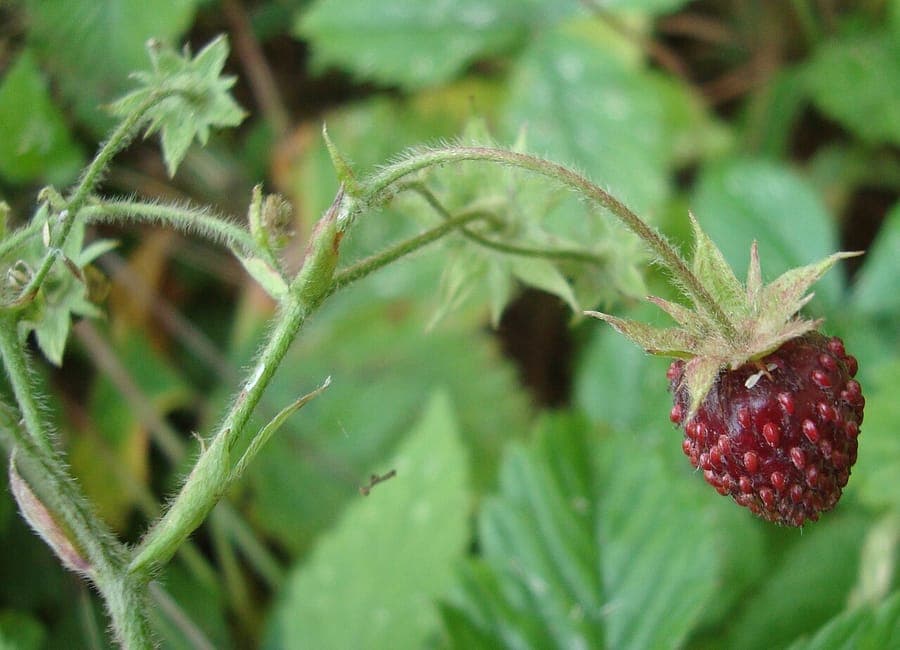
Dendrofil / Public domain, via Wikimedia Commons
Hautbois strawberry: complete guide
Fragaria moschata
Want to see Hautbois strawberry: complete guide in your garden?
1 minute, no credit card
Overview
Fragaria moschata, the Hautbois strawberry, stands apart from common garden varieties with its refined flavour and woodland charm. Native to forest clearings and damp slopes across central and eastern Europe, this perennial is perfect for gardeners seeking a more natural, low-maintenance aesthetic. Unlike the vigorous Fragaria × ananassa, it spreads slowly via runners and produces elongated, hollow berries with a musky, almost vinous sweetness. The scent is unforgettable-think wild strawberries warmed by sun, with a hint of spice. It's not the highest-yielding variety, but for taste and elegance, few match it. On gardenworld.app, you can design a planting scheme that fits the subtle spread of Hautbois strawberry in your shaded borders.
Appearance & bloom cycle
Growing 15–25 cm tall, this strawberry forms dense, low mats of softly hairy, trifoliate leaves that stay green until hard frosts. From April to June, delicate white to pale yellow flowers rise just above the foliage on slender stalks. Each bloom has five rounded petals and a bright yellow centre, attracting early pollinators like bees and hoverflies. The fruit follows in June, ripening to a deep, glossy red. Though smaller than commercial strawberries, they're prized for their intense aroma and complex flavour. The berries detach easily when ripe-a sign to harvest gently by hand.
Ideal location
Choose a spot with dappled shade to partial sun-around 6 on the light scale (10 being full summer sun). Avoid hot, south-facing beds that dry out quickly. A north-east facing border, under light tree canopy, or along a wooden fence works best. Full shade (below 4) reduces flowering; too much sun stresses the plant. In urban gardens, try planting beneath hazel or birch trees. Use gardenworld.app to assess your garden's light conditions and find the ideal microclimate for Fragaria moschata.
Soil requirements
This species thrives in rich, humus-rich soil with good drainage. The ideal pH is between 6.5 and 7. Avoid acidic soils below 6.0 and heavy clay without amending. When planting, mix in compost or well-rotted leaf mould to boost organic content. On sandy soils, add extra compost to improve moisture retention. Keep the root zone cool and moist-this plant dislikes drying out, especially in early summer.
Watering
Keep soil consistently moist but never waterlogged. Water deeply once a week during dry spells, preferably in the morning at the base of the plant. Avoid wetting the foliage to prevent powdery mildew. A 5 cm layer of organic mulch-like straw or leaf litter-helps retain moisture and suppress weeds. In prolonged droughts, increase to twice weekly for young plants.
Free design
Want to see Hautbois strawberry: complete guide in your garden? Make a free design now.
Pruning
Pruning is minimal. In early spring (March–April), remove any dead or damaged leaves with clean secateurs. After fruiting (July–August), trim back excessive runners to keep the mother plant strong. You can propagate new plants from healthy runners or gift them to fellow gardeners. Don't allow the patch to become overcrowded-this reduces air circulation and fruit yield.
Maintenance calendar
- Jan: Check for rotting foliage; maintain mulch layer
- Feb: Inspect for early pests; remove diseased material
- Mar: Cut back dead leaves; apply compost around crown
- Apr: Monitor for aphids; feed with organic fertiliser if needed
- May: Keep soil moist; hand-weed around plants
- Jun: Begin harvesting; increase watering in dry weather
- Jul: Trim excess runners; harvest final fruits
- Aug: Plant new runners; divide overcrowded patches
- Sep: Watch for leaf spot; remove infected leaves promptly
- Oct: Leave fallen leaves as natural mulch
- Nov: Protect young plants with straw if hard frost is forecast
- Dec: Minimal care; check for crown rot in wet winters
Winter hardiness
Fragaria moschata is hardy to USDA zone 5 (-20°C to -29°C), making it suitable for most of the UK, northern US, and Canada. Established plants survive winter without protection, but first-year plants benefit from a light mulch of straw or pine needles. Avoid plastic covers-they trap moisture and encourage rot. In wet winters, ensure good drainage to prevent crown drowning.
Companion plants
Pair with shade-tolerant perennials like Tiarella cordifolia, Geranium macrorrhizum, or Pulmonaria. Avoid invasive groundcovers like ivy. Under fruit trees (apple, pear), it makes an excellent edible ground cover. Interplant with chives or thyme to deter slugs and aphids. Its low, lush growth adds texture and seasonal interest to mixed borders.
Closing
The Hautbois strawberry rewards patience. It won't flood your basket with fruit, but what it lacks in quantity, it makes up for in quality. Its fragrance, beauty, and resilience make it a standout in naturalistic gardens. You can find it at garden centres like OBI and Hornbach in Germany, or Truffaut and Jardiland in France. In the UK, check independent nurseries or online specialists. Always ask for the botanical name-common labels can be misleading. With the right care and placement, Fragaria moschata will bring quiet delight to your garden for years.
Want to see Hautbois strawberry: complete guide in your garden? Make a free design now.
Upload a photo, pick a style, and get a photorealistic design with plant list in under a minute.
10,000+ gardens designed already
No credit card required


Similar plants
Siberian crab apple: complete guide
Malus x robusta
Complete guide to the Siberian crab apple (Malus x robusta): location, soil, pruning, winter hardiness and the best companion plants for your garden.
Chinese flowering crabapple (Malus x spectabilis): complete guide
Malus x spectabilis
Meet the Chinese flowering crabapple (Malus x spectabilis): a classic spring bloomer with carmine buds and pink blossom.
Potentilla crassinervia: complete guide
Potentilla crassinervia
Potentilla crassinervia, the Corsican cinquefoil, grows wild on Corsica and Sardinia's peaks. Discover how to grow this hardy alpine rock garden gem.