Jerzy Opioła / CC BY-SA 4.0, via Wikimedia Commons
Border forsythia: complete guide
Forsythia × intermedia
Want to see Border forsythia: complete guide in your garden?
Full design in HD: €7.99
Look after your Border forsythia with the GardenWorld app
Identify plants with your camera and get a care calendar with reminders for this plant.


Overview
Border forsythia (Forsythia × intermedia) is, for many people, the clearest sign that spring has arrived. In late March, while most shrubs are still bare, its branches suddenly fill with bright yellow flowers. You see it in front gardens, car parks, hedges and school grounds. Few shrubs are as familiar, as easy or as dependable.
Forsythia × intermedia is a hybrid between two Chinese species, Forsythia suspensa and Forsythia viridissima. The cross arose around 1880 in the botanic garden at Göttingen in Germany, and dozens of cultivars have been selected since. The best known are 'Lynwood' (also sold as 'Lynwood Gold'), with large, open flowers in clear golden yellow, and 'Spectabilis', which is free-flowering and vigorous. 'Week End' blooms very heavily, while 'Minigold' stays much more compact at about 1.5 m.
The common border forsythia grows 2 to 3 m tall and roughly as wide. It is upright, with long stems that arch slightly at the tips. You can grow it as a single shrub, as an informal hedge or as a clipped hedge. On gardenworld.app you can have a garden design made that gives forsythia a spot where it catches the eye in March and April without taking up too much room for the rest of the year.
Appearance and bloom cycle
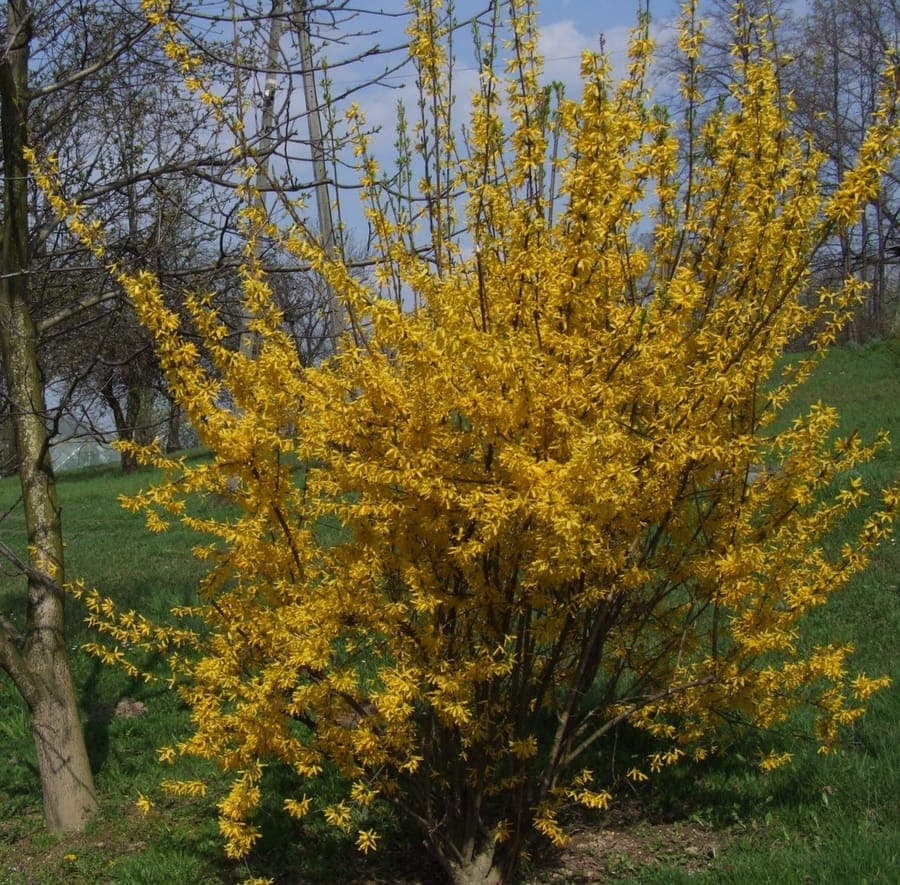
The flowers open before the leaves, which is what makes the display so striking: nothing but yellow on bare, grey-brown stems. Each flower has four narrow petals and measures 2.5 to 3.5 cm. They sit in ones to threes in the leaf axils along the full length of the previous year's shoots. The photo shows a mature, multi-stemmed shrub in full flower on a grassy slope, with leafless trees around it and a blue sky behind. That is what forsythia looks like across western Europe in early April.
Flowering usually starts in mid-March and lasts three to four weeks, into mid-April. A mild winter can bring it forward; a cold spring holds it back.
To be fair, forsythia offers little to bees and bumblebees. The flowers produce very little nectar or pollen. If you want to help pollinators too, pair it with plants that do, such as flowering currant or spring bulbs.
After flowering, oval to lance-shaped, toothed leaves of 6 to 12 cm appear. On vigorous shoots some leaves are divided into three. In summer the shrub is a fresh green mass. In autumn the leaves sometimes turn yellow-green to purplish, though the colour is rarely remarkable.
Ideal location
Forsythia flowers best in full sun. It grows well in partial shade too, but blooms less. In the shade of large trees it produces mostly leaves.
Wind, exposed sites and town gardens pose no problem, and it copes well with air pollution, which explains why it is so common in urban planting. Do give it enough room: a mature forsythia soon spreads to 2.5 m across. For an informal hedge plant two shrubs per metre; for a clipped hedge, three per metre.
A useful fact: stems that touch the ground often root where they land. That makes propagation easy, but it also means that arching branches in a narrow bed need shortening now and then.
Soil requirements
Forsythia × intermedia is undemanding. It grows in sand, loam and clay, from slightly acidic to chalky. Moisture-retentive but free-draining soil is ideal. It dislikes only ground that stays waterlogged for long periods.
Mix some compost into the soil at planting time. After that, a layer of compost in early spring is enough. Do not overfeed: lots of nitrogen gives long, leafy shoots and fewer flower buds.
Free preview
Want to see Border forsythia: complete guide in your garden? Make a free preview of your design.
Watering
In the first year after planting, water regularly, around 10 litres a week in dry weather, so the shrub develops a deep root system. After that, an established forsythia copes fine in a normal summer without extra water. Only in prolonged hot, dry spells, when the leaves start to droop, will it need a thorough soak. Drought in July and August can also reduce the number of flower buds for the following year.
A mulch of bark or leaf mould keeps the soil cool and moist and suppresses weeds at the base.
Pruning
With forsythia, timing is everything. The flower buds form in summer on young shoots and open the following spring. Prune in autumn or winter and you cut off next year's flowers.
So prune straight after flowering, in April or early May. For a free-standing shrub, thinning is the best approach: each year, cut about a third of the oldest, thickest stems right down to the ground. Also cut flowered shoots back to a young side shoot. This keeps the shrub open and encourages fresh growth from the base. Avoid shearing the whole shrub across the top, which creates a dense broom of upright shoots that flower only on the outside.
Clip a formal hedge once straight after flowering, and if needed lightly again in July. An old, neglected forsythia can be cut back to 30 cm above the ground in one go. It regrows quickly but will not flower again until the year after.
Maintenance calendar
January–February: Cut a few stems and bring them indoors in a vase. After a week or two the flowers open.
March–April: Full flower. Spread compost around the base.
April–May: Prune straight after flowering. Thin out the oldest stems and cut flowered shoots back.
June–August: Growing season. Next year's flower buds are forming. Water young plants in dry weather and give a clipped hedge a light trim in July if needed.
September–November: Good planting time. No more pruning.
December: Dormant. Bare-root and root-balled plants can go in as long as the ground is not frozen.
For an overview of every garden job through the year, take a look at the planting calendar on gardenworld.app.
Winter hardiness
Forsythia × intermedia is fully hardy and copes with temperatures down to about -25 °C (USDA zone 5). In Britain and the Low Countries it never needs winter protection. In exceptionally harsh winters the flower buds on the upper stems may be frosted, so the shrub only flowers lower down, but the plant itself stays healthy.
Forsythia is not known to be toxic to people or pets and does not appear on lists of poisonous garden plants. Nor is it invasive in Europe: it barely self-seeds. Pests and diseases are uncommon. You may occasionally see knobbly galls on the stems; simply cut them out.
Companion plants
Forsythia's yellow looks even brighter next to blue. Grape hyacinths (Muscari armeniacum) and Siberian squill (Scilla siberica) at its feet make a classic picture. Daffodils work too, but yellow on yellow is cheerful rather than striking.
Among shrubs, flowering currant (Ribes sanguineum) and Japanese quince (Chaenomeles speciosa) are good partners. They flower at the same time in pink and red and, unlike forsythia, are valuable for bees. Beneath the shrub, lesser periwinkle (Vinca minor) makes an evergreen ground cover with small blue flowers in April.
Because forsythia is a fairly plain green shrub after flowering, add summer interest nearby, such as a buddleja or hydrangea further along the border, so the spot still has colour in July.
Final thoughts
Forsythia × intermedia is one of the easiest shrubs there is. It grows in almost any soil, shrugs off wind and frost, and flowers every spring with a force few other shrubs can match. The one thing to remember: prune straight after flowering, and thin rather than shear.
Plant a forsythia where you can see it from the window in March, tuck blue bulbs around its base, and spring will start a little earlier at your place every year.
Frequently asked questions about Border forsythia
Is Border forsythia winter hardy?
Forsythia × intermedia is fully hardy and copes with temperatures down to about -25 °C (USDA zone 5). In Britain and the Low Countries it never needs winter protection.
When and how do you prune Border forsythia?
With forsythia, timing is everything. The flower buds form in summer on young shoots and open the following spring.
How much water does Border forsythia need?
In the first year after planting, water regularly, around 10 litres a week in dry weather, so the shrub develops a deep root system. After that, an established forsythia copes fine in a normal summer without extra water.
Where does Border forsythia grow best?
Forsythia flowers best in full sun. It grows well in partial shade too, but blooms less.
What soil does Border forsythia need?
Forsythia × intermedia is undemanding. It grows in sand, loam and clay, from slightly acidic to chalky.

See it in your garden
See Border forsythia in your garden
One photo of your garden and a few questions. You see the result in about a minute.
Try it with a photoIdentify this plant in your own garden. Identify a plant
Similar plants
Common grape-hyacinth: complete guide
Muscari armeniacum
Muscari armeniacum blooms in early spring with dense clusters of blue, grape-like flowers. Hardy, low-maintenance, and bee-friendly, it's perfect for borders, lawns, and naturalized plantings.
Scilla siberica: complete guide
Scilla siberica
Discover Scilla siberica, the Siberian squill - the most reliable and prolific early spring bulb. With vivid blue flowers that multiply readily, it creates stunning naturalized drifts and restores joy to winter-weary gardens.
Flowering currant: complete guide
Ribes sanguineum
Grow flowering currant: this American winter-blooming shrub reaches 2-3m with pink or red flowers from February to April, attracts wildlife.
