
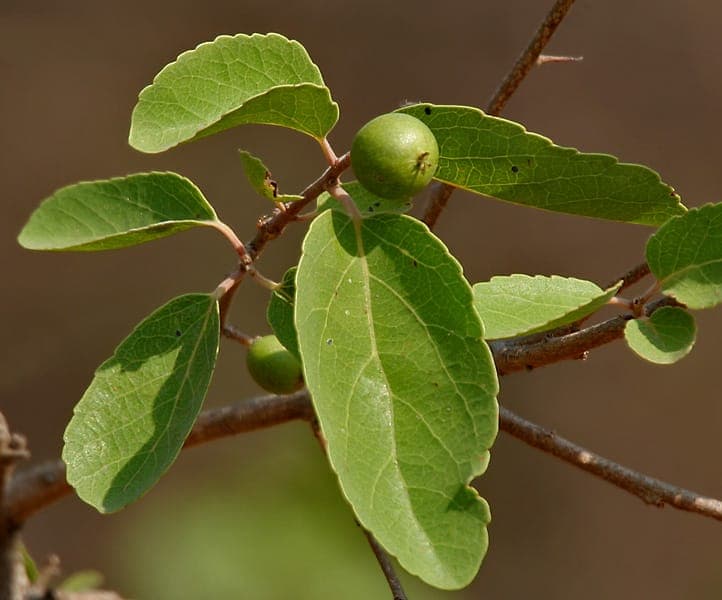
J.M.Garg / CC BY 3.0, via Wikimedia Commons
Governor's plum: complete guide
Flacourtia indica
Want to see Governor's plum: complete guide in your garden?
1 minute, no credit card
Governor's plum, scientifically Flacourtia indica, is a fruit tree from the Salicaceae family native to Africa and Asia. This compact tree is recognized for producing small, tart dark purple fruits reaching 1 to 2 centimeters in diameter. The tree grows to 3 to 5 meters tall, making it suitable for containers and smaller gardens in warm climates. Governor's plum offers both fruit production and ornamental appeal.
The tree produces numerous small yellow to white flowers that attract pollinators enthusiastically. Following bloom, many dark purple, almost black fruits develop featuring a tart to slightly sweet flavor. These fruits are edible and can be eaten fresh or processed into jam. The tree grows rapidly and can begin fruiting by its third year, making it attractive for gardeners wanting to cultivate exotic fruits.
Appearance
Governor's plum grows as a compact, densely foliaged tree or large shrub. The leaves are dark green, elliptical, approximately 5 to 10 centimeters long, and smooth. The tree has smooth grey-brown bark and produces thornless branches. Small flowers are yellow to white and appear in clusters. The fruits are round, dark purple to almost black, approximately 1 to 2 centimeters in diameter with thin flesh surrounding a hard seed.
Ideal location and light
Governor's plum performs best in full to partial sun. Position the tree where it receives at least 5 to 6 hours of direct sunlight daily. The tree tolerates partial shade but fruits better in full sun. Windy locations may be acceptable provided protection from strong winds exists. In containers, position the tree near a sunny window.
Soil and nutrition
Governor's plum grows in diverse soils from sand to clay provided they drain well. The tree thrives in well-draining, moderately fertile soil with pH 6.0 to 7.5. Heavy clay soils can be improved by adding sand and compost. The tree is not particularly fussy and accepts poor soils. In pots, universal potting soil amended with some sand works well.
Free design
Want to see Governor's plum: complete guide in your garden? Make a free design now.
Watering
Governor's plum requires regular watering, especially during the growing season and fruit set. Water when the top 2 to 3 centimeters of soil feels dry. In warm periods, daily watering may be necessary. In winter, watering can be reduced. Ensure water does not stagnate around roots. In dry climates, mulching helps retain soil moisture.
Pruning and maintenance
Governor's plum can be carefully pruned for shaping. Pruning during the growing season helps maintain a compact form. Remove crossing branches and dead material. The tree can also be trained as a shrub with multiple trunks. Pruning immediately after harvest helps prepare for the next season.
Maintenance calendar
March-May: Plant or repot the tree. Provide regular feeding with balanced fertilizer. June-August: Water regularly. Monitor flowering and fruit set. Prune as needed. September-October: Harvest fruit when dark purple and soft. Reduce fertilization. November-February: Winter dormancy period. Minimal watering. Careful pruning.
Winter hardiness
Governor's plum is not frost hardy in regions experiencing freezing. The tree cannot tolerate temperatures below 5 to 10 degrees Celsius. In cold regions, the tree must be kept indoors or well protected. In warm climates, it grows outdoors year-round. Winter protection using burlap can help in marginal zones.
Propagation
Governor's plum can be propagated from seed or semi-hardwood cuttings. Seed must be used fresh and dies quickly. Seed germination takes 4 to 6 weeks. Cuttings placed in moist soil root within 3 to 4 weeks under warmth. Cutting method produces faster flowering than seed.
Companion plants
Governor's plum combines well with other tropical fruit trees. Mango, avocado, and guava create lovely plant combinations. In containers, it can grow alongside other compact tropical plants. Underplanting with low-growing flowering plants adds visual interest.
Conclusion
Governor's plum represents a fascinating fruit tree for anyone wanting to grow exotic fruits in warm climates. With its compact growth, rapid fruit production, and ornamental appeal, it offers much gardening enjoyment. Available from specialized tropical fruit tree nurseries, particularly in warm regions. For colder climates, container cultivation proves ideal.
Want to see Governor's plum: complete guide in your garden? Make a free design now.
Upload a photo, pick a style, and get a photorealistic design with plant list in under a minute.
No credit card required


Similar plants
Grey poplar: complete guide
Populus x canescens
Everything about Populus x canescens - a fast-growing hybrid poplar with silver-grey foliage, ideal as a windbreak or specimen tree in large gardens.
Populus adenopoda: complete guide
Populus adenopoda
Chinese aspen: a fast-growing tree for large gardens. Cultivation tips, pruning, and use as windbreak or shade tree.
Populus fremontii: complete guide
Populus fremontii
Fremont's cottonwood is a majestic American tree with rapid growth and drought tolerance. Read our guide for cultivation tips and garden integration.