Louise Wolff --darina 00:12, 7 May 2005 (UTC) / CC BY-SA 3.0, via Wikimedia Commons
Nerve plant: care guide
Fittonia albivenis
Want to see Nerve plant: care guide in your garden?
Full design in HD: €7.99
Look after your Nerve plant with the GardenWorld app
Identify plants with your camera and get a care calendar with reminders for this plant.


Overview
The nerve plant (Fittonia albivenis) is a low, creeping houseplant from the acanthus family (Acanthaceae), and its leaves are some of the most graphic you can bring indoors. Each green leaf is covered in a fine network of white, pink or red veins, as if someone had drawn it with a thin pen. That is where the species name comes from: albivenis simply means "white-veined". In the wild it grows in the rainforests of Colombia, Ecuador, Peru, Bolivia and northern Brazil, creeping across the damp, shaded forest floor. You will also hear it called mosaic plant.
It is still often labelled with the old name Fittonia verschaffeltii. Growers divide the forms into two groups: the Argyroneura Group with silvery-white veins and the Verschaffeltii Group with pink to red veins. On top of that there are countless modern cultivars and miniature forms with leaves barely 2 to 3 cm long, bred for bottle gardens and terrariums.
The nerve plant is small, colourful and fairly forgiving, as long as you never let it dry out and keep it out of direct sun. If you want greenery to flow from indoors to out, you can have a garden design made at gardenworld.app for your patio or conservatory.
Appearance and flowering
The plant grows only 10 to 15 cm tall but easily spreads to 30 cm or more. Its stems are hairy and partly lie along the ground, rooting at the nodes. The leaves sit in opposite pairs, are oval with a blunt tip and reach 5 to 10 cm long on the ordinary form. They feel soft and slightly papery.
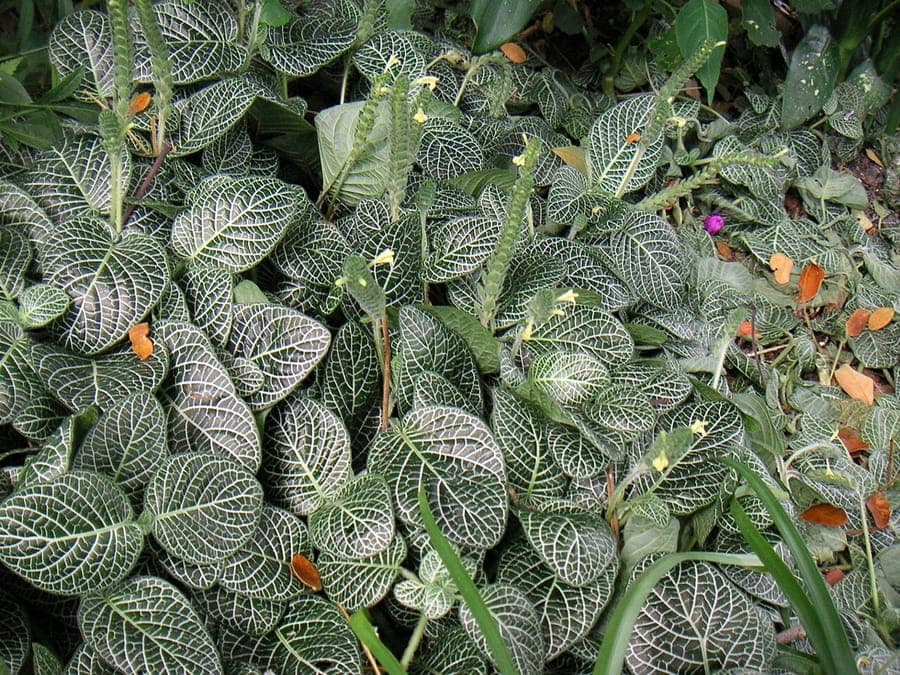
The photo shows a dense groundcover of dark green leaves with a bright white network of veins, growing outdoors in a tropical garden. Between the leaves stand upright, four-sided spikes packed with overlapping green bracts, with the occasional small, pale yellow flower peeping out. That is how the nerve plant flowers: modestly and without much fuss. Indoors it flowers less often. Many growers snip off the spikes, because the plant tends to become leggy and open after flowering.
The nerve plant is famous for fainting. When the compost gets too dry, every stem collapses over the rim of the pot at once. Water it promptly and it will stand up again within a few hours. It is a useful warning sign, but do not rely on it too often: each time, the plant loses a few lower leaves.
Where to put it indoors
A warm, draught-free spot with a steady temperature works best. Keep it off cold windowsills and out of the airflow from radiators or air conditioning. A bright bathroom, a kitchen with a north or east window, or a shelf some distance from a south-facing window are all good choices. Thanks to its low habit it is perfectly suited to a terrarium, a glass cloche or a bottle garden, where the air stays humid.
Light
Bright, indirect light to partial shade is ideal. Direct sun scorches the thin leaves within a few hours and bleaches the colours. In too little light the veins lose their contrast and the stems stretch. An east or north window is usually perfect. In a terrarium on a darker shelf you can add a small grow light and leave it on for about twelve hours a day.
Humidity
The nerve plant wants humidity of 60 % or more. In dry air the leaves develop brown, curled edges, which is exactly why it thrives in a terrarium. If it is in an open pot, stand it on a tray of moist clay pebbles, group it with other plants or run a humidifier. A light mist with soft water now and then does no harm, but the effect is brief and the leaves should never stay wet.
Potting mix and repotting
Use a fine, humus-rich houseplant compost that holds moisture while staying airy. Mix in about a fifth perlite for better drainage. In a closed terrarium, start with a layer of clay pebbles or gravel for drainage, add a thin layer of horticultural charcoal and only then the compost.
The roots are shallow, so a wide, low pot or bowl suits it best. Repot in spring when the plant outgrows its container, usually every other year. A pot 2 cm wider is enough. Older plants often go bare in the middle; it is better to replace them with fresh cuttings.
Free preview
Want to see Nerve plant: care guide in your garden? Make a free preview of your design.
Watering and feeding
Keep the compost evenly moist. Water as soon as the top centimetre feels dry, and never leave the pot standing in water: wet roots lead to rot. Rainwater, or water at room temperature that has stood overnight, is best, since cold, hard tap water suits it less well. In winter water a little less, but still do not let the compost dry out.
From April to September, feed every three to four weeks with liquid houseplant fertiliser at half strength. Too much feed burns the fine roots. In a closed terrarium feed very little or not at all, or the plant will quickly outgrow its space.
Propagation
Cuttings almost always succeed. In spring or summer take a tip cutting of 5 to 7 cm, strip off the lower leaves and stand it in water or moist cutting compost. Under a clear cover at around 21 °C it roots within two to three weeks. Even simpler: stems that have already rooted into the compost can be snipped off and potted up straight away. Regular pinching keeps the plant compact and full. Remove the flower spikes too if you want a dense, leafy plant.
Maintenance calendar
March-April: Repot if needed and start feeding. Pinch out the tips to encourage branching.
May-June: Best time for cuttings. Protect the plant from strong spring sun through the window.
July-August: Water regularly and check for thrips, mealybugs and spider mites. Remove flower spikes for a compact plant.
September-October: Stop feeding and move the plant to a slightly brighter spot.
November-February: Rest. Keep the compost lightly moist and the humidity high. Avoid cold windows and draughts. To keep track of everything, add watering, feeding and repotting to the planting calendar on gardenworld.app.
Temperature and winter care
The nerve plant is happiest at 18 to 25 °C. Below about 16 °C growth stops and it responds with leaf drop and limp stems. A cold draught, from a window left open for example, can do damage in a single night. It is not hardy and stays indoors all year. We would not move it outside in summer either: wind, sun and cool nights are too much for such a delicate plant.
Toxicity to pets
According to the ASPCA, the American animal welfare organisation with an extensive plant database, the nerve plant is non-toxic to dogs, cats and horses. No toxic compounds have been identified, and it is not poisonous to people either. That makes it popular in homes with animals. A cat that eats a lot of leaves may still get a mild stomach upset, so place the plant up high or inside a terrarium, where it is better protected anyway.
Companion plants
In a terrarium or a wide bowl the nerve plant teams up well with Selaginella kraussiana, the tiny leaves of Soleirolia soleirolii and the moss-like Pilea microphylla. A maidenhair fern (Adiantum raddianum) adds airy height above it. In a larger group on the windowsill it sits happily beside a bird's nest fern (Asplenium nidus), which wants the same humid air and soft light. Combine white-veined and red-veined forms for a playful mosaic. Keep succulents and cacti well apart, as they need the opposite treatment.
Final thoughts
The nerve plant is a small plant with a great deal of pattern. Give it indirect light, warmth, humid air and compost that never dries out, and it will stay fresh for years. Its fainting act when dry is a clear alarm signal, and because it roots so easily you can replace a tired plant without any trouble. For a terrarium or a humid bathroom there are few better choices.

See it in your garden
See Nerve plant in your garden
One photo of your garden and a few questions. You see the result in about a minute.
Try it with a photoIdentify this plant in your own garden. Identify a plant
Similar plants
Krauss Spikemoss (Selaginella kraussiana): complete guide
Selaginella kraussiana
Krauss spikemoss is an elegant, moss-like plant ideal for shade gardens. Learn about cultivation, care, and design integration.
Soleirolia soleirolii: complete guide
Soleirolia soleirolii
Soleirolia soleirolii, the baby's-tears or Corsican carpet, is a delicate trailing plant with tiny leaves. Learn care requirements and humidity management.
Pilea microphylla: complete guide
Pilea microphylla
The Artillery plant is a charming tropical houseplant with fine foliage and unique flowering mechanism. Perfect for indoor planting and easy care requirements.
