
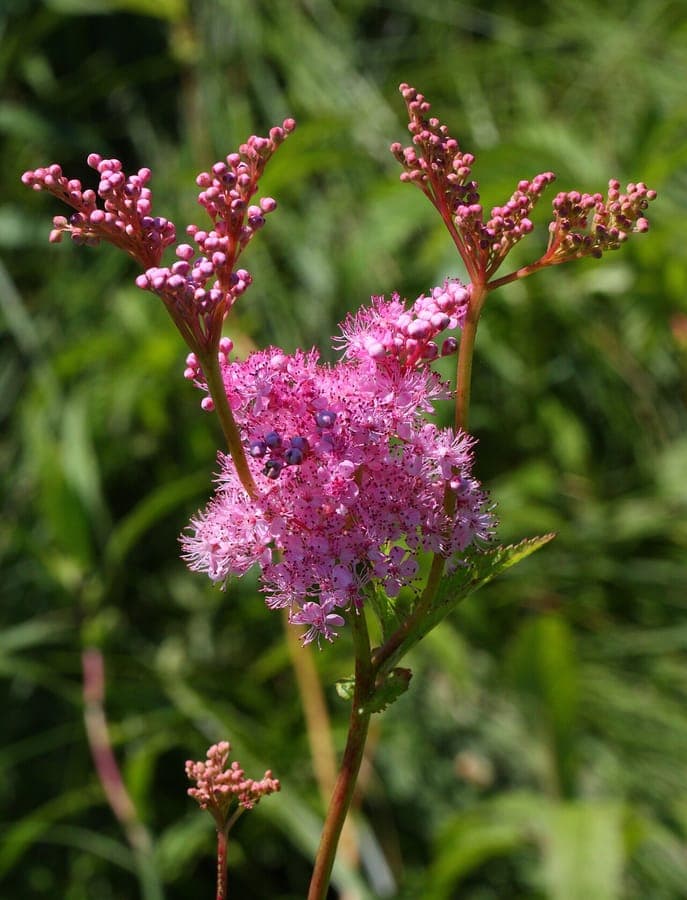
Bruce Marlin / CC BY-SA 3.0, via Wikimedia Commons
Filipendula rubra: complete guide
Filipendula rubra
Want to see Filipendula rubra: complete guide in your garden?
1 minute, no credit card
Overview
Filipendula rubra, better known as Queen of the Prairie or Red Meadowsweet, is a spectacular flowering perennial from eastern North America. This plant from the rose family naturally grows in wet meadows and marsh edges from Illinois and Kentucky to Vermont and North Carolina.
This is a very impressive, visually striking plant that grows to 1.5-2 meters tall with beautiful, finely-cut foliage and very attractive pink flowers in plumes. It is ideal for water features, bog gardens, pond banks, and other wet locations where most plants refuse to grow.
Appearance & bloom
Filipendula rubra creates an impressive silhouette in the garden. The plant reaches 120-180 centimeters height, with delicate feathery, thoroughly divided leaves that can be 30-40 centimeters long. The foliage is dark green with a very ornamental, fine texture.
Flowers appear in June-July in large, feathery, loose panicles at the branch tips. These are not dense like coral, but rather loosely branched and very ornamental. The color is deep pink to red-pink - in the cultivar 'Venusta', this is even deeper red.
After flowering, small seed capsules develop that turn yellowish. The seed fruits themselves are still decorative.
Ideal location
Filipendula rubra thrives best in full sun to light shade. Minimum 4-5 hours direct sunlight daily promotes optimal blooming. In very hot climates, light afternoon shade prevents plant desiccation.
Most important is moisture - this plant is a true bog-dweller. Plant it along water features, in bog gardens, or other wet locations. It performs poorly in dry soil.
Protection from strong wind is useful, because the long, slender stems can bend. Don't plant it in an exposed position.
Soil
Filipendula rubra requires nutrient-rich, very moist to wet soil. This is the key to success. Heavy clay soils are actually ideal - not very pleasant to work with, but moist.
Add lots of organic matter - peat moss, decomposition products, compost. This helps with moisture retention and nutrition. The plant thrives in slightly acidic to neutral soils (pH 6.0-7.5).
Poor, dry soil will result in sparse growth and poor blooming. Provide nutrient-rich, moist soil.
Watering
Filipendula rubra requires lots of water. This is not a plant for dry gardens. Keep soil consistently moist throughout the growing season - not wetter than a marsh, but certainly not dry.
In dry periods, water daily in warm seasons. In wet soils, you can water less frequently, but consistent moisture feel is essential.
In very wet situations (pond margins, bog soils), the plant can grow without any supplemental water - in fact, it feels at home in wet conditions.
Free design
Want to see Filipendula rubra: complete guide in your garden? Make a free design now.
Pruning
Filipendula rubra requires very little maintenance. Cut off faded flowers after blooming is over (August) for a neater appearance. This also promotes a second, lighter bloom in September.
In spring, remove dead stems when temperature is consistently above freezing. Cut back to ground level. The plant will re-emerge naturally.
You can enjoy seed formation without cutting - this provides winter interest.
Maintenance calendar
Spring (March-May): Cut back dead stems in March. Give feeding in April with organic fertilizer. Monitor water levels - check that moisture conditions are good. No further maintenance.
Summer (June-August): Enjoy blooming in June-July. Water in dry periods. Cut off faded flowers in August. Plant thrives in heat.
Autumn (September-October): Seed capsules remain for fall interest. Plant dies back in autumn. Leave stems standing until March.
Winter (November-February): Dead stems stand in garden for winter structure. Cut back in March. Plant survives without trouble.
Winter hardiness
Filipendula rubra is VERY winter hardy. This is a North American native plant that tolerates temperatures down to -30 degrees Celsius. In zones 3-8, it grows without trouble.
Frost is absolutely not a problem - in fact, the plant seems to require winter to grow well. Without a cold period, blooming can be poor.
In very warm climates (zone 9 and warmer), the plant may not perform as well - it prefers temperate climates.
Companion plants
Filipendula rubra combines beautifully with other moisture lovers: Astilbe, Hosta, Carex, Iris laevigata, Lysichton, other Filipendula species. The tall, ornamental form provides excellent contrast against low-growing partners.
In bog landscapes, this is a top choice - together with native sedges, joe-pye-weed, and other water plants, it creates a very attractive ecosystem feel.
As a solitary specimen in a wet border, the plant draws real attention.
Closing
Filipendula rubra is a true showstopper for the right location - somewhere moist and nutrient-rich. This plant performs poorly in normal, dry soil, so provide the right growing conditions.
Once properly placed, these plants grow for years with minimal maintenance. The spectacular blooming and ornamental foliage make all the effort worthwhile.
Available from specialized water plant nurseries and native plant growers. Plant in moist soil; avoid dry locations. Expect success in temperate climates.
Want to see Filipendula rubra: complete guide in your garden? Make a free design now.
Upload a photo, pick a style, and get a photorealistic design with plant list in under a minute.
No credit card required


Similar plants
Siberian crab apple: complete guide
Malus x robusta
Complete guide to the Siberian crab apple (Malus x robusta): location, soil, pruning, winter hardiness and the best companion plants for your garden.
Chinese flowering crabapple (Malus x spectabilis): complete guide
Malus x spectabilis
Meet the Chinese flowering crabapple (Malus x spectabilis): a classic spring bloomer with carmine buds and pink blossom.
Potentilla crassinervia: complete guide
Potentilla crassinervia
Potentilla crassinervia, the Corsican cinquefoil, grows wild on Corsica and Sardinia's peaks. Discover how to grow this hardy alpine rock garden gem.