
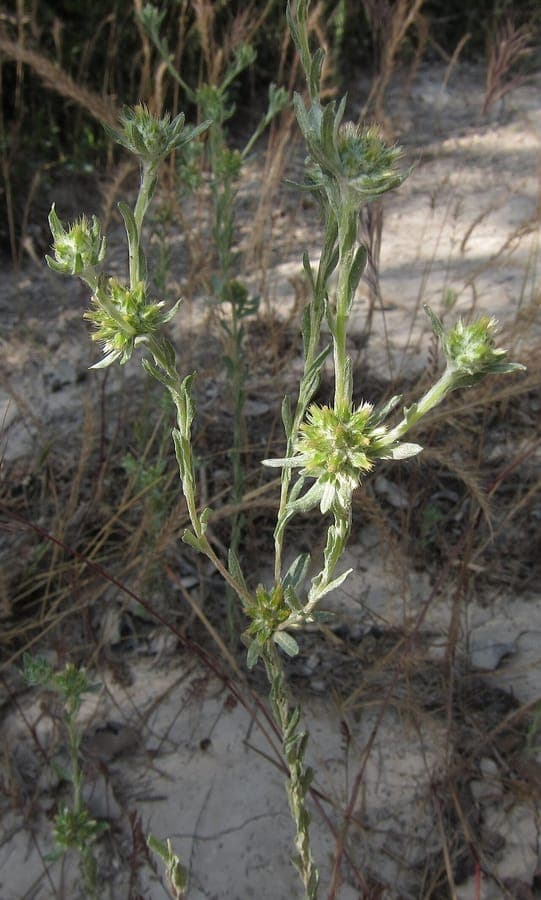
Alogiraf / CC BY-SA 3.0, via Wikimedia Commons
Broad-leaved cudweed: complete guide
Filago pyramidata
Want to see Broad-leaved cudweed: complete guide in your garden?
1 minute, no credit card
Overview
Filago pyramidata, commonly known as broad-leaved cudweed, is a humble yet distinctive annual forb that thrives where most plants struggle. Native to southern Europe and parts of North Africa-including regions like the Balearic Islands, Corsica, and Algeria-it has adapted to harsh, dry environments. While not commonly sold in mainstream garden centres, it occasionally pops up in wildflower mixes or appears spontaneously in gravel paths and rock gardens. Its low profile and unassuming nature make it easy to overlook, but for gardeners seeking resilience and subtle texture, it's a quiet winner.
This plant belongs to the Asteraceae family, sharing structural traits with daisies and asters, though its flowers are far more subdued. It grows as a soft, woolly herb with a spreading habit, reaching heights between 10 and 25 cm. The silvery foliage and cotton-like flower heads give it a unique presence in dry, open settings. It's ideal for naturalistic planting schemes or low-water gardens where character matters more than flash.
On gardenworld.app, you can design a garden layout that highlights drought-tolerant species like broad-leaved cudweed, especially in xeriscaped or gravel-based designs.
Appearance & bloom cycle
Broad-leaved cudweed forms a low, mat-like clump with densely packed, spatulate leaves covered in fine, grey-white hairs. These give the plant a velvety, felt-like texture-hence the common name 'cudweed'. The leaves are typically 2–5 cm long and arranged in a basal rosette, with upright stems emerging in summer.
From July to September, small yellow flower heads appear, nestled within woolly, white bracts that resemble tiny tufts of cotton. The actual flowers are tiny and yellow, barely visible beneath the protective bracts. Each head is about 3–5 mm wide, clustered at the tips of slender stems. While not showy, they attract small pollinators like hoverflies and tiny bees.
As an annual, it completes its life cycle in one season: germinating in spring, flowering mid-summer, setting seed in autumn, and dying off. Its seeds are lightweight and wind-dispersed, allowing it to reappear year after year if conditions are right.
Ideal location
Full sun is essential. This plant needs at least 6 hours of direct sunlight daily to thrive. It performs best in hot, exposed spots-rock crevices, dry borders, gravel paths, or between stepping stones. Partial shade leads to leggy growth and reduced flowering.
It's perfect for low-water gardens, Mediterranean-style plantings, or wildlife-focused designs. Avoid shaded, moist areas. If you're designing a drought-resistant garden, broad-leaved cudweed fits seamlessly into the aesthetic. On gardenworld.app, you can experiment with plant combinations that include Filago pyramidata for texture and resilience.
Free design
Want to see Broad-leaved cudweed: complete guide in your garden? Make a free design now.
Soil requirements
It demands poor, well-drained soil. Rich, fertile, or water-retentive soils are detrimental. Ideal conditions include sandy, gravelly, or stony substrates with minimal organic matter. A pH range of 5.5 to 7.5 is acceptable-neutral to slightly acidic or alkaline soils work fine, as long as drainage is excellent.
If amending soil, mix in sharp sand or fine gravel to improve drainage. Avoid compost or manure, which promote lush growth and increase susceptibility to rot.
Watering
Once established, broad-leaved cudweed requires no supplemental watering. It's highly drought-tolerant and survives prolonged dry spells. Overwatering is the fastest way to kill it-excess moisture leads to root rot and fungal issues.
During germination and early seedling stages, light watering may help, but reduce it as the plant matures. In containers, ensure pots have drainage holes and allow the soil to dry completely between waterings.
Pruning
No pruning is necessary. The plant maintains a neat, compact form naturally. If you want to limit self-seeding, deadhead spent flower stalks before seeds mature. Otherwise, leave it be-the seed heads add winter interest and may support small insects.
Maintenance calendar
- January–March: Dormant period. No action needed.
- April: Check for natural germination. Thin seedlings if overcrowded.
- May–June: Seedlings establish. Keep soil dry; avoid overwatering.
- July–August: Peak bloom. Monitor for pollinator activity.
- September: Flowers fade. Begin seed dispersal.
- October–December: Plant dies back. Leave debris for texture or clear for tidiness.
Winter hardiness
As an annual, broad-leaved cudweed does not survive winter. It dies after setting seed. However, it often reappears the following year through self-seeding, especially in USDA hardiness zones 7–10. In milder climates (zone 8+), fall-germinated seedlings may overwinter, but they're not reliably hardy.
No winter protection is needed. Let nature take its course.
Companion plants
Pair with other drought-tolerant species: Thymus vulgaris, Sedum spp., Achillea millefolium, or Helichrysum. These share similar needs-full sun, lean soil, and infrequent watering. The silver foliage of Filago contrasts nicely with darker greens or golden hues.
Avoid pairing with moisture-loving plants like hostas or ferns, which create incompatible growing conditions. Also steer clear of aggressive spreaders that could smother its delicate form.
While not widely stocked, some specialist seed suppliers and online retailers offer Filago pyramidata. In the UK and US, check independent nurseries or order seeds online. Mainstream garden centres rarely carry it, but related species may be available.
Closing
Broad-leaved cudweed isn't a plant for those chasing bold colours or dramatic blooms. It's for gardeners who appreciate texture, resilience, and the quiet beauty of plants that thrive with almost no help. It's a testament to what can grow in the harshest spots-between stones, on poor soil, under relentless sun. If you're designing a low-maintenance, ecologically sound garden, this unassuming annual deserves a place. Let it weave its soft, silvery presence into the fabric of your outdoor space.
Want to see Broad-leaved cudweed: complete guide in your garden? Make a free design now.
Upload a photo, pick a style, and get a photorealistic design with plant list in under a minute.
No credit card required


Similar plants
Calendula stellata: complete guide
Calendula stellata
Complete guide to Calendula stellata, the star-flowered marigold from Sicily: location, soil, watering and companion planting tips.
Korean chrysanthemum: complete guide
Chrysanthemum x rubellum
Chrysanthemum x rubellum is a hardy autumn perennial with single pink to copper flowers from August to November. Care and combinations.
Helianthus divaricatus: complete guide
Helianthus divaricatus
Helianthus divaricatus is a North American woodland sunflower with yellow summer blooms, ideal for naturalistic borders and shady edges.