
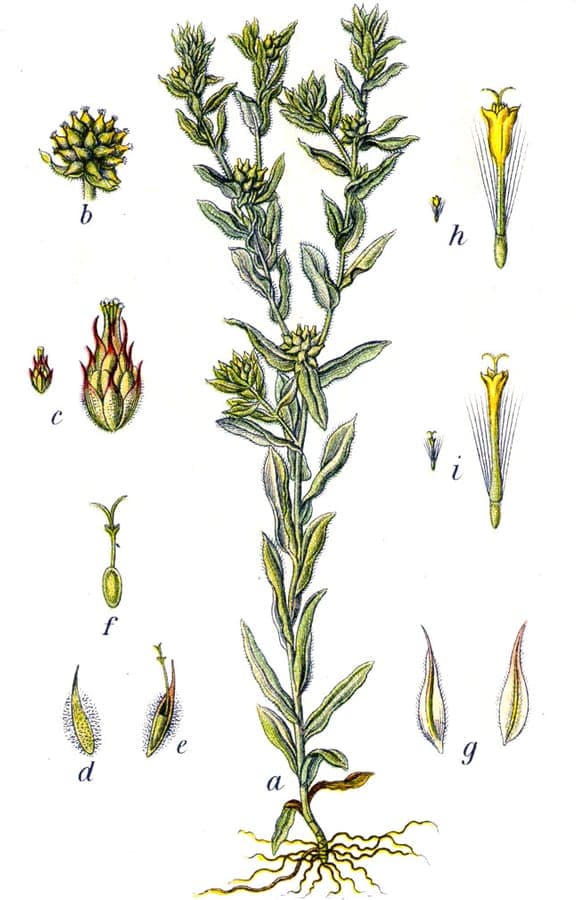
Johann Georg Sturm (Painter: Jacob Sturm) / Public domain, via Wikimedia Commons
Broad-leaved cudweed: complete guide
Filago germanica
Want to see Broad-leaved cudweed: complete guide in your garden?
1 minute, no credit card
Overview
Broad-leaved cudweed (Filago germanica) is a fascinating annual plant from the Asteraceae family, also known as "common cudweed" and "Broadleaf cottonrose". This species is native to Europe, North Africa, and Central Asia. The plant contributes distinctive textural qualities to garden designs with its unique silvery appearance and compact growth habit.
Appearance & Bloom
Broad-leaved cudweed grows to a height of 15 to 30 centimeters. The plant features characteristic woolly, gray-green leaves densely packed along the stems. Flowers are small, yellow to greenish-yellow in color, and grow in compact clusters at the branch tips. The entire plant exhibits a silvery, felted appearance due to fine hairs covering the leaves and stems.
Ideal Location
Select a position with full sun to light shade for this plant. At least six hours of direct sunlight daily produces optimal growth. The plant tolerates various garden locations well and thrives along garden borders, in containers, or as groundcover. Self-seeding frequently creates new plants.
Soil
Broad-leaved cudweed is not fussy about soil type. It grows in virtually all soil types from sandy to loamy, as long as drainage is good. The plant tolerates poor, nutrient-deficient soils excellently and often flowers more profusely in leaner soils. A neutral to slightly acidic pH is ideal.
Free design
Want to see Broad-leaved cudweed: complete guide in your garden? Make a free design now.
Watering
This plant tolerates drought well thanks to its woolly leaves that limit water loss. Water regularly during the growing season, especially in dry periods, but always ensure good drainage. Excessive moisture can lead to fungal diseases. Seedlings need extra drainage during wet winters.
Pruning
Pruning is not really necessary for this plant. You can remove withered flower clusters for a neater appearance. For self-seeding, allow some flowers to dry in place. If the plant becomes too large, you can cut it back in early spring.
Maintenance Calendar
March-April: sow seeds directly in garden beds. May-June: first flowers appear. July-September: full bloom period. October-November: seed production, allow seeds to dry. December-February: plant dies after first hard frost.
Winter Hardiness
Broad-leaved cudweed is not winter-hardy. It is an annual that does not survive the first hard frost. After blooming and seed production, the plant dies naturally. This is normal and part of its lifecycle. However, seeds can survive winter and germinate naturally in spring.
Companion Plants
Eulalia japonica and Stipa tenuissima provide beautiful textural contrast. Combine broad-leaved cudweed with campanula, senecio, and artemisia for Mediterranean garden style. The woolly foliage creates stunning contrast with darker-colored flowers.
Closing
Broad-leaved cudweed brings simplicity and charm to your front garden. With minimal care requirements and attractive form, it is ideal for beginning gardeners. Available at garden centers across Europe. Find more at gardenworld.app/nl and gardenworld.app/en.
Want to see Broad-leaved cudweed: complete guide in your garden? Make a free design now.
Upload a photo, pick a style, and get a photorealistic design with plant list in under a minute.
No credit card required


Similar plants
Calendula stellata: complete guide
Calendula stellata
Complete guide to Calendula stellata, the star-flowered marigold from Sicily: location, soil, watering and companion planting tips.
Korean chrysanthemum: complete guide
Chrysanthemum x rubellum
Chrysanthemum x rubellum is a hardy autumn perennial with single pink to copper flowers from August to November. Care and combinations.
Helianthus divaricatus: complete guide
Helianthus divaricatus
Helianthus divaricatus is a North American woodland sunflower with yellow summer blooms, ideal for naturalistic borders and shady edges.