
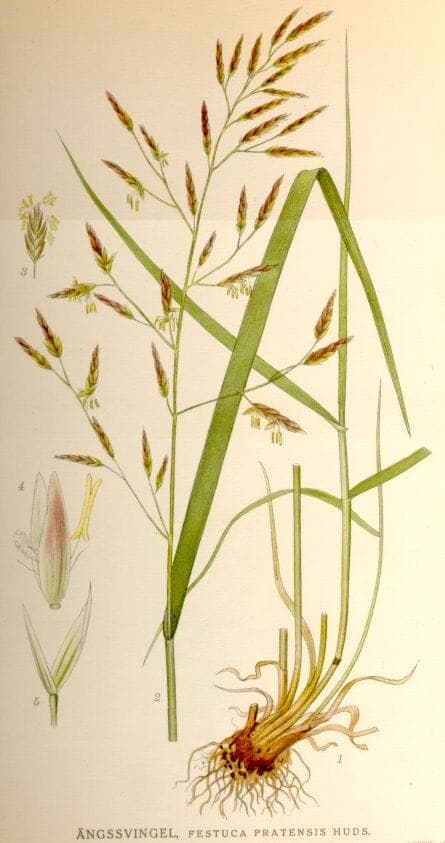
Wikimedia Commons / Public domain, via Wikimedia Commons
Meadow fescue: complete guide
Festuca pratensis
Want to see Meadow fescue: complete guide in your garden?
1 minute, no credit card
Overview
Meadow fescue (Festuca pratensis) is a hardy, clump-forming grass in the Poaceae family, native to European meadows and widely naturalised across temperate regions. Unlike some of its more aggressive relatives, it maintains a neat, upright habit and adds fine texture and movement to garden designs. Standing between 60 and 90 cm tall, it's ideal for borders, meadow plantings, or as a structural element in naturalistic schemes.
Gardeners appreciate meadow fescue not just for its looks, but for its resilience. It's unfussy about soil, tolerates moderate drought once established, and rarely suffers from pests or disease. It also provides shelter and overwintering sites for beneficial insects. If you're planning a new planting, gardenworld.app lets you visualise how meadow fescue fits into your overall garden layout, helping you balance height, texture and seasonal interest.
Appearance & bloom cycle
This grass forms dense tufts of bright green, narrow leaves that grow 30–50 cm long. In early summer-typically from late May to July-it sends up airy panicles on slender stems, reaching up to 100 cm. The flowers start silvery-green and mature to a soft grey or beige, catching the light beautifully in morning and evening sun. The bloom lasts four to six weeks, after which the seed heads persist into autumn, gradually fading to a warm straw colour.
Even in winter, the dried foliage remains upright, adding structure and subtle movement to the dormant garden. Unlike fluffy ornamental grasses that collapse under snow, meadow fescue holds its shape well, making it a reliable choice for year-round appeal.
Ideal location
Full sun is best-aim for at least 6 hours of direct light daily. Meadow fescue will tolerate light shade, especially in hotter southern regions, but in low light, the clumps become looser and may flop. Plant it where it can sway freely in the breeze, such as in a mixed border, wildflower meadow, or on a dry slope.
It's also suitable for large containers, provided they're at least 40 cm wide and have good drainage. Avoid crowded spots where airflow is limited, as this can encourage fungal issues. For gardeners in the UK and northern Europe, this grass works well in coastal areas too, as long as salt spray isn't excessive.
Soil requirements
Meadow fescue thrives in average, well-drained soil. It adapts to sandy, loamy, or clay soils as long as water doesn't pool around the roots. The ideal pH range is 5.5 to 7.5-slightly acidic to neutral. Avoid overly rich soils or heavy fertilisation, which promote weak, floppy growth.
If you're planting in heavy clay, mix in some horticultural grit or composted bark to improve drainage. In sandy soils, a light application of compost helps retain moisture during establishment. But remember: this grass evolved in nutrient-poor meadows, so less is more when it comes to feeding.
Free design
Want to see Meadow fescue: complete guide in your garden? Make a free design now.
Watering
Once established-usually after 6 to 8 weeks-meadow fescue is drought-tolerant and rarely needs supplemental watering. During its first growing season, water weekly in dry spells, giving each plant about 5–10 litres. Use rainwater when possible, as the grass is adapted to natural conditions and doesn't benefit from chlorinated tap water.
In prolonged dry summers, the leaves may curl slightly or turn grey-green, but this is a survival mechanism, not a sign of distress. The plant will bounce back quickly after rainfall. Never let the roots sit in waterlogged soil-this is the main cause of failure.
Pruning
No pruning is needed during the growing season. However, in late winter or early spring (February to March), cut back the previous year's foliage to about 15–20 cm above ground level. This clears space for fresh growth and prevents the centre of the clump from becoming congested.
Use sharp shears or a grass hook for best results. Leave the cut material on-site for a few days if you want to provide shelter for overwintering insects, then remove or compost it. Avoid cutting too late into spring, as new shoots may already be emerging.
Maintenance calendar
- January: Check clumps for winter damage. Leave old growth intact.
- February: Begin cutting back dead foliage.
- March: Complete pruning. Watch for slugs near new shoots.
- April: New growth appears. No feeding required.
- May: Growth accelerates. Monitor for dry spells.
- June: Flowering begins. Ensure good air circulation.
- July: Peak bloom. Admire the airy panicles.
- August: Flowers fade. Seed heads persist.
- September: No action needed.
- October: Leave standing for winter interest.
- November: Structure remains. No pruning.
- December: Dried grass adds texture to winter scenes.
Winter hardiness
Meadow fescue is fully hardy in USDA zones 4 to 8 (-34°C to -12°C). It tolerates frost, snow, and cold winds without protection. The foliage browns but stays upright, providing visual interest and habitat. In milder climates, it may remain semi-evergreen.
The only real threat is winter wet. If your garden has poor drainage, consider planting on a slight mound or raised bed to keep the crown dry.
Companion plants
Pair meadow fescue with other grasses like Deschampsia cespitosa or Stipa gigantea for contrast in texture and height. It also complements bold perennials such as Echinacea, Rudbeckia, or Salvia nemorosa. For a natural meadow look, mix with native wildflowers like knapweed (Centaurea nigra) or field scabious (Knautia arvensis).
Avoid invasive groundcovers or vigorous spreaders like mint or dead-nettle, which can overwhelm the grass. Stick to clump-forming plants that respect boundaries.
Closing
Meadow fescue is a quiet achiever in the garden-unfussy, elegant, and ecologically valuable. It asks for little but gives back in movement, texture, and year-round structure. Whether you're creating a low-maintenance border or restoring a native meadow, this grass is a dependable choice. Pick healthy specimens from reputable garden centres, and use gardenworld.app to plan your planting for maximum impact and harmony.
Want to see Meadow fescue: complete guide in your garden? Make a free design now.
Upload a photo, pick a style, and get a photorealistic design with plant list in under a minute.
No credit card required


Similar plants
Sporobolus pungens: complete guide
Sporobolus pungens
Sporobolus pungens is a stoloniferous Mediterranean coastal grass with outstanding salt and drought tolerance, perfect for seaside and dry gardens.
Mediterranean aegilops: complete guide
Aegilops biuncialis
Everything about Aegilops biuncialis, a Mediterranean annual grass with ornamental spikes and outstanding drought tolerance for dry gardens.
Silver bluestem: complete guide
Bothriochloa saccharoides
Full guide to Bothriochloa saccharoides (silver bluestem): site, soil, watering, winter hardiness, pruning, and garden companions.