
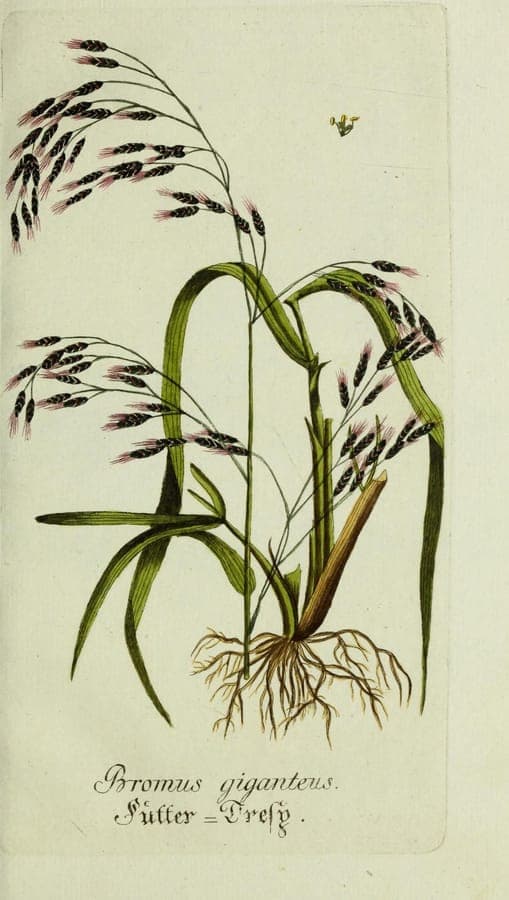
Unknown authorUnknown author / Public domain, via Wikimedia Commons
Giant fescue: complete guide
Festuca gigantea
Want to see Giant fescue: complete guide in your garden?
1 minute, no credit card
Overview
Festuca gigantea, commonly known as giant fescue, is a standout ornamental grass that brings texture and architectural form to modern garden designs. Unlike some spreading grasses, this species forms tight, fountain-like clumps that stay upright and neat without flopping. It's a member of the Poaceae family and reaches a height of up to 90 cm with a spread of about 60 cm. As a clump-forming perennial, it's reliably hardy in USDA zones 6 to 9 (-20°C to -1°C), making it suitable for most temperate gardens.
Giant fescue isn't flashy, but it's dependable. It works best when used to contrast bold-leaved plants or to add soft movement in a border. On gardenworld.app, you can visualise how this grass fits into a mixed planting scheme with silver, grey, and blue-toned companions.
Appearance & bloom cycle
The plant's real charm lies in its narrow, arching leaves, which are a striking blue-green. These form dense, rounded clumps that stay attractive all season. From June to August, slender, silvery-green to pale purple flower spikes rise above the foliage, reaching the full 90 cm. The effect is airy and light, especially when backlit by morning or evening sun. Even after flowering, the stems persist through autumn and into winter, adding vertical interest and movement in the breeze.
This grass doesn't die back completely in winter, but the foliage does take on a more golden-brown hue. It's best left standing until early spring to provide habitat for overwintering insects and to maintain visual structure.
Ideal location
Giant fescue thrives in full sun but tolerates light shade. However, in too much shade, the clumps become loose and may collapse, ruining the tidy look. A sunny spot ensures the best leaf color and strong stems. Avoid exposed, windy areas - the delicate flower spikes can snap or bend in strong gusts. A sheltered border edge or near low stone walls works well.
Give each plant at least 50 cm of space on all sides. This allows for proper airflow and prevents overcrowding, which can lead to fungal issues. When planning your layout, use gardenworld.app to map out spacing and see how multiple clumps create rhythm in a planting bed.
Soil requirements
This grass isn't fussy about soil type, as long as it's well-drained. It grows well in sandy, loamy, or even rocky soils. The key is avoiding heavy clay or waterlogged conditions, which can cause crown rot. If your soil is dense, mix in grit or coarse sand when planting to improve drainage.
It prefers a neutral to slightly acidic pH (5.5–7.5), but it adapts well to most garden soils. Avoid rich compost or high-nitrogen fertilisers - they promote weak, floppy growth. Lean soil keeps the plant compact and upright.
Free design
Want to see Giant fescue: complete guide in your garden? Make a free design now.
Watering
Once established, giant fescue is drought-tolerant and rarely needs supplemental watering. During the first growing season (May to August), water weekly during dry spells to help roots establish. Always water deeply at the base rather than misting the leaves, which can encourage fungal growth.
After year one, rainfall is usually sufficient. Only water during prolonged droughts, especially if the clump starts to look thin or dry at the edges.
Pruning
Cut back in early spring, around March. Use sharp shears to trim the entire clump to about 15–20 cm above ground level. This removes old, ragged growth and makes room for fresh, vibrant leaves. Don't cut too low - you don't want to damage the crown.
Avoid cutting in autumn; leaving the old growth provides winter interest and protection. If you notice any dead or damaged stems during the growing season, snip them out selectively.
Maintenance calendar
- January–February: Dormant period. Check for heaved clumps after frost and press them back into the soil.
- March: Prune back old foliage. No feeding required.
- April–May: New growth emerges. Water only if spring is unusually dry.
- June–August: Flowering season. Enjoy the silvery spikes. No extra care needed.
- September–October: Structure remains strong. Leave seed heads for winter effect.
- November–December: Overwintering. Avoid overhead watering to prevent rot.
Winter hardiness
Hardy to USDA zone 6, giant fescue handles cold winters well. In zone 7 and above (most of the UK and similar climates), it stays semi-evergreen. In colder zones, the top growth may brown, but the crown survives. The plant benefits from being left uncut until spring, as the old foliage insulates the base.
No winter protection is needed unless you're in a particularly wet, exposed site. In such cases, a light mulch of gravel around the base helps shed water.
Companion plants
Giant fescue pairs beautifully with plants that contrast in texture or bloom time. Consider:
- Eryngium giganteum – same silver tones and architectural form
- Verbena bonariensis – adds height and see-through purple flowers
- Helenium 'Moerheimii' – warm orange-red blooms in late summer
- Stachys byzantina – fuzzy grey leaves for soft contrast
- Sedum 'Matrona' – stout stems and pink flower heads
Avoid aggressive spreaders like some mint or goldenrod species that could overwhelm the clump.
Closing
Festuca gigantea is a quiet achiever - not loud, but always in good form. It asks for little and gives back structure, texture, and seasonal interest. With the right spot and minimal care, it lasts for years without needing division.
You'll find it at major garden centres, often in 2- or 3-litre pots. When planting, respect its clumping nature and give it room to breathe. And as always, use gardenworld.app to preview how giant fescue plays with other plants in your design - it's a smart way to avoid overcrowding and plan for long-term beauty.
Want to see Giant fescue: complete guide in your garden? Make a free design now.
Upload a photo, pick a style, and get a photorealistic design with plant list in under a minute.
No credit card required


Similar plants
Sporobolus pungens: complete guide
Sporobolus pungens
Sporobolus pungens is a stoloniferous Mediterranean coastal grass with outstanding salt and drought tolerance, perfect for seaside and dry gardens.
Mediterranean aegilops: complete guide
Aegilops biuncialis
Everything about Aegilops biuncialis, a Mediterranean annual grass with ornamental spikes and outstanding drought tolerance for dry gardens.
Silver bluestem: complete guide
Bothriochloa saccharoides
Full guide to Bothriochloa saccharoides (silver bluestem): site, soil, watering, winter hardiness, pruning, and garden companions.