
Daderot / CC0, via Wikimedia Commons
Blue fescue: complete guide
Festuca cinerea
Want to see Blue fescue: complete guide in your garden?
1 minute, no credit card
Overview
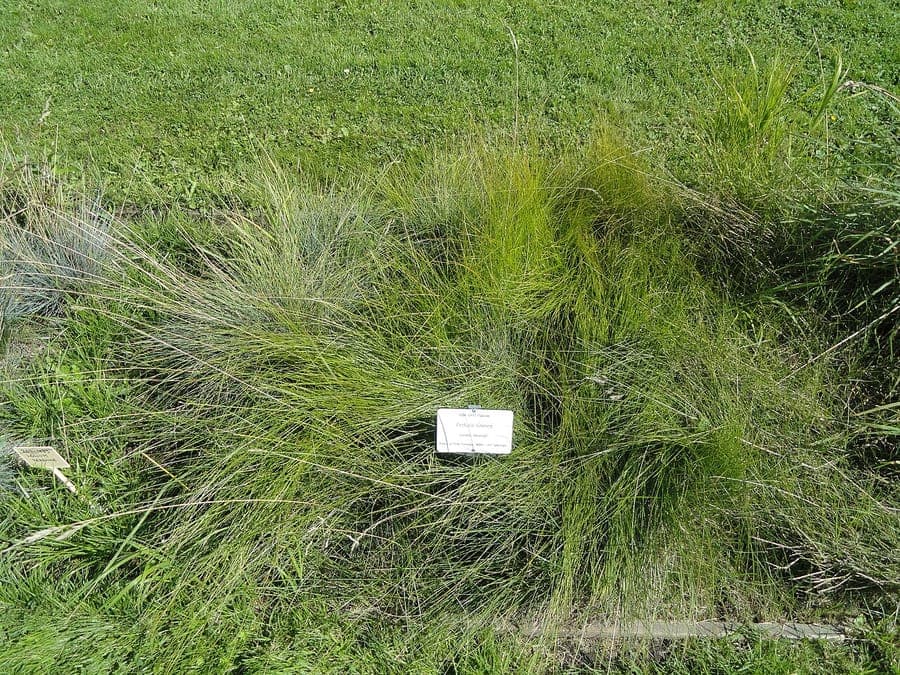
Festuca cinerea, commonly known as Blue fescue, is a compact, evergreen ornamental grass prized for its fine, steel-blue foliage. Native to southern France and Italy, it thrives in dry, sunny conditions and forms tight mounds up to 30 cm tall and 25 cm wide. This makes it perfect for front borders, rock gardens, or as a textural accent in mixed plantings.
Hardy to USDA zone 4 (-34°C), Blue fescue handles cold winters with ease, making it suitable for much of the UK, northern Europe, and North America. It's low maintenance, drought-tolerant, and resists most pests. Once established, it needs little care. On gardenworld.app, you can design a layout that highlights this grass in a xeriscape or modern garden.
Appearance & bloom cycle
The plant forms dense, spherical clumps of fine, needle-like leaves in a striking silvery-blue hue. In early summer, from June to August, it sends up slender, greenish flower spikes that rise 30–40 cm above the foliage. The blooms are subtle, not showy, but add lightness and movement to the clump.
By late summer, the flowers fade to tan, and the foliage may take on golden or russet tones in autumn. While evergreen in milder climates, it may brown slightly in harsh winters. The real draw is the foliage – that intense blue color stands out against green or flowering neighbors. Cut back old growth in spring to keep it looking fresh.
Ideal location
Blue fescue demands full sun – at least 6 hours of direct sunlight daily. In shade, it sprawls, loses color, and becomes weak. It performs best in sunny borders, gravel gardens, or containers on a south-facing patio. Avoid overcrowding; give it space for air circulation.
Use it as an edging plant, in drought-tolerant schemes, or to soften hardscapes like stone paths. On gardenworld.app, you can preview how this grass complements gravel, stone, or low perennials in your garden layout.
Soil requirements
It needs well-drained soil – sandy, gravelly, or rocky mixes work best. Avoid heavy clay unless amended with sharp sand or grit. The ideal pH is between 6.0 and 7.5. Poor, lean soils are actually preferred; rich soils encourage floppy growth and reduce hardiness.
Never add compost or fertilizer at planting. Overfeeding leads to weak, floppy clumps that die out quickly. Instead, plant directly into unamended soil, and consider adding a handful of horticultural grit to the planting hole for extra drainage.
Watering
Water newly planted Blue fescue 2–3 times a week for the first month. After that, it's extremely drought-tolerant. In dry summers, a deep soak every two weeks is enough. Overwatering is the biggest threat – it causes root rot and collapse.
In containers, use a gritty mix (equal parts compost, sand, and perlite). Water only when the top 5 cm of soil is dry. Avoid wetting the foliage; water at the base to prevent fungal issues.
Free design
Want to see Blue fescue: complete guide in your garden? Make a free design now.
Pruning
Blue fescue doesn't need formal pruning, but it benefits from an annual trim in early spring (February to March). Use sharp shears to cut the entire clump down to about 10 cm above ground. Remove dead, matted, or browned leaves to make way for fresh, upright growth.
Be careful not to cut too low – you don't want to damage the crown. If the plant looks sparse afterward, don't worry; it will fill out within weeks. Never cut it back in autumn – that removes its winter protection.
Maintenance calendar
- Jan: Check for waterlogging or rot in containers
- Feb: Begin clearing old foliage
- Mar: Cut back to 10 cm, avoid new shoots
- Apr: New growth appears, no feeding needed
- May: Monitor for self-seeding (rare)
- Jun-Aug: Flowering period, no extra care
- Sep: Observe autumn color, leave standing
- Oct: No action required
- Nov: Leave for winter interest
- Dec: Dormant; ensure pots are elevated to prevent water pooling
Winter hardiness
Blue fescue is hardy to USDA zone 4. In zones 5–8, it remains semi-evergreen. Avoid mulching heavily – the plant needs good air flow and dislikes wet crowns. In wet winters, slight rot can occur, so ensure drainage is excellent.
Leave the plant intact over winter; old foliage insulates the crown. In containers, move pots to a sheltered spot or place them on pot feet to improve drainage. Avoid plastic covers – they trap moisture and promote rot.
Companion plants
Pair Blue fescue with sun-loving, drought-tolerant plants. Great companions include Lavandula, Sedum, Echinacea, and Achillea. The blue foliage contrasts beautifully with purple, yellow, or white flowers.
Avoid moisture-loving plants like Hosta or Astilbe. It works well with gravel, stone, or wooden edging. Try combining it with rosemary or thyme for a Mediterranean look. In modern designs, it softens clean lines and adds movement.
Closing
Blue fescue is a reliable, low-effort plant that brings year-round texture and color. Its compact size and vivid hue make it a standout in small gardens or large landscapes. Available at most garden centres in late spring, it's easy to find and plant. OBI and Hornbach in Germany, Truffaut in France, and local UK garden centres often stock it in 1-litre pots.
Plant it in sun, skip the fertilizer, and give it space to breathe. On gardenworld.app, you can test how it fits into your garden's style – whether you're aiming for cottage, modern, or naturalistic.
Want to see Blue fescue: complete guide in your garden? Make a free design now.
Upload a photo, pick a style, and get a photorealistic design with plant list in under a minute.
No credit card required


Similar plants
Sporobolus pungens: complete guide
Sporobolus pungens
Sporobolus pungens is a stoloniferous Mediterranean coastal grass with outstanding salt and drought tolerance, perfect for seaside and dry gardens.
Mediterranean aegilops: complete guide
Aegilops biuncialis
Everything about Aegilops biuncialis, a Mediterranean annual grass with ornamental spikes and outstanding drought tolerance for dry gardens.
Silver bluestem: complete guide
Bothriochloa saccharoides
Full guide to Bothriochloa saccharoides (silver bluestem): site, soil, watering, winter hardiness, pruning, and garden companions.