
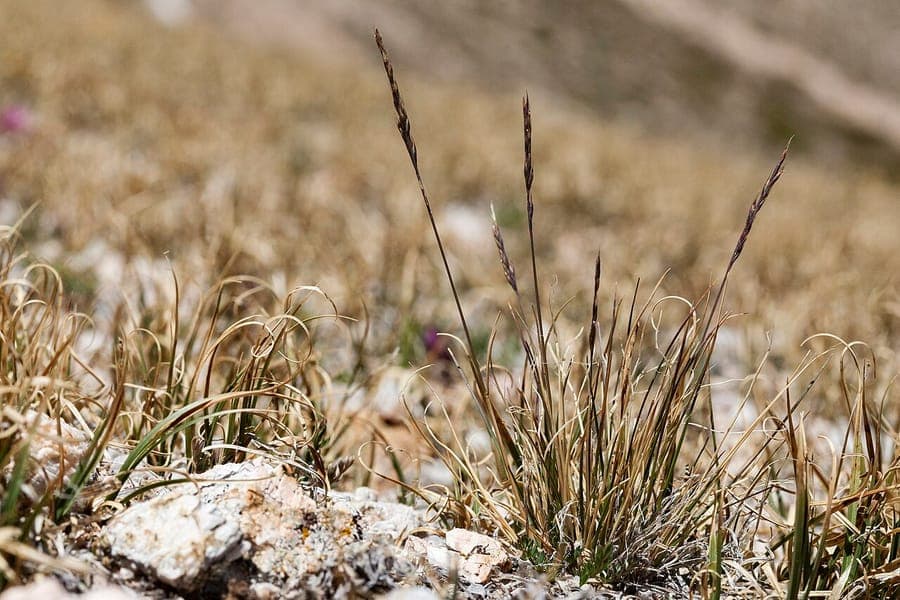
Patrick Alexander from Las Cruces, NM / CC0, via Wikimedia Commons
Festuca brachyphylla: complete guide
Festuca brachyphylla
Want to see Festuca brachyphylla: complete guide in your garden?
1 minute, no credit card
Overview
Festuca brachyphylla, also known as Alpine fescue, Rock fescue, or Shortleaf fescue, is a very popular ornamental grass for alpine borders and rock gardens. This grass naturally occurs in subarctic and alpine areas of North America, Russia, Scandinavia, and Asia.
This is an extremely resilient plant that adapts to extreme cold, mountain wind, poor soils, and limited moisture availability. It forms compact, dense tufts with fine, blue-green needle-like foliage.
This grass is ideal for anyone seeking a low-maintenance, winter-hardy ornamental plant for rocky areas, alpine borders, green roofs, and other dry locations.
Appearance & bloom
Festuca brachyphylla forms compact mounds approximately 15-30 centimeters wide. The foliage is very fine, needle-shaped, and blue-green in color. In the growing season, this grass reaches 20-40 centimeters tall, including flower panicles.
Flower panicles appear in May-June, are approximately 5-8 centimeters long, and have an inconspicuous green to pale brown color. They are not very ornamental, but they contribute to the grass structure.
In autumn, the foliage retains its blue-green color, and in winter can turn purple-brown depending on frost intensity. This color change is actually very decorative.
Ideal location
Festuca brachyphylla thrives in full sun to light shade. Minimum 5-6 hours direct sunlight daily is needed. In very warm climates, light afternoon shade prevents plant burn.
The plant is very wind resistant - in fact, alpine grasses need wind resistance to maintain their compact form. Plant it therefore not in sheltered corners, but rather in open locations.
Altitude is no issue - this plant grows from sea level to 3,000 meters elevation. In hot, low areas, more shade may be needed.
Soil
Festuca brachyphylla requires very well-drained, poor soil. This grass performs poorly in nutrient-rich soil. A mixture of gravel, sand, and minimal garden soil works best.
The plant performs poorly in heavy clay or wet soils. Ensure excellent drainage by adding coarse sand, gravel, or perlite to the planting hole.
The pH can be acidic to neutral - pH 6.0-7.0 is ideal. This grass does well in calcium-rich soils.
Watering
Festuca brachyphylla requires very little water once established. This alpine plant is adapted to dry conditions. Do not water at all in dry periods.
During planting (first 4-6 weeks), moderate watering is needed until the root system is established. After that, dry growth is fine.
Excessive water is a much bigger problem than underwater for this grass. Ensure very good drainage.
In very warm regions, sporadic water during extreme heat waves prevents the plant from dying from stress.
Free design
Want to see Festuca brachyphylla: complete guide in your garden? Make a free design now.
Pruning
Festuca brachyphylla requires minimal pruning. Remove only dead foliage in early spring, just after frost passes. This encourages new growth.
Remove faded flower panicles after blooming ends (June-July). This keeps the plant more compact.
Once every two to three years, the grass can be "tidied" by carefully removing dead material - do this very carefully however to not damage the plant heart.
Maintenance calendar
Spring (March-May): Plant or transplant in early spring. Water until well-rooted. Remove dead foliage. No feeding needed - this grass doesn't respond well to much fertilizer.
Summer (June-August): Remove faded flower panicles. Water very sporadically, only in extreme drought. Check for poor drainage.
Autumn (September-October): Check soil drainage for coming winter. No special preparation needed - this plant overwintering itself well.
Winter (November-February): No maintenance needed. Plant survives extreme cold without trouble. Foliage may turn purple-brown, which is normal.
Winter hardiness
Festuca brachyphylla is VERY winter hardy. This grass tolerates temperatures down to -40 degrees Celsius. It grows from subarctic regions to the Himalayas, so cold is absolutely not a problem.
In temperate climates (Northern Europe, North America), this grass survives winters without any protection. Even in zone 2-3 (very cold), it grows well.
Winter dryness (dry, cold wind) is more of a problem than pure cold. Ensure soil drainage is very good so winter moisture doesn't cause problems.
Companion plants
Festuca brachyphylla combines nicely with other alpine grasses and dwarf plants: Festuca glauca, Carex, Stipa, Sempervivum, Sedum, Pulsatilla. The fine texture of this grass provides good contrast with softer forms.
In alpine borders, this grass creates a calm background for colorful flowers. It can also work well in rock gardens, green roof settings, or as a groundcover plant.
In pots, this grass can look spectacular for alpine containers and pottery.
Closing
Festuca brachyphylla is an excellent choice for anyone seeking a winter-hardy, low-maintenance ornamental grass. This grass literally grows everywhere standard garden plants refuse to grow.
The fine texture, blue-green color, and compact form make it a very decorative addition to any garden. Thanks to its hardiness and drought tolerance, you don't need to worry about failures.
Available at major garden centers. Buy small plugs - they grow quickly. Plant in rock gardens in very dry spots. No maintenance after establishment.
Want to see Festuca brachyphylla: complete guide in your garden? Make a free design now.
Upload a photo, pick a style, and get a photorealistic design with plant list in under a minute.
No credit card required


Similar plants
Sporobolus pungens: complete guide
Sporobolus pungens
Sporobolus pungens is a stoloniferous Mediterranean coastal grass with outstanding salt and drought tolerance, perfect for seaside and dry gardens.
Mediterranean aegilops: complete guide
Aegilops biuncialis
Everything about Aegilops biuncialis, a Mediterranean annual grass with ornamental spikes and outstanding drought tolerance for dry gardens.
Silver bluestem: complete guide
Bothriochloa saccharoides
Full guide to Bothriochloa saccharoides (silver bluestem): site, soil, watering, winter hardiness, pruning, and garden companions.