
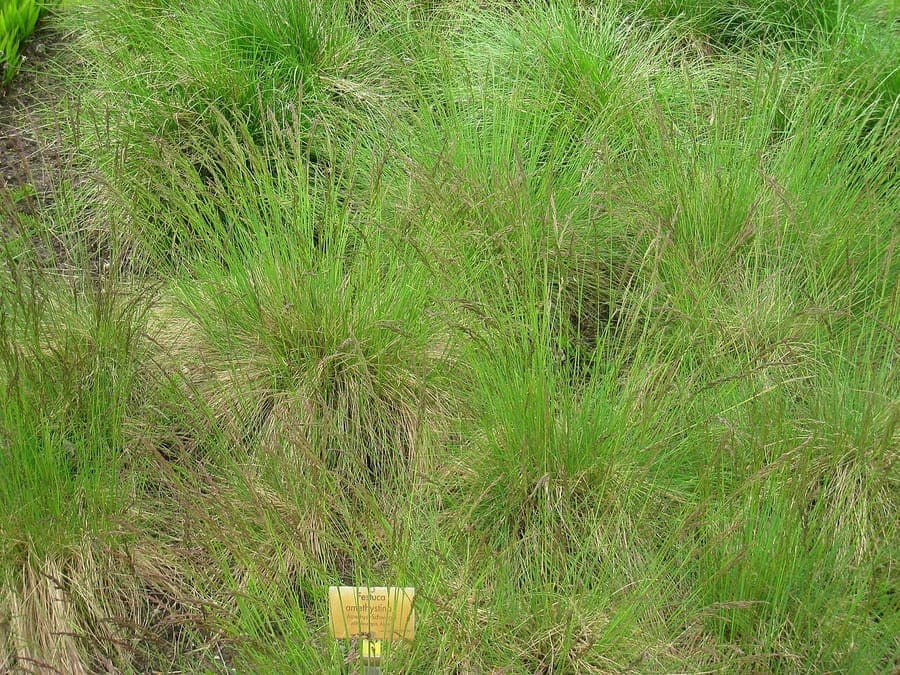
Daderot / Public domain, via Wikimedia Commons
Amethyst fescue: complete guide
Festuca amethystina
Want to see Amethyst fescue: complete guide in your garden?
1 minute, no credit card
Overview
Amethyst fescue, or Festuca amethystina, is a striking ornamental grass native to mountainous regions of Central and Southern Europe, including Austria, Italy, and Greece. It thrives in dry, sunny conditions and brings year-round texture to gardens with minimal care. Mature clumps reach 30–40 cm in height and spread to about 25 cm wide, making it ideal for borders, rock gardens, or as a structural accent in mixed plantings.
On gardenworld.app, you can design a garden layout that highlights the fine texture and upright form of Amethyst fescue, ensuring it's placed where its bloom colour can shine.
Appearance & bloom cycle
This grass forms tight, mounded clumps of fine, blue-green foliage. The real show begins in late spring to early summer - typically June through July - when slender flower stalks rise up to 50 cm, developing a soft amethyst-purple hue. The bloom lasts four to six weeks, after which the stems fade to a warm beige, providing subtle interest into autumn.
The foliage stays semi-evergreen in mild winters, though tips may brown in prolonged cold. New growth emerges fresh and vibrant each spring. The overall effect is airy and elegant, adding movement and lightness to garden beds.
Ideal location
Plant Amethyst fescue in full sun - at least 6 hours of direct sunlight daily. It performs poorly in heavy shade, where it becomes floppy and loses its compact shape. Use it in gravel gardens, between paving stones, or as part of a drought-tolerant planting scheme. It also works well in containers, especially when paired with succulents or silver-foliaged plants.
Ensure 30 cm spacing between plants to allow airflow and prevent fungal issues. Avoid overcrowding, as poor circulation can lead to rot in wet conditions.
Soil requirements
Amethyst fescue prefers well-drained soil and tolerates poor, sandy, or gravelly types. It struggles in heavy clay unless amended with grit or coarse sand. The ideal pH range is 5.5 to 7.5 - slightly acidic to neutral. Avoid rich compost or high-nitrogen fertilisers, which encourage weak, floppy growth.
For pots, mix standard potting soil with 30% perlite or horticultural grit to improve drainage. Never let the plant sit in soggy soil.
Watering
Once established (after the first growing season), this grass is highly drought-tolerant. Water young plants weekly during dry spells in their first summer. After that, rainfall is usually sufficient, even in dry UK or US summers. Overwatering is a bigger threat than under-watering - soggy roots lead to crown rot.
If the clump starts to shrink or leaves curl tightly, a deep soak every 10–14 days should revive it.
Free design
Want to see Amethyst fescue: complete guide in your garden? Make a free design now.
Pruning
Do not cut back in autumn. Leave the old foliage to protect the crown during winter and add winter structure. The best time to prune is late winter or early spring - late February to early March in USDA zones 5–8. Cut the entire clump down to about 10 cm above ground using sharp, clean shears.
If you want to use the flower stalks in dried arrangements, leave them standing until late winter, but remove them before new growth emerges.
Maintenance calendar
- Jan: Dormant, no action needed
- Feb: Prepare for pruning
- Mar: Cut back old foliage
- Apr: Monitor for new growth, watch for slugs
- May: No supplemental watering if rain is regular
- Jun: Bloom begins, ensure full sun exposure
- Jul: Peak bloom, avoid cutting
- Aug: Flowers fade, no feeding
- Sep: Allow seed heads to persist or remove
- Oct: Leave standing for winter interest
- Nov: Avoid mulching heavily around the crown
- Dec: Dormancy continues, no care required
With gardenworld.app, you can generate a seasonal maintenance plan for your entire garden, including reminders for pruning Amethyst fescue at the right time.
Winter hardiness
Festuca amethystina is hardy in USDA zones 5 to 8 (down to -23°C). It survives most winters without issue, retaining some green foliage in milder regions. In colder zones, foliage may die back but re-sprouts in spring. Avoid winter mulch directly around the crown, as trapped moisture promotes rot.
Companion plants
Pair Amethyst fescue with drought-tolerant perennials like Sedum 'Autumn Joy', Nepeta racemosa, Salvia x sylvestris, or Echinacea. Its blue-green foliage contrasts beautifully with yellow, purple, or white blooms. Avoid moisture-loving plants like Astilbe or ferns.
It also works well with other grasses such as Carex comans or Deschampsia cespitosa for layered texture. Place it in the front or middle of borders to showcase its airy flower stems.
Closing
Amethyst fescue is a low-demand, high-reward plant. Its elegant form, drought tolerance, and long seasonal interest make it a staple in modern, sustainable gardens. While not always available at every garden centre, you can often find it at local independents or online nurseries in spring. With patience - it establishes best in year two - this grass becomes a reliable, eye-catching feature. For gardeners seeking beauty with minimal fuss, Festuca amethystina delivers.
Want to see Amethyst fescue: complete guide in your garden? Make a free design now.
Upload a photo, pick a style, and get a photorealistic design with plant list in under a minute.
No credit card required


Similar plants
Sporobolus pungens: complete guide
Sporobolus pungens
Sporobolus pungens is a stoloniferous Mediterranean coastal grass with outstanding salt and drought tolerance, perfect for seaside and dry gardens.
Mediterranean aegilops: complete guide
Aegilops biuncialis
Everything about Aegilops biuncialis, a Mediterranean annual grass with ornamental spikes and outstanding drought tolerance for dry gardens.
Silver bluestem: complete guide
Bothriochloa saccharoides
Full guide to Bothriochloa saccharoides (silver bluestem): site, soil, watering, winter hardiness, pruning, and garden companions.