
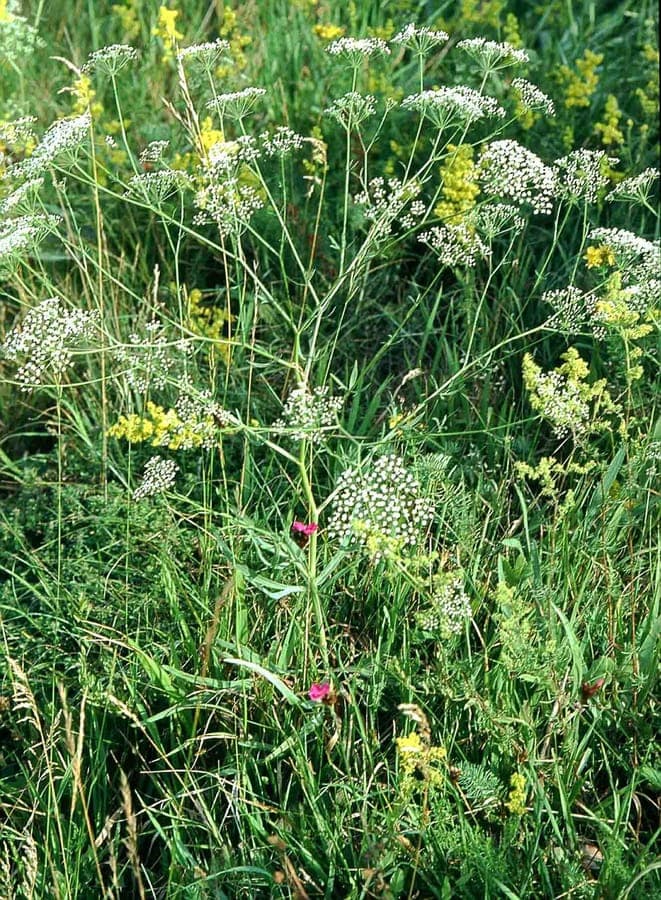
Wikimedia Commons / CC BY-SA 3.0, via Wikimedia Commons
Longleaf: complete guide
Falcaria vulgaris
Want to see Longleaf: complete guide in your garden?
1 minute, no credit card
Overview
Longleaf (Falcaria vulgaris) is one of those quiet performers in the garden world - unassuming, reliable, and surprisingly graceful. As a member of the Apiaceae family, it shares its lineage with carrots, parsley, and hemlock, but don't let that fool you: this plant holds its own in a well-balanced border. Native to regions across Eastern Europe, the Baltics, and Central Russia, it's adapted to temperate climates much like those found in the UK and northern US.
It's a biennial or short-lived perennial herb that reaches 60 to 120 cm in height, depending on soil and moisture. Though it self-seeds freely, it's not invasive unless conditions are ideal and left unchecked. It thrives in cottage gardens, wildflower meadows, or dry borders where structure and movement matter. On gardenworld.app, you can design a planting scheme that positions Longleaf where it catches the late summer light just right.
Appearance & bloom cycle
From July through September, Longleaf produces clusters of small, creamy-white flowers arranged in flat-topped umbels, typical of the carrot family. Each umbel spans 4 to 7 cm across, held aloft on slender, ribbed stems. The foliage is finely dissected, almost fern-like, with long, tapering leaflets that give the plant its common name. The leaves are a mid to deep green, slightly glossy, and arranged alternately along the stem.
The bloom peaks in August, attracting hoverflies, small bees, and butterflies. It's not a nectar powerhouse, but it offers reliable pollen and a landing platform for beneficial insects. After flowering, the plant sets small, dry fruits that disperse easily by wind and animal contact. If you're keen to limit spread, deadhead before seed maturity.
Ideal location
Longleaf prefers a sun-drenched spot - rate it a 7 out of 10 for light. That means full sun to light shade, with at least 5 to 6 hours of direct sunlight daily. It performs best in open areas with good air circulation, avoiding damp, stagnant corners. It's perfect for the middle to back of a border, or along a fence line where it won't block shorter plants.
Hardy in USDA zones 6b to 9, it handles cold winters well. In the UK, it's suitable for zones H5 to H7, meaning it survives most winters without protection. If you're unsure about your zone, check your microclimate on gardenworld.app before planting.
Soil requirements
This plant likes well-drained, slightly alkaline soil with a pH between 7.5 and 8.0. It tolerates poor, stony, or sandy soils better than rich, waterlogged ones. Avoid heavy clay unless amended with grit or coarse sand to improve drainage.
It doesn't demand fertility - in fact, overly rich soil leads to leggy growth and fewer flowers. A light application of compost or well-rotted manure in spring is plenty. If your soil is acidic, consider adding ground limestone, but test first to avoid over-correction.
Free design
Want to see Longleaf: complete guide in your garden? Make a free design now.
Watering
Once established, Longleaf is drought-tolerant. Young plants need consistent moisture for the first 4 to 6 weeks after planting. Water at the base, not over the foliage, to prevent fungal issues like powdery mildew.
During dry spells, especially in July and August, give a deep soak once a week. Use a soaker hose or drip system to deliver water directly to the roots. Overhead watering in full sun can scorch leaves, so aim for early morning or late evening.
Pruning
No formal pruning is needed, but you can cut back spent flower stems to control self-seeding. If you want to encourage a second, smaller flush of blooms, trim lightly after the main flowering period. Otherwise, leave the stems standing through winter for structural interest and habitat.
Many beneficial insects overwinter in the hollow stems, so delay cutting back until early spring, just before new growth emerges.
Maintenance calendar
- January–February: Monitor for overwintering insects; no action needed.
- March: Cut back old stems if not left for winter interest.
- April–May: Sow seeds directly or transplant seedlings. Light feed with organic compost.
- June: Water young plants during dry periods.
- July–August: Peak bloom. Watch for self-seeding.
- September: Deadhead if needed, or collect seeds.
- October–December: Leave standing or clear debris. No feeding.
Winter hardiness
Longleaf is fully hardy in USDA zones 6b and above. In zone 6, it may die back completely but regrows from rootstock. In milder zones (7–9), top growth may persist into winter. No mulch or protection is necessary, even in harsh conditions.
It self-seeds reliably in spring, so you'll often see new plants appearing where you least expect them - sometimes a blessing, sometimes a chore.
Companion plants
Pair Longleaf with other sun-loving, drought-tolerant perennials: Echinacea, Sedum 'Autumn Joy', Nepeta, and Salvia nemorosa. It contrasts beautifully with bold textures like Verbena bonariensis or dark-leaved Heuchera.
Avoid pairing with moisture-hungry plants like Astilbe or Ligularia - their needs clash too strongly. In a wildlife garden, it complements native grasses and late-blooming forbs.
Closing
Longleaf isn't flashy, but it's dependable - a quiet backbone in the late-season garden. It asks for little, gives structure, and supports pollinators when many other plants are fading. If you're designing a low-maintenance, ecologically sound border, this plant deserves a spot.
You can find it at garden centres across the UK and US, though it's more common in seed form. In the UK, check Triffic Seeds or specialist nurseries. In the US, look for it at Prairie Moon or native plant sales. For design inspiration, try placing Longleaf in a virtual bed on gardenworld.app - see how it flows with neighbouring plants in real-time.
Want to see Longleaf: complete guide in your garden? Make a free design now.
Upload a photo, pick a style, and get a photorealistic design with plant list in under a minute.
No credit card required


Similar plants
Whorled carrot: complete guide
Daucus involucratus
Daucus involucratus is a Mediterranean umbellifer with white flower heads framed by lacy bracts. Growing this gravel garden gem.
Daucus muricatus: complete guide
Daucus muricatus
Daucus muricatus, the spiny wild carrot, grows wild on Mediterranean coasts. Discover sowing, June-July bloom, and wildflower meadow use.
Daucus pumilus: complete guide
Daucus pumilus
Daucus pumilus is a dwarf wild carrot relative with white lacy umbels, thriving on dunes and coastal rock in poor, fast-draining soil.