
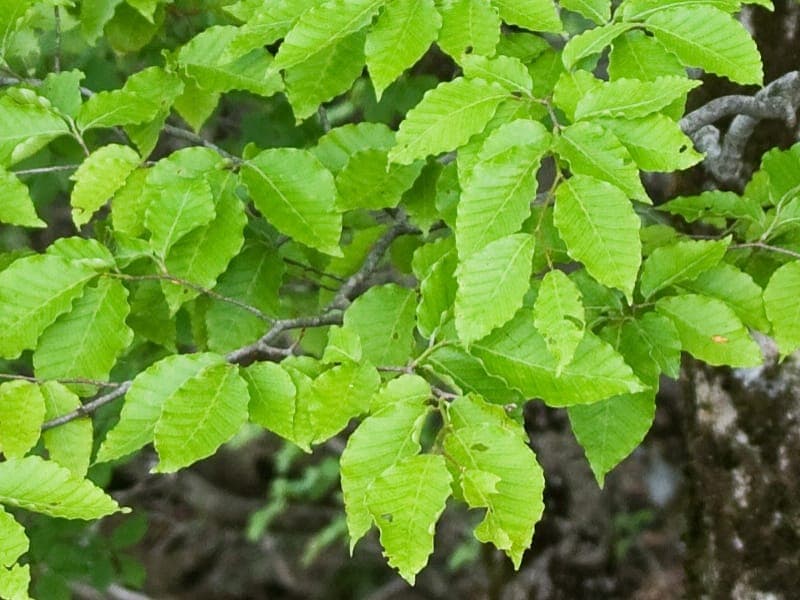
Fagus_japonica_03.jpg: Σ64 derivative work: Bff (talk) / CC BY 3.0, via Wikimedia Commons
Fagus japonica: complete guide
Fagus japonica
Want to see Fagus japonica: complete guide in your garden?
1 minute, no credit card
Overview
Fagus japonica, the Japanese beech, is an elegant and impressive deciduous tree native to Japan. This tree is highly valued in large-scale gardens and parks for its ornamental value year-round. The Japanese beech grows vigorously and forms a beautiful, regular crown. In spring, the leaves unfold in soft greenish-white, in summer they become dark green, and in autumn they display spectacular red to purple tints. This tree is ideal for those seeking a garden monument.
Appearance and Bloom
The Fagus japonica is a deciduous tree that can grow to 20 meters or higher. The crown is regular, oval to round in shape. The leaves are fine, with neat veining, giving the plant an elegant appearance. Flowers are small, inconspicuous, and appear in spring along with the leaves. After flowering, characteristic beechnuts develop in spiny capsules. In autumn, the foliage transforms into spectacular colors. The bark is smooth, gray in color, and highly decorative.
Ideal Location
The Japanese beech grows best in a sunny to half-shaded location. At least 3-4 hours of direct sun daily is preferred, although the tree also thrives in lightly shaded conditions. Position the tree where it has sufficient space to reach its full size without maintenance work. A single tree in a visible location provides the best effect. Ensure the tree is protected from strong wind.
Soil
The Fagus japonica grows best on nutrient-rich, well-draining soil. A pH between 6.0 and 7.5 is ideal. The plant tolerates both acidic and neutral soil, provided it is sufficiently deep. Ensure a depth of at least 60-80 cm of loose soil for a strong root system. Add compost or peat when planting. The plant grows better in non-compacted soil. Proper drainage of rainwater is important.
Watering
After planting, the Fagus japonica should be watered regularly in the first and second growing years. Ensure the soil remains evenly moist, but not waterlogged. Once established, the tree is very drought-tolerant and requires no supplemental water in normal years. In dry summers, you may water if the plant appears stressed. Young trees appreciate regular water during the growing period. A mulch layer around the trunk helps retain moisture.
Free design
Want to see Fagus japonica: complete guide in your garden? Make a free design now.
Pruning
The Fagus japonica grows naturally into a neat shape and requires little pruning. Carefully remove dead or damaged branches in late winter. Avoid heavy pruning, as this can damage the natural beauty of the tree. The tree naturally forms a beautiful crown. Only maintenance work to remove crossing or diseased branches is usually necessary. Major interventions can manifest themselves for years.
Maintenance Calendar
Spring: Check for winter damage. Maintenance work on dead branches. Summer: Water regularly during dry periods. Inspect for disease. Autumn: Enjoy the autumn color. Monitor for pests. Winter: No maintenance needed. Inspect the crown annually for structural issues.
Winter Hardiness
The Fagus japonica is fully winter-hardy in the UK and Northern Europe. This tree can tolerate temperatures down to -20 degrees Celsius. No special winter protection is required. After the first winter, young trees can withstand frost very well. In years with very severe frost, the tips of young shoots may suffer some damage, but this is usually not serious. The tree recovers well.
Companion Plants
The Fagus japonica as a specimen tree in the center of a park-like setting is most beautiful. Below the tree, you can place groups of shade-loving plants such as hostas, heuchera, or helleborus. For contrast, use light-foliaged plants such as Japanese maple or white-green variegated shrubs. Avoid dense planting around the tree so the trunk remains well visible. Grass or natural ground cover around is ideal.
Conclusion
The Fagus japonica is an impressive tree for those with sufficient space. This is an investment that lasts decades and becomes increasingly beautiful with age. This tree is available at specialty tree nurseries and large garden centers. Ask for advice through gardenworld.app for positioning this magnificent tree in your front yard.
Want to see Fagus japonica: complete guide in your garden? Make a free design now.
Upload a photo, pick a style, and get a photorealistic design with plant list in under a minute.
No credit card required


Similar plants
Lucombe oak: complete guide
Quercus crenata
Lucombe oak (Quercus crenata): a majestic semi-evergreen giant with corky bark, perfect for large gardens, parks, and country estates.
Blue oak: complete guide
Quercus douglasii
Discover the blue oak, a drought-tolerant Californian shade tree with striking blue-green foliage, ideal for large, climate-resilient gardens.
Quercus montana: complete guide
Quercus montana
Quercus montana, the chestnut oak, is a rugged American shade tree with deeply furrowed bark and large acorns, well suited to dry, rocky, spacious gardens.