
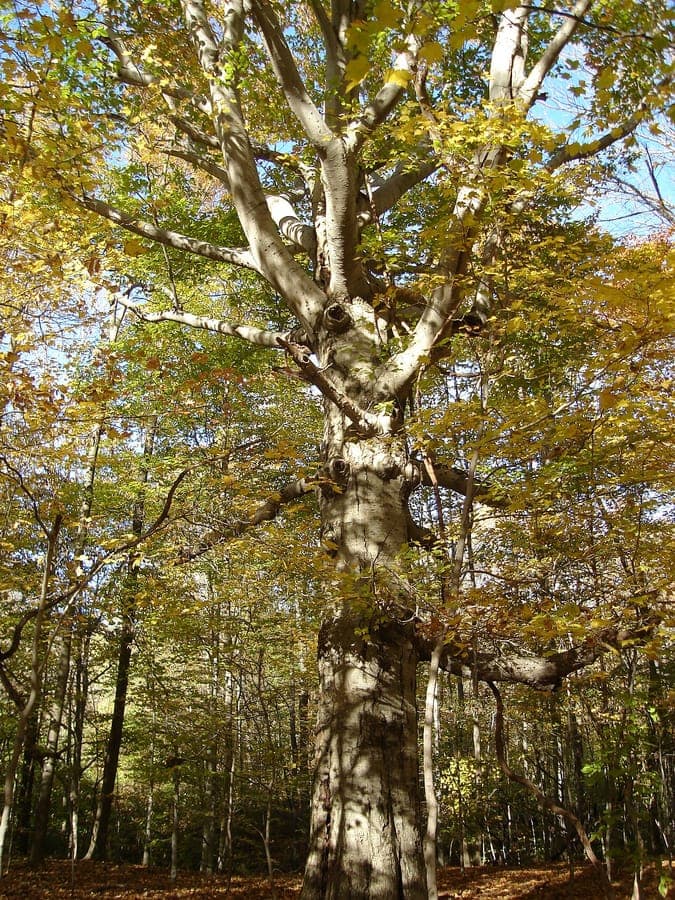
Marqqq / CC BY-SA 3.0, via Wikimedia Commons
American beech: complete guide
Fagus grandifolia
Want to see American beech: complete guide in your garden?
1 minute, no credit card
Overview
The American beech (Fagus grandifolia) is a stately, long-lived deciduous tree native to eastern North America, ranging from Alabama to Connecticut. With its smooth, silver-gray bark and dense, upright crown, it brings quiet dignity to any landscape. Mature trees reach 50 to 80 feet (15–25 m) tall and spread 30 to 50 feet (9–15 m) wide, making them best suited for larger gardens or park-like settings. While slow-growing, they can live for centuries under the right conditions. If you're planning a spacious, naturalistic garden, gardenworld.app lets you design a layout that accommodates the American beech's eventual size and shade spread.
Appearance & bloom cycle
Young American beech trees have a pyramidal shape that evolves into a broad, rounded crown with age. The leaves are oblong, 2–4 inches (5–10 cm) long, with a finely toothed margin and a glossy dark green upper surface. In autumn, they turn a warm bronze or coppery gold and often cling to the branches well into winter - a trait known as marcescence. This provides visual interest during the colder months. Small, inconspicuous greenish flowers appear in May, followed by tiny, triangular beechnuts in spiky husks. These are favored by birds and small mammals but are not toxic to humans.
Ideal location
Plant your American beech in full sun to partial shade. It performs best with at least 6 hours of direct sunlight daily but can tolerate light shade, especially in hotter climates. Avoid south-facing, exposed sites in the UK and northern Europe where summer heat and dry winds can stress young trees. Allow at least 20 feet (6 m) of clearance from buildings or neighbouring gardens. This tree works well as a specimen on a lawn, along woodland edges, or in large naturalised gardens. Keep it away from patios - falling leaves and nuts can create mess. Use gardenworld.app to map your garden's sun exposure and available space before planting.
Soil requirements
American beech thrives in moist, well-drained, humus-rich soil with a pH between 4.1 and 7.2. It dislikes heavy clay that stays wet, as this leads to root rot. Sandy soils will need regular mulching and composting to retain moisture. When planting, mix in plenty of organic matter like composted manure or leaf mold. A 2–3 inch (5–8 cm) layer of shredded bark or wood chips helps keep the root zone cool and moist - ideal for this shallow-rooted species.
Free design
Want to see American beech: complete guide in your garden? Make a free design now.
Watering
Young trees need consistent watering during their first 2–3 years, especially through dry summers. Apply 20–30 liters per week during drought periods. Use a soaker hose or drip irrigation to encourage deep rooting. Mature trees are moderately drought-tolerant once established but perform best with consistent soil moisture. Avoid overwatering - standing water is detrimental. In prolonged dry spells, even older trees benefit from occasional deep watering.
Pruning
Pruning is rarely needed. The American beech naturally develops a strong, balanced structure. If required, remove only dead, damaged, or crossing branches. Do this in late winter or early spring before bud break. Use clean, sharp tools to minimize injury. Avoid heavy pruning - this species heals slowly. Also, the bark is thin and easily damaged, so protect the trunk from lawnmowers and trimmers.
Maintenance calendar
January: Inspect for dead or weak branches. Light pruning if needed. February: Replenish mulch. Prepare planting sites. March: Keep root zone clear of weeds. Avoid soil compaction. April: No action required. Watch for bud swell. May: Flowers emerge. Check for aphids or fungal spots. June: Water young trees during dry spells. July: Monitor for pests. No pruning. August: Continue observing. Water if rainfall is below 2.5 cm/week. September: Leaf color begins to change. Top up mulch. October: Let fallen leaves decompose under the tree as natural mulch. November: Assess crown structure. Remove hazardous limbs. December: Protect young trunks from rodents with wire mesh.
Winter hardiness
The American beech is hardy in USDA zones 4 to 9. It tolerates winter temperatures down to -25°C (-13°F). In the UK and Ireland (zone 8), it handles cold winters well. Marcescent leaves offer some wind protection. Young trees may benefit from burlap wrapping in exposed areas during their first few winters to prevent sunscald.
Companion plants
Underplant with shade-tolerant species that won't compete aggressively with the beech's shallow roots. Good choices include hellebores, bloodroot (Sanguinaria canadensis), spring ephemerals like trillium, and native ferns. Avoid invasive groundcovers like English ivy. Around the drip line, consider shade-tolerant shrubs such as mahonia, spicebush (Lindera benzoin), or native viburnums.
Closing
The American beech is not a quick fix, but a legacy tree. It grows slowly, demands space, and needs patience. But for gardeners willing to invest, it rewards with decades of beauty, wildlife value, and structural presence. Buy young, container-grown specimens from reputable garden centres, where staff can advise on planting depth and spacing. With proper care and a well-thought-out design - which you can visualise on gardenworld.app - this tree will become the quiet centerpiece of your garden for generations.
Want to see American beech: complete guide in your garden? Make a free design now.
Upload a photo, pick a style, and get a photorealistic design with plant list in under a minute.
No credit card required


Similar plants
Lucombe oak: complete guide
Quercus crenata
Lucombe oak (Quercus crenata): a majestic semi-evergreen giant with corky bark, perfect for large gardens, parks, and country estates.
Blue oak: complete guide
Quercus douglasii
Discover the blue oak, a drought-tolerant Californian shade tree with striking blue-green foliage, ideal for large, climate-resilient gardens.
Quercus montana: complete guide
Quercus montana
Quercus montana, the chestnut oak, is a rugged American shade tree with deeply furrowed bark and large acorns, well suited to dry, rocky, spacious gardens.