
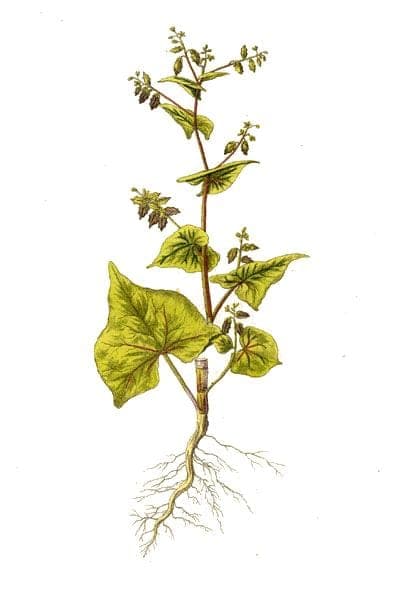
Jan Kops, Herman Christiaan van Hall and others / Public domain, via Wikimedia Commons
India buckwheat: complete guide
Fagopyrum tataricum
Want to see India buckwheat: complete guide in your garden?
1 minute, no credit card
Overview
India buckwheat, or Fagopyrum tataricum, is a quick-maturing annual herb from the Polygonaceae family, native to the mountainous regions of central and southern China, including Tibet. Unlike common buckwheat (Fagopyrum esculentum), this species is more heat-tolerant and slightly more compact, reaching 40 to 100 cm in height. It's grown both for its edible seeds and as a dynamic cover crop in sustainable gardens. Gardeners in temperate climates (USDA zones 3–8) find it especially useful for filling gaps quickly and improving soil health. With a growth cycle of just 70 to 90 days, it's perfect for succession planting or as a summer filler in ornamental beds.
On gardenworld.app, you can design a garden layout that incorporates India buckwheat for maximum visual impact and ecological benefit, especially in mixed borders or urban plots with limited space.
Appearance & bloom cycle
India buckwheat features heart-shaped, medium-green leaves, 3–8 cm across, arranged alternately along slender, angular stems. The foliage has a fresh, slightly glossy appearance. From July through September, it produces clusters of small, white flowers in open panicles. These blooms are rich in nectar and attract bees, hoverflies, and butterflies-making it a valuable addition to any pollinator garden. The flowering period lasts four to six weeks, peaking in mid-summer when many other plants are just establishing. After pollination, the plant develops dark brown, triangular seeds that rattle slightly in dry pods when mature.
Ideal location
This plant thrives in full sun-rate it an 8 out of 10 for light needs. It requires at least 7–8 hours of direct sunlight daily. Partial shade leads to weak, leggy growth and reduced flowering. Plant it in open areas with good air circulation to prevent fungal issues. Avoid low-lying, damp spots. In gardens with taller perennials, place India buckwheat toward the front or middle of borders so it doesn't get shaded out. It works well in cottage gardens, vegetable plots, or on bare patches needing fast cover.
Soil requirements
India buckwheat is adaptable but prefers well-drained, sandy loam soils with a pH between 4.6 and 6.5. It tolerates poor, acidic soils better than many crops, but avoid heavy clay or waterlogged ground. Prepare the soil with a light application of compost before sowing-no need for high-nitrogen fertilizers, which promote leafy growth at the expense of flowers. A pH test kit from your local garden centre can help determine if amendments like lime are needed.
Free design
Want to see India buckwheat: complete guide in your garden? Make a free design now.
Watering
Keep the soil lightly moist during germination and early growth (first 2–3 weeks). Once established, India buckwheat is moderately drought-tolerant. Water deeply but infrequently-about 1 inch (2.5 cm) per week during dry spells. Overwatering increases disease risk and weakens stems. Use drip irrigation or water at the base to keep foliage dry.
Pruning
Pruning isn't required, but deadheading spent blooms can encourage a second, lighter flush of flowers. Pinch back young plants at 20 cm to promote bushier growth and prevent flopping. If growing for seed, leave flower heads intact until seeds turn dark and hard.
Maintenance calendar
- January: Test soil pH, plan sowing dates
- February: Order seeds online or from garden centres
- March: Prepare garden beds, add compost
- April: Start seeds indoors at 18–21°C (65–70°F)
- May: Sow directly outdoors after last frost (soil >10°C)
- June: Thin seedlings to 15–20 cm apart, control weeds
- July: Flowers appear, monitor for pests
- August: Peak bloom, support tall plants if needed
- September: Begin seed harvest, collect dry pods
- October: Cut back dead foliage, compost plant material
- November: Protect soil with mulch
- December: Rest period, review season's success on gardenworld.app
Winter hardiness
As an annual, India buckwheat completes its life cycle in one growing season and dies off after the first hard frost. It has no winter hardiness and does not survive below freezing. Self-seeding can occur in mild climates, but volunteer plants are easy to manage. Clean up plant debris in late fall to reduce overwintering pests.
Companion plants
India buckwheat pairs well with carrots, onions, and brassicas in vegetable gardens. Its flowers attract beneficial insects that prey on aphids and cabbage worms. Avoid planting near legumes like beans or peas, as they compete for root space. In ornamental beds, combine with Echinacea, Rudbeckia, or ornamental grasses for texture contrast. It also works as a living mulch under taller crops.
Closing
India buckwheat is a low-effort, high-reward plant for gardeners seeking quick results and ecological benefits. It's easy to grow from seed, improves soil structure, and supports pollinators. Whether you're refreshing a tired border or boosting biodiversity, this plant delivers. Pick up seeds at garden centres like those in the UK or online, and test a small patch first. With thoughtful placement-easily visualized using gardenworld.app-you'll create a resilient, blooming garden space that works with nature, not against it.
Want to see India buckwheat: complete guide in your garden? Make a free design now.
Upload a photo, pick a style, and get a photorealistic design with plant list in under a minute.
No credit card required


Similar plants
Crosby's wild buckwheat: complete guide
Eriogonum crosbyae
Full guide to growing Eriogonum crosbyae: ideal site, soil, watering, winter hardiness and companion plants for this rare western wild buckwheat.
Spreading buckwheat: complete guide
Eriogonum effusum
Full guide to growing Eriogonum effusum: ideal site, soil, watering, winter hardiness and companion plants for this prairie subshrub from the American West.
Tall woolly buckwheat: complete guide
Eriogonum elatum
Full guide to Eriogonum elatum: siting, soil, watering, pruning and companion plants for this elegant white-flowered buckwheat from the western United States.