
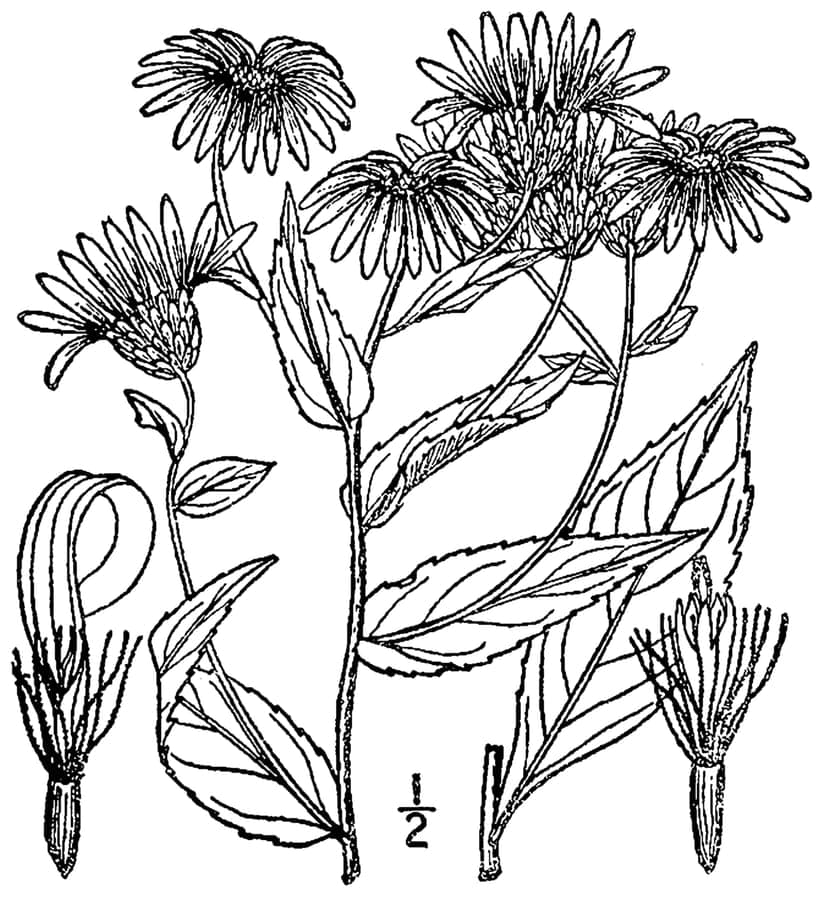
Britton, N.L., and A. Brown. 1913. An illustrated flora of the northern United States, Canada and the British Possessions. 3 vols. Charles Scribner's Sons, New York. Vol. 3: 425. Courtesy of Kentucky Native Plant Society. Scanned by Omnitek Inc. / Public domain, via Wikimedia Commons
Rough Aster: complete guide
Eurybia radula
Want to see Rough Aster: complete guide in your garden?
1 minute, no credit card
Overview
Eurybia radula, known as Rough Aster, Rough-leaf Aster, or Low Rough Aster, is an underrated North American native perennial distributed from eastern Canada to the northeastern United States. This hardy, low-growing plant is distinguished by its characteristically rough-textured leaves and charming purple flowers. It is an excellent choice for native plantings, woodland edges, and wildlife gardens.
Appearance and Bloom
Rough Aster forms a compact, spreading perennial 30-60 cm (12-24 inches) tall with a gradually widening habit. Leaves are narrow, lanceolate, approximately 2-4 cm long, featuring distinctive rough, bristly texture (hence "radula" - rasp-like). Flowers emerge in late summer through autumn, small to medium-sized purple-violet blooms in loose clusters. Individual flowers display 10-25 ray florets in shades of lavender-blue to deep purple.
Ideal Location
Rough Aster thrives in full sun to part shade. Minimum 4-6 hours direct sunlight daily is optimal. Part shade beneath light, open forest canopy is acceptable and reduces moisture stress. Protect from intense afternoon sun in extremely hot climates.
Soil
This plant is remarkably undemanding regarding soil. Dry to moderately moist, well-drained soils with pH 4.5 to 7.5 are ideal. The plant naturally inhabits woodland fragments and forest edges with modest soil. Avoid excess fertilization; marginal soils often produce superior flowering.
Watering
Eurybia radula is moderately drought-tolerant once established. During growth seasons (spring and early summer), provide regular water until well-rooted. During summer stress periods, maintain consistent moisture without waterlogging. Moist soils in partial shade may require less supplemental watering.
Free design
Want to see Rough Aster: complete guide in your garden? Make a free design now.
Pruning
Pruning is generally unnecessary. Remove dead canes in early spring. After blooming, old stems may be cut to half-height to encourage neat form. Self-sown seedlings can be removed if desired, though they rarely become weedy.
Maintenance Calendar
- Spring (March-May): Water when soil feels dry, remove dead canes
- Summer (June-August): Consistent moisture, monitor for wildlife visitors
- Autumn (September-October): Enjoy bloom spectacle, reduce watering
- Winter (November-February): Minimal care, dormant plant
Winter Hardiness
Eurybia radula is exceptionally hardy, suitable for USDA zones 3-9. This plant tolerates temperatures to -40°C (-40°F). Cold winters pose no threat; indeed, a cold period is beneficial for bloom initiation.
Companion Plants
Pair effectively with:
- Solidago species (goldenrod): synchronized autumn bloom
- Liatris species (blazing star): vertical contrast
- Rudbeckia species (black-eyed Susan): yellow complement
- Vernonia species (ironweed): deep autumn richness
- Anemone species (windflower): soft textural contrast
Closing Remarks
Eurybia radula is a native North American aster of genuine appeal and ecological value. With minimal care, this plant establishes as a robust, self-sufficient component of native plantings and wildlife gardens. Available from specialized native plant nurseries.
Add Rough Aster to your woodland edge design on gardenworld.app for authentic native fall spectacle and wildlife value.
Want to see Rough Aster: complete guide in your garden? Make a free design now.
Upload a photo, pick a style, and get a photorealistic design with plant list in under a minute.
10,000+ gardens designed already
No credit card required


Similar plants
Calendula stellata: complete guide
Calendula stellata
Complete guide to Calendula stellata, the star-flowered marigold from Sicily: location, soil, watering and companion planting tips.
Korean chrysanthemum: complete guide
Chrysanthemum x rubellum
Chrysanthemum x rubellum is a hardy autumn perennial with single pink to copper flowers from August to November. Care and combinations.
Helianthus divaricatus: complete guide
Helianthus divaricatus
Helianthus divaricatus is a North American woodland sunflower with yellow summer blooms, ideal for naturalistic borders and shady edges.