
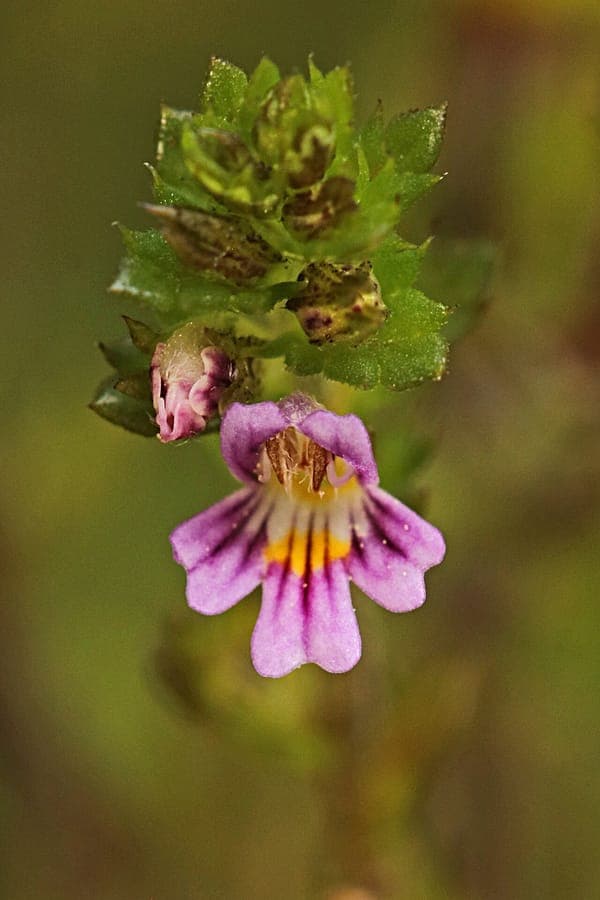
Knud Knudsen, Species recordings from the Danish National portal Arter.dk (Project by The Danish Environmental Protection Agency and The Natural History Museum of Denmark) / CC BY 4.0, via Wikimedia Commons
Northern eyebright: complete guide
Euphrasia micrantha
Want to see Northern eyebright: complete guide in your garden?
1 minute, no credit card
Overview
Northern eyebright (Euphrasia micrantha) is a slender, annual herb native to open, acidic grasslands across northern and central Europe. Growing 10–25 cm tall, it thrives in full sun and damp, low-nutrient soils. This unassuming plant plays a quiet but vital role in supporting pollinators and maintaining biodiversity in heath and meadow ecosystems. Its small, white flowers with subtle blue veining appear from June through October, peaking in midsummer. Found naturally in Austria, the Baltic States, Belgium, Russia, Czechia, Denmark, Finland, France, and Germany, it's a specialist plant best suited to naturalistic garden designs.
On gardenworld.app, you can design a planting scheme that aligns perfectly with Northern eyebright's light and soil needs, ensuring it integrates seamlessly into your landscape.
Appearance & bloom cycle
Northern eyebright features narrow, lance-shaped leaves with fine serrations and a soft green hue, sometimes flushed with purple near the stem. The flowers are tiny-only 5–8 mm across-clustered in loose spikes at the top of upright stems. Each bloom has a white lower lip with delicate blue or lilac veins, serving as nectar guides for small bees and hoverflies. The blooming period stretches from June to October, with the heaviest flowering in July and August. As a hemiparasite, it draws some nutrients from the roots of nearby grasses, particularly fine-leaved species like Deschampsia or Agrostis, but rarely harms its hosts.
Because of this parasitic trait, Northern eyebright doesn't transplant well and is best established from seed directly sown in place. It self-seeds readily in suitable conditions, returning year after year if undisturbed.
Ideal location
This plant demands high light-around a 7/10 on the sun scale-meaning it needs at least 5–6 hours of direct sunlight daily. Full sun in open meadows, heath edges, or sunny woodland margins is ideal. Avoid shady spots under trees or dense shrubs. Good air circulation is essential to prevent fungal issues, especially in humid summers.
In garden settings, Northern eyebright works well in wildlife meadows, rain gardens, or naturalistic rockeries with acidic soil. Pair it with other acid-loving perennials for a cohesive look. Make sure competing vegetation is kept in check, as aggressive grasses or weeds can quickly overwhelm it. You can map out its ideal placement using the planting planner on gardenworld.app, which helps visualise sun exposure and companion species.
Free design
Want to see Northern eyebright: complete guide in your garden? Make a free design now.
Soil requirements
Northern eyebright insists on acidic soil with a pH between 4.0 and 4.5. It dislikes alkaline or chalky soils, which inhibit its growth. The ideal substrate is moist, well-draining, and low in nutrients-think peaty sand, acidic loam, or heath soil. Avoid compost, manure, or fertilisers; enriching the soil will only encourage competitors.
To prepare a bed, mix equal parts ericaceous compost and sharp sand, then top-dress the surface without deep digging. This preserves the shallow root zone and allows natural seed germination.
Watering
Keep the soil consistently moist but never waterlogged. During dry spells in summer, water lightly in the morning using rainwater if possible-tap water is often too alkaline. Avoid wetting the foliage to reduce the risk of powdery mildew. Young seedlings are especially vulnerable to drying out, so monitor them closely in their first few weeks.
Pruning
No pruning is required. As an annual, Northern eyebright completes its lifecycle in one season. Allow the plants to die back naturally in autumn, leaving seed heads intact to self-sow. If you want to limit spread, snip off the flower spikes before seeds mature. Otherwise, let nature take its course.
Maintenance calendar
- March–April: Watch for seedlings. Remove invasive weeds like nettles or brambles.
- May: Protect young plants from late frosts. Maintain even moisture.
- June–August: Monitor flowering. No feeding needed.
- September: Check seed development. Thin overcrowded areas if necessary.
- October–November: Let plants senesce. Leave seeds on site for next season.
- December–February: No action. Seeds lie dormant in soil.
Winter hardiness
Northern eyebright is hardy in USDA zones 5–8. While the plant itself doesn't survive winter, its seeds overwinter in the soil and germinate in spring when temperatures rise and light increases. Avoid disturbing the soil in winter to preserve the seed bank.
Companion plants
Pair Northern eyebright with other acid-soil lovers: common heather (Calluna vulgaris), cotton grass (Eriophorum angustifolium), sundew (Drosera rotundifolia), and fine-leaved sedges (Carex flacca, C. panicea). Avoid nutrient-hungry or fast-spreading plants like tall meadow grasses or aggressive perennials. In a garden, it blends well with foxglove (Digitalis purpurea) or wild thyme (Thymus serpyllum), provided pH stays low.
Closing
Northern eyebright isn't for every garden-it's fussy about soil and light, and won't thrive in rich, cultivated beds. But for those aiming to create a wild, ecologically rich space, it's a rewarding choice. Its delicate presence adds texture and supports biodiversity without demanding much in return. You won't find it at most garden centres, but specialist native seed suppliers often carry it. For visual inspiration and layout planning, visit gardenworld.app to see how this subtle herb can enhance a thoughtfully designed natural garden.
Want to see Northern eyebright: complete guide in your garden? Make a free design now.
Upload a photo, pick a style, and get a photorealistic design with plant list in under a minute.
No credit card required


Similar plants
Northwestern Indian paintbrush: complete guide
Castilleja angustifolia
All about Castilleja angustifolia, the northwestern Indian paintbrush from dry western US steppes. Growing, care, and companion plant advice.
Wavyleaf Indian paintbrush: complete guide
Castilleja applegatei
Everything about Castilleja applegatei, the wavyleaf paintbrush from Oregon and California. Host plants, care, location, and garden use covered.
Bushy bird's-beak: complete guide
Cordylanthus ramosus
Complete guide to Cordylanthus ramosus, the hemiparasitic annual of western US steppes: ecology, host plants, cultivation and uses.