
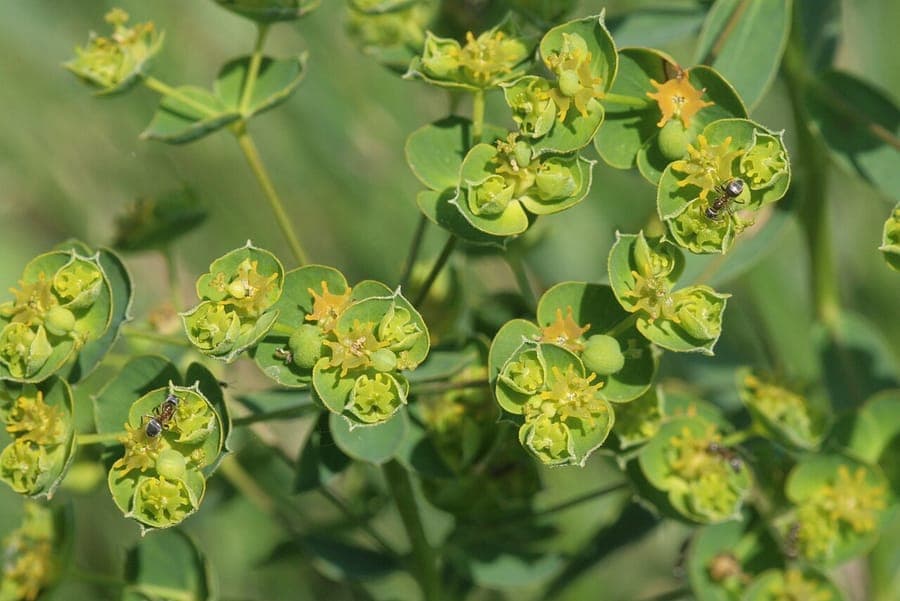
HermannSchachner / CC0, via Wikimedia Commons
Euphorbia virgata: complete guide
Euphorbia virgata
Want to see Euphorbia virgata: complete guide in your garden?
1 minute, no credit card
Euphorbia virgata, commonly known as leafy spurge or Waldstein's spurge, is an elegant herbaceous perennial from the Euphorbiaceae family native to Europe through Afghanistan. This species thrives in dry, sunny locations and provides interesting foliage throughout the growing season. The botanical name "virgata" refers to the slender, wand-like stems characteristic of this plant.\n\nEuphorbia virgata grows as a dense mound reaching 60 to 100 centimeters in height. The stems are narrow and distinctly upright, creating an elegant silhouette in the garden. In autumn, the foliage transforms to golden-yellow or orange tones, providing striking contrast alongside evergreen companions. Small yellow flowers emerge in dense clusters from May through June.\n\nThis plant requires full sun and well-draining soil to perform its best. Leafy spurge tolerates drought conditions exceptionally well and prefers sandy or gravelly substrates. Heavy clay or waterlogged soils must be avoided as they promote root rot. Once established, this perennial is remarkably drought-tolerant.\n\nWatering needs are minimal once the plant is fully established. During extended dry periods, supplemental water may be beneficial, but stagnant water must be prevented. Regular overwatering encourages fungal diseases. The plant thrives without frequent fertilization, though a thin layer of compost added in spring supports soil structure.\n\nMaintenance is straightforward for this plant. Spent flowers can be removed after blooming to maintain appearance. In late spring around March-April, cut stems back to approximately 10-15 centimeters to encourage denser branching. Cuts may exude milky sap, so work carefully and protect your hands.\n\nEuphorbia virgata displays excellent winter hardiness. This species survives temperatures below USDA zone 5 (to -28 degrees Celsius) without protection. Foliage dies back in winter, but new growth emerges reliably each spring. In temperate climates, no winter protection is required.\n\nMaintaining well-draining soil is the primary requirement for success. Combine this plant with other drought-loving species including lavender, stiff bottlebrush, or sedums. It provides excellent contrast in borders with silver foliage plants or dark-leaved cultivars. As a solitary specimen in Mediterranean gardens, it makes a strong architectural statement.\n\nPropagate through seed sown in spring or by division in late spring after foliage has died back. Seeds germinate better following stratification (cold treatment for 4-6 weeks).\n\nEuphorbia virgata is an underappreciated gem for cottage gardens and larger borders. With minimal care, this plant becomes a structural element providing visual interest throughout the year. Garden centers and independent retailers stock this species regularly. Visit gardenworld.app for specialized cultivation advice.
Want to see Euphorbia virgata: complete guide in your garden? Make a free design now.
Upload a photo, pick a style, and get a photorealistic design with plant list in under a minute.
No credit card required


Similar plants
Woolly mercury: complete guide
Mercurialis tomentosa
All about Mercurialis tomentosa, the woolly mercury from southwestern Europe: site, soil, watering, care and garden design tips.
Shurur: complete guide
Euphorbia fruticosa
Everything about Shurur: cultivation in dry climates, xeriscaping, care and tips for drought-resistant gardens in warm climates
Glary spurge: complete guide
Euphorbia glareosa
Everything about glary spurge: cultivation, maintenance, frost hardiness and use in Mediterranean and mountain-inspired gardens