
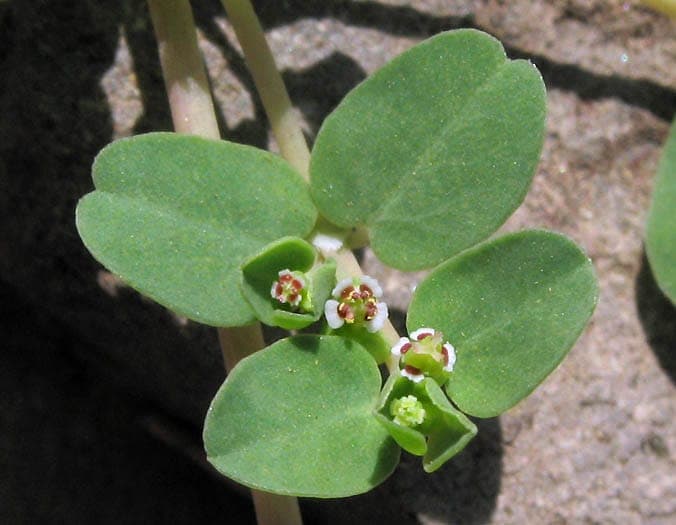
Anthony Valois and the National Park Service / Public domain, via Wikimedia Commons
Matted sandmat: complete guide
Euphorbia serpens
Want to see Matted sandmat: complete guide in your garden?
1 minute, no credit card
Overview
Euphorbia serpens, commonly known as Matted sandmat, is a low-growing annual that spreads quickly via creeping stems. Native to warm regions of South America and the southern United States, it adapts surprisingly well to temperate garden conditions, especially in dry, well-drained spots. In the UK and US, it's often used as a temporary ground cover in sunny borders, between stepping stones, or in gravel gardens. Despite its modest appearance, Matted sandmat is a resilient little plant that asks for very little in return.
Many gardeners don't realize this Euphorbia readily self-seeds, though it rarely becomes invasive in cooler climates. The plant dies back in winter, but if seeds land in a favorable spot, it may reappear the following year. On gardenworld.app you can create a garden design that perfectly incorporates Matted sandmat, especially in rock gardens or dry, sunny pathways where maintenance is kept to a minimum.
Appearance & bloom cycle
Matted sandmat forms a dense, mat-like cover with stems that creep outward up to 30 cm in diameter. It stays extremely low, typically under 5 cm tall, making it ideal for tight spaces. The small, oval leaves are light green to gray-green and closely spaced along the stems. They feel smooth to the touch - hence the name 'sandmat'.
Flowering occurs from June through October. The blooms are actually cyathia (specialized bracts), not true flowers, typical of Euphorbias. They're greenish-yellow to creamy white and appear in leaf axils. While not flashy, they add a subtle texture that keeps the plant looking fresh all summer. The extended bloom period ensures consistent coverage during peak growing months.
Ideal location
If you've got a hot, dry spot where other plants struggle, Matted sandmat is a solid choice. It needs at least 6 hours of direct sun daily to thrive. Partial shade is possible, but growth will be sparser and flowering reduced. Best locations include gaps between pavers, dry slopes, or along the edges of sunny patios.
Because it grows so low, it pairs well with taller, more structural plants. Think sedums, ornamental grasses, or upright salvias. On gardenworld.app you can experiment with plant combinations and spacing to find the right balance for your garden style.
Soil requirements
This plant doesn't need fertile soil - in fact, it performs better in poor, sandy, or rocky conditions. Heavy clay is a problem unless amended with sand or gravel. Aim for a pH between 6.0 and 7.5. For container growing, use a mix of potting soil with added perlite or coarse sand (2:1 ratio).
Crucially, it hates wet feet. Matted sandmat is highly drought-tolerant but susceptible to root rot in soggy soil. Always ensure excellent drainage, especially during wet springs or rainy summers.
Free design
Want to see Matted sandmat: complete guide in your garden? Make a free design now.
Watering
Once established, Matted sandmat rarely needs supplemental watering. During the first few weeks after sowing or transplanting, keep the surface lightly moist, especially in dry spells. Water 1–2 times per week using a fine spray to avoid disturbing delicate stems.
In average UK or US summers, rainfall is usually sufficient. Only water during prolonged dry periods (over 10 days without rain), and even then, go easy. Overwatering is a much bigger threat than underwatering.
Pruning
Pruning isn't usually necessary for this annual. It grows naturally compact and spreads without becoming leggy. If you want a neater edge in a pathway or border, trim the perimeter with sharp scissors or hand shears in July or August, when growth is strongest.
Caution: the plant exudes a milky sap that can irritate skin and eyes. Wear gloves when handling, and wash hands thoroughly afterward. Keep children and pets away during maintenance.
Maintenance calendar
- March–April: Check for self-sown seedlings. Remove moss or competing weeds.
- May: Sow fresh seed or transplant young plants. Keep lightly moist in dry spells.
- June–July: Monitor growth density. Light watering during drought.
- August–September: Peak blooming. No feeding required.
- October: Plants die after frost. Remove debris or leave as light mulch.
- November–February: No action needed.
Winter hardiness
Matted sandmat is not winter-hardy in the UK or most of the US. As an annual, it won't survive freezing temperatures. However, it may self-seed if seeds fall in protected areas. For more reliable returns, collect seeds in autumn and resow in spring. It's hardy in USDA zones 9–11 as a perennial, but in cooler zones, treat it as a summer annual.
Companion plants
This plant pairs well with other drought-tolerant species. Consider:
- Sedum spurium (20–25 cm tall)
- Thymus serpyllum (creeping thyme)
- Artemisia schmidtiana (silver mound)
- Nepeta faassenii (catmint)
- Echinacea purpurea (coneflower)
Space companions at least 15 cm apart to give Matted sandmat room to spread without competition. Use gravel or edging to guide growth.
Closing
Matted sandmat isn't a showy plant, but it's a quiet achiever in the garden. With minimal care, it delivers reliable ground cover for tricky spots. Its low profile and drought tolerance make it perfect for low-maintenance, modern gardens. Buy seeds or young plants from garden centres, or visit retailers like OBI and Hornbach in Germany, Truffaut and Jardiland in France, or local nurseries in the US and UK. When planning your layout, use gardenworld.app to visualize how this subtle plant fits into your overall design.
Want to see Matted sandmat: complete guide in your garden? Make a free design now.
Upload a photo, pick a style, and get a photorealistic design with plant list in under a minute.
No credit card required


Similar plants
Woolly mercury: complete guide
Mercurialis tomentosa
All about Mercurialis tomentosa, the woolly mercury from southwestern Europe: site, soil, watering, care and garden design tips.
Shurur: complete guide
Euphorbia fruticosa
Everything about Shurur: cultivation in dry climates, xeriscaping, care and tips for drought-resistant gardens in warm climates
Glary spurge: complete guide
Euphorbia glareosa
Everything about glary spurge: cultivation, maintenance, frost hardiness and use in Mediterranean and mountain-inspired gardens