
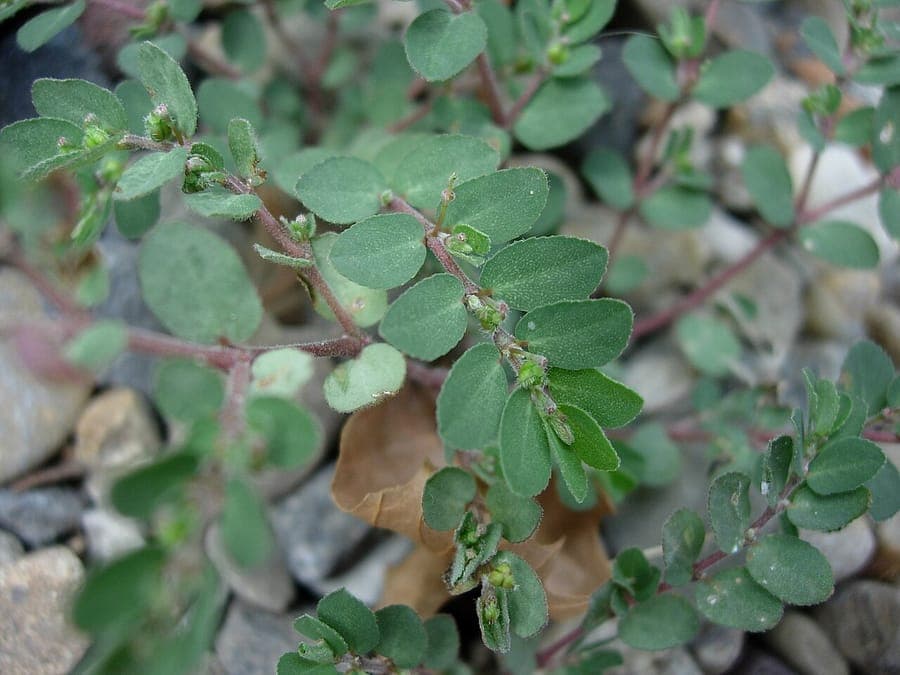
toony / CC BY-SA 3.0, via Wikimedia Commons
Prostrate spurge: complete guide
Euphorbia prostrata
Want to see Prostrate spurge: complete guide in your garden?
1 minute, no credit card
Overview
Prostrate spurge (Euphorbia prostrata) is a low, spreading groundcover hailing from warm regions of Central and South America. With its fine, red-tinted foliage densely-packed in trailing mats, it forms an elegant, supportive living carpet just 5-15 cm tall. This plant thrives in heat, drought, and full sun conditions better than most conventional groundcovers.
Appearance and bloom cycle
Prostrate spurge spreads horizontally, displaying fine elliptical leaves that often develop reddish or purplish tones in response to sun stress or cooler temperatures. The entire plant takes on a reddish-brown sheen in warm conditions. From July through September, tiny, easily-overlooked greenish flowers appear in leaf axils - actually cyathia, the characteristic bloom structure of Euphorbia. Appeal lies in fine foliage and compact form rather than floral display.
Ideal location
Prostrate spurge demands full sun and warm sites. Provide 6+ hours of direct daily light. It thrives on sunny banks, raised beds, and gravel terraces. In temperate climates, position in the warmest available site. This is frost-tender (USDA 9-11), suitable outdoors year-round only in warm regions. Elsewhere, containerize and move to shelter during colder months.
Soil requirements
Poor, coarsely-drained ground is perfect. Mix 60% coarse sand, 20% small gravel, 15% minimal organic matter, 5% peat or leaf mould. Heavy clay is harmful. Container mix: 50% perlite, 30% coarse sand, 20% loam-based compost. Alkaline soil is tolerated. The plant grows on moderately fertile soils but lean conditions are superior - avoiding rank, sappy growth.
Watering
One of the most drought-tolerant plants available. Once established, water minimally. Summer watering no more than once every 2 weeks, lightly applied. During extreme heat and dryness, slightly more frequent misting helps, but overwatering is toxic. Pot plants: once per 3 weeks in summer, less thereafter. Rot develops rapidly with excess moisture; underwatering is preferable to overwatering.
Free design
Want to see Prostrate spurge: complete guide in your garden? Make a free design now.
Pruning
Minimal work required. Plants naturally maintain compact, low growth. If growth exceeds boundaries, simply trim back to desired extent. Remove dead foliage freely but no other cleaning is necessary. In late spring, light pinching encourages denser growth. Wear gloves as sap causes irritation.
Maintenance calendar
- January-February: Frost protection outdoors; minimal watering
- March-April: Gentle growth resumption; minimal watering
- May-June: Growth accelerates; slightly more frequent watering
- July-August: Flowering period; very minimal watering
- September-October: Growth slows; reduce watering
- November-December: Dormancy; minimal water
Winter hardiness
Prostrate spurge is frost-tender, tolerating only -2 to 0°C without serious damage. In cooler climates, grow outdoors only in warm regions (zones 9-11) or highly sheltered south-facing sites. Elsewhere, containerize and move to frost-free shelter - a cold frame, conservatory, or very well-protected entrance. A heavy mulch layer outdoors helps marginally but protection is uncertain.
Companion plants
Prostrate spurge combines beautifully in succulent arrangements and hot, dry groundcover schemes. Space plants 20-25 cm apart. Ideal companions:
- Sedum species in various cultivars
- Sempervivum (hens-and-chicks)
- Delosperma (ice plant)
- Gazania in warm tones
- Orostachys in silver tinges
Each shares prostrate spurge's heat-loving, drought-tolerant character.
Closing
Prostrate spurge is perfect for gardeners seeking a low groundcover thriving with minimal care. Hot, dry, sunny gardens receive elegant infill. For those without garden space, it performs beautifully in containers on warm terraces. Explore drought-tolerant combinations using Gardenworld.app, discovering succulent schemes that pair with prostrate spurge for modern xeriscape design. Use Gardenworld.app to craft a genuinely water-wise garden requiring minimal intervention.
Want to see Prostrate spurge: complete guide in your garden? Make a free design now.
Upload a photo, pick a style, and get a photorealistic design with plant list in under a minute.
No credit card required


Similar plants
Woolly mercury: complete guide
Mercurialis tomentosa
All about Mercurialis tomentosa, the woolly mercury from southwestern Europe: site, soil, watering, care and garden design tips.
Shurur: complete guide
Euphorbia fruticosa
Everything about Shurur: cultivation in dry climates, xeriscaping, care and tips for drought-resistant gardens in warm climates
Glary spurge: complete guide
Euphorbia glareosa
Everything about glary spurge: cultivation, maintenance, frost hardiness and use in Mediterranean and mountain-inspired gardens