
Frank Vincentz / CC BY-SA 3.0, via Wikimedia Commons
Euphorbia meloformis: complete guide
Euphorbia meloformis
Want to see Euphorbia meloformis: complete guide in your garden?
1 minute, no credit card
Overview
Euphorbia meloformis, commonly called melon spurge or melon-shaped spurge, is an exceptional succulent native to South Africa. Belonging to the Euphorbiaceae family, this plant is renowned for its unique globe-shaped stems. In its natural habitat, it thrives in dry, rocky areas of the Cape region.
This remarkable plant excels in container cultivation, dry gardens, and cactus arrangements. With minimal water requirements and distinctive architectural form, it serves as a stunning focal point.
Appearance and Bloom
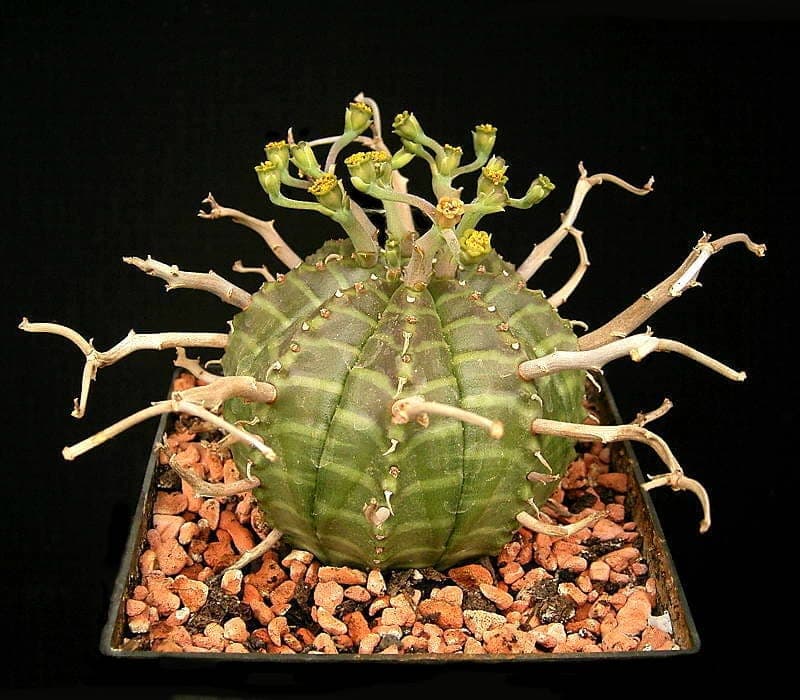
Euphorbia meloformis grows as a single, rarely branching plant with strongly succulent stems swollen to near-perfect spheres. Stem color ranges from blue-green to gray-green with scattered tubercles bearing tiny leaves that quickly drop. Plants reach 20-40 centimeters tall.
Flowers are small and inconspicuous, yellow to reddish, appearing mainly in spring at the plant's apex. While botanically interesting, flowers are not spectacular. The true charm lies in the form: massive, swollen stem resembling a melon.
Ideal Location
Select the brightest, sunniest location possible for Euphorbia meloformis. The plant thrives with 8+ hours of direct sunlight daily. Insufficient light causes etiolation (stretching).
The plant suits windowsill cultivation or bright terrace placement perfectly. Windy locations are acceptable and even beneficial. Avoid deeply shaded areas and enclosed spaces with stagnant air.
Soil
Euphorbia meloformis demands extremely well-draining soil. Use pure cactus mix or prepare homemade mixture: 50% garden soil mixed with 50% coarse sand or perlite. Adding extra coarse gravel improves drainage further.
Acidic to neutral soils are preferred. Avoid clay-heavy soils and constantly moist media. The plant tolerates even extremely impoverished soils - nutrient-rich mediums can actually be harmful.
Watering
Euphorbia meloformis should be grown very dry. During growing season (spring-summer) water very sparingly, waiting until soil is completely dry between waterings. Winter essentially demands no water.
The plant stores substantial water in its stem and can survive months without water. Overwatering is the most frequent cause of death. Excellent drainage and cautious watering are essential.
Free design
Want to see Euphorbia meloformis: complete guide in your garden? Make a free design now.
Pruning
Euphorbia meloformis normally requires no pruning. The plant naturally forms a compact shape. Damaged or diseased parts may be carefully removed, but avoid cutting into healthy tissue as wounds can provide infection entry points.
Sometimes offspring plantlets develop from damaged areas, which can be interesting for propagation purposes.
Maintenance Calendar
Spring: Carefully repot in fresh cactus mix. Begin watering as new growth appears. Apply minimal feeding (dilute fertilizer).
Summer: Continue watering only when soil completely dries. Cease feeding. Enjoy growth and sunshine. No pruning or disturbance.
Autumn: Gradually reduce watering. No feeding. Prepare plant for winter dormancy.
Winter: Give virtually no water. Maintain complete dormancy. No feeding or manipulation.
Winter Hardiness
Euphorbia meloformis is sensitive to frost. In regions with temperatures below 10 degrees Celsius, grow indoors or provide frost protection. The plant can recover from brief chilling but cannot tolerate freezing.
In mild climates, plant in protected raised beds that prevent hard frosts. Container cultivation is therefore recommended for northern Europe.
Companion Plants
In cactus arrangements, combine Euphorbia meloformis successfully with:
- Aloe species: similar habit and water needs
- Echeveria: interesting leaf forms for contrast
- Stapelia: flowers where euphorbia lacks them
- Sedum morganianum: cascading forms for contrast
- Lithops: very compact forms for contrast
- Haworthia: matching extreme drought preference
Avoid planting partners with higher water requirements.
Closing
Euphorbia meloformis is a strikingly interesting plant for succulent collectors and enthusiasts. With unique form, extreme drought tolerance, and minimal maintenance demands, it represents the ultimate "set it and forget it" plant. Whether building a cactus collection or seeking botanical curiosity, this South African gem absolutely deserves consideration.
Light availability through specialized cactus and succulent retailers online. Ideally grown in pots in homes with abundant daylight or on bright terraces.
Want to see Euphorbia meloformis: complete guide in your garden? Make a free design now.
Upload a photo, pick a style, and get a photorealistic design with plant list in under a minute.
No credit card required


Similar plants
Woolly mercury: complete guide
Mercurialis tomentosa
All about Mercurialis tomentosa, the woolly mercury from southwestern Europe: site, soil, watering, care and garden design tips.
Shurur: complete guide
Euphorbia fruticosa
Everything about Shurur: cultivation in dry climates, xeriscaping, care and tips for drought-resistant gardens in warm climates
Glary spurge: complete guide
Euphorbia glareosa
Everything about glary spurge: cultivation, maintenance, frost hardiness and use in Mediterranean and mountain-inspired gardens