
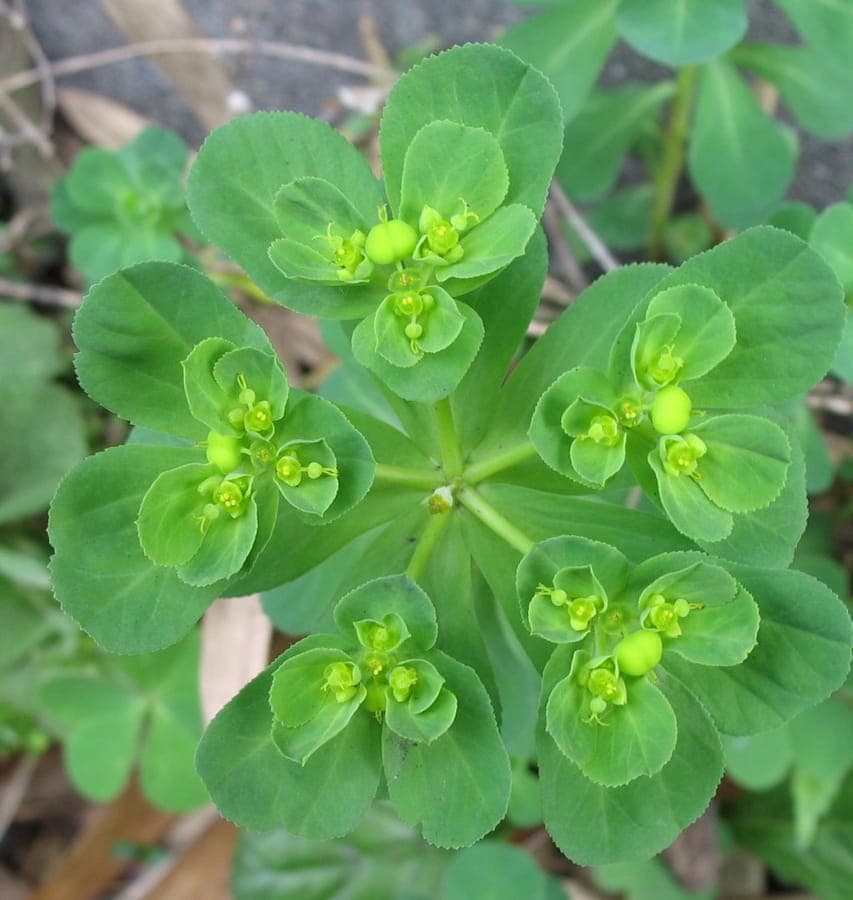
Sphl / CC BY-SA 3.0, via Wikimedia Commons
Sun spurge: complete guide
Euphorbia helioscopia
Want to see Sun spurge: complete guide in your garden?
1 minute, no credit card
Overview
Sun spurge (Euphorbia helioscopia), also called umbrella spurge or madwoman's milk, is a fascinating annual that often appears spontaneously in temperate gardens. The name refers to its heliotropic (sun-tracking) habit - its rounded umbel flowers angle toward the sun throughout the day, and the plant's growth favors sunny exposures.
While technically a weed, sun spurge is increasingly appreciated by gardeners for its delicate form and extended bloom period from spring through autumn.
Appearance & bloom cycle
Sun spurge grows as an elegant, branching plant from 15-40 cm tall with broad, spoon-shaped leaves. From April through October, characteristic yellow-green flowers appear in distinctive rounded clusters (cyathia) resembling tiny jeweled crowns.
All parts contain mildly toxic milky sap, so cautious handling is wise, especially around children.
Ideal location
Sun spurge thrives in full sun, though it tolerates lighter shade adequately. The plant is remarkably flexible - it appears spontaneously in unexpected places, indicating how undemanding it truly is regarding siting.
Soil requirements
Sun spurge accepts virtually all soil types provided they drain reasonably well. It grows equally in rich and poor soils, making it ideal for experimental planting and awkward corners where you're uncertain what else might work.
Free design
Want to see Sun spurge: complete guide in your garden? Make a free design now.
Watering
Once established, sun spurge requires minimal supplemental watering. Newly sown seed needs regular moisture, but thereafter water only during severe droughts.
Sowing & propagation
Sun spurge self-seeds easily. Sow seed directly in April where you want plants to grow, or sow indoors for later transplanting. Interestingly, volunteer seedlings often choose ideal locations without deliberate placement.
Maintenance calendar
April-May: Sow directly outdoors or indoors for later planting May-October: Peak flowering and seed production October-November: Collect seed for next season if desired
Winter hardiness
Sun spurge seed does not overwinter; plants die with the first hard frosts - as expected for an annual. The plant resows so readily, however, that volunteers typically appear the following season without intervention.
Companion plants
Sun spurge combines well with:
- Other spring annuals like California poppies
- Wildflower mixes - natural appearance
- Fine ornamental grasses - airy effect
Closing
While often dismissed as a weed, sun spurge offers considerable charm and reliable color. Its spontaneous presence gives gardens a playful, free-spirited character. On gardenworld.app you can explore how this spontaneous bloomer fits into your garden design vision.
Want to see Sun spurge: complete guide in your garden? Make a free design now.
Upload a photo, pick a style, and get a photorealistic design with plant list in under a minute.
No credit card required


Similar plants
Woolly mercury: complete guide
Mercurialis tomentosa
All about Mercurialis tomentosa, the woolly mercury from southwestern Europe: site, soil, watering, care and garden design tips.
Shurur: complete guide
Euphorbia fruticosa
Everything about Shurur: cultivation in dry climates, xeriscaping, care and tips for drought-resistant gardens in warm climates
Glary spurge: complete guide
Euphorbia glareosa
Everything about glary spurge: cultivation, maintenance, frost hardiness and use in Mediterranean and mountain-inspired gardens