
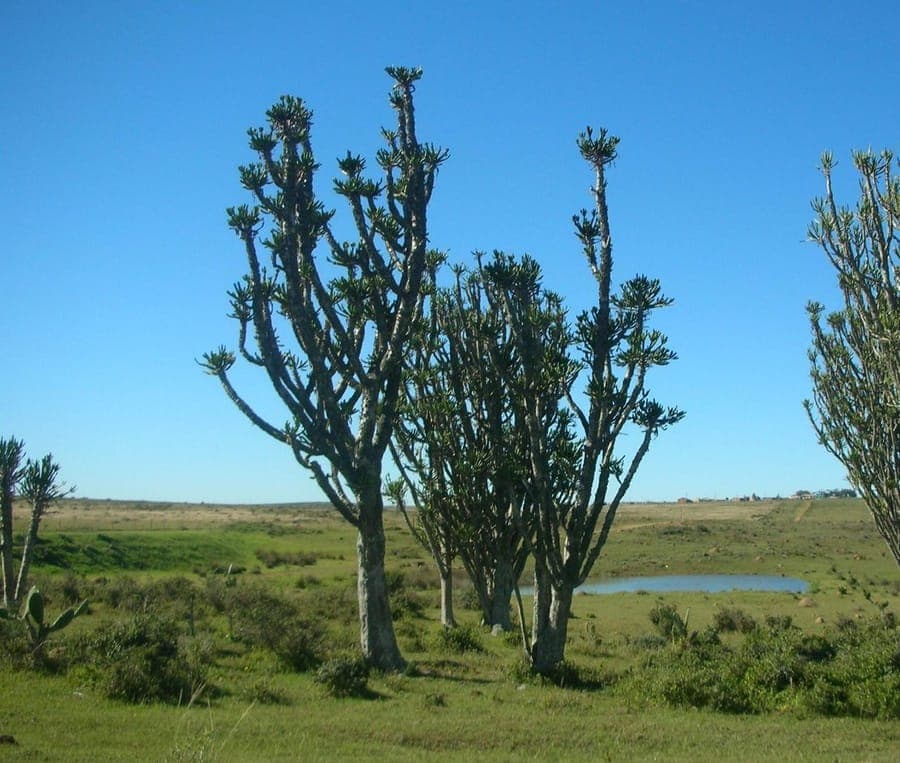
Xufanc / CC BY-SA 3.0, via Wikimedia Commons
Euphorbia grandidens: complete guide
Euphorbia grandidens
Want to see Euphorbia grandidens: complete guide in your garden?
1 minute, no credit card
Overview
Euphorbia grandidens, known as the large-toothed euphorbia or valley bush euphorbia, is an impressive, tree-shaped succulent from the family Euphorbiaceae. This unique plant is native to southeastern Africa, with distribution from Mozambique to the Cape Provinces of South Africa. In its natural habitat, this plant grows as a medium-sized tree reaching 5 to 8 meters in height, but in cultivation it remains smaller, usually 2 to 4 meters.
Euphorbia grandidens is known for its thick, gray trunk and its characteristic growth pattern with large, blue-green branches. The plant is widely used in xeriscapes and large container gardens in warm climates. This article covers all aspects of successfully growing this beautiful tree.
Appearance and Bloom
Euphorbia grandidens is immediately recognizable by its tree-like structure with a thick, gray to brown-gray trunk. The trunk can reach 30 to 60 centimeters in diameter in mature specimens. The branches grow horizontally or slightly upward, creating a wide, spreading crown.
The leaves are small to medium, elongated-spatulate, green to gray-green in color. They grow along the branches and largely disappear during dry seasons. This is an adaptation to the dry South African climates.
The flowers are small and inconspicuous, yellowish-green in color, appearing in clusters at the branch tips. They bloom in spring and early summer. The flowers are followed by three-lobed fruits.
Ideal Location
Euphorbia grandidens grows best in very sunny locations with plenty of space. In its natural habitat, it grows on hillsides and valleys with full sun exposure. For optimal growth, place the plant in a very sunny spot, receiving at least 6 to 8 hours of direct sunlight daily.
The plant can grow both indoors (in a very large greenhouse) and outdoors in warm climates. In USDA zones 9 to 13, it can remain outdoors year-round. In cooler climates, it must be kept indoors or in a warm greenhouse.
Ensure the plant has plenty of space to grow. This is not a small plant. Do not place it in small spaces or close to buildings.
Soil
Euphorbia grandidens requires well-draining soil. In the wild, it grows in rocky, mineral-rich soils. For cultivation, use a mixture of 1 part potting soil to 2 parts mineral material such as sand or perlite.
The plant also grows well in loamy soil with good drainage. pH may be neutral to slightly acidic. Ensure water does not accumulate in the pot.
When planting outdoors in warm climates, dig a large hole and improve the soil with sand and gravel as needed for drainage.
Free design
Want to see Euphorbia grandidens: complete guide in your garden? Make a free design now.
Watering
Euphorbia grandidens is very drought-tolerant once established. However, young plants need regular watering to develop a strong root system. Water young plants weekly during the growing season.
Adult plants need much less water. During the growing season, water monthly or less. Always test the soil before watering. In winter, water very rarely or not at all.
Excessive water is harmful. Ensure the soil can dry completely between waterings.
Pruning
Euphorbia grandidens can be pruned to maintain shape or to remove dead branches. The best time for pruning is in early spring. Pruning stimulates bushier growth.
Be careful with the milky sap - it can be irritating. Wear gloves and wash your hands thoroughly after pruning.
The plant grows naturally in an attractive tree form, so extensive pruning is not needed.
Maintenance Calendar
In spring (March-May), the plant begins to grow. This is the best time for pruning and repotting. Water regularly and add fertilizer once monthly.
In summer (June-August), the plant grows actively. Water as needed. Ensure the plant has protection from extremely hot afternoon sun in very hot climates.
In fall (September-October), growth slows. Gradually reduce watering.
In winter (November-February), the plant rests. Minimal water. Keep temperature above 10 degrees Celsius.
Winter Hardiness
Euphorbia grandidens is not winter-hardy in temperate climates. Temperatures below 10 degrees Celsius cause damage. In warm climates (USDA zones 10-13), it may overwinter outdoors.
In cooler regions, it must overwinter indoors or in a large greenhouse. Place it in a warm, sunny location.
Companion Plants
Euphorbia grandidens combines well with other large xeric plants:
Other Euphorbia species can grow together. Acacias and other tree-like xeric plants are compatible. For landscape design, combine with other South African plants such as Protea and Leucadendron.
Closing
Euphorbia grandidens is an impressive tree euphorbia that makes a statement in any warm-climate garden. With its characteristic tree form, gray trunk, and extreme drought resistance, it is an ideal plant for large landscapes and xeriscapes.
Provide plenty of sun, good drainage, and minimal water once established. This plant will grow for decades and transform your garden.
For more inspiration, visit gardenworld.app. For purchase in warm regions, contact local garden centers for advice on large container plants.
Want to see Euphorbia grandidens: complete guide in your garden? Make a free design now.
Upload a photo, pick a style, and get a photorealistic design with plant list in under a minute.
No credit card required


Similar plants
Woolly mercury: complete guide
Mercurialis tomentosa
All about Mercurialis tomentosa, the woolly mercury from southwestern Europe: site, soil, watering, care and garden design tips.
Shurur: complete guide
Euphorbia fruticosa
Everything about Shurur: cultivation in dry climates, xeriscaping, care and tips for drought-resistant gardens in warm climates
Glary spurge: complete guide
Euphorbia glareosa
Everything about glary spurge: cultivation, maintenance, frost hardiness and use in Mediterranean and mountain-inspired gardens