
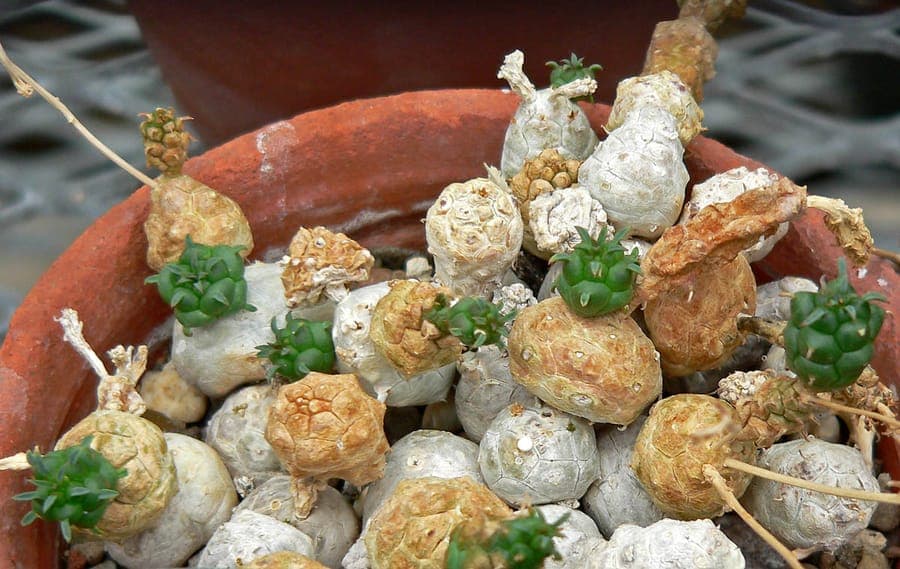
Stan Shebs / CC BY-SA 3.0, via Wikimedia Commons
Euphorbia globosa: complete guide
Euphorbia globosa
Want to see Euphorbia globosa: complete guide in your garden?
1 minute, no credit card
Overview
Euphorbia globosa, also known as the globose euphorbia or ball euphorbia, is a fascinating succulent with a highly recognizable, nearly perfect spherical shape. This small but striking plant is native to the Cape Provinces of South Africa, where it grows in dry, rocky areas with minimal rainfall. With its compact growth and attractive form, this plant is a popular choice for succulent collectors and garden enthusiasts.
The plant typically reaches heights of 20 to 30 centimeters with similar width, creating a nearly perfect spherical silhouette. The plant grows very slowly, which means it maintains the same size for many years. This makes it ideal for container gardens, rock gardens, and xeriscapes.
Caring for Euphorbia globosa is relatively simple for anyone who understands basic succulent care.
Appearance and Bloom
Euphorbia globosa is immediately recognizable by its characteristic spherical formation. The plant consists of dense, clustered stems that branch from the base, all growing upward to form that perfect ball shape. The stems are green, smooth, and relatively slender.
The leaves are extremely small and linear, usually clustered at the stem tops. They are blue-green in color and largely disappear during dry seasons. This is an adaptation to drought.
Flowers appear at the stem tops and are small, yellow cyathiums (pseudoflowers). They grow in small clusters and attract pollinators in spring and early summer. The flowers are followed by small fruits.
Ideal Location
Euphorbia globosa grows best in very sunny locations. In its natural habitat, it grows on sunny mountain slopes. For optimal growth, choose a location with at least 6 to 8 hours of direct sunlight daily. A south or southwest-facing window is ideal.
The plant can grow both indoors and outdoors, depending on the climate. In warm, dry regions (USDA zones 9-11), the plant can remain outdoors year-round. In cooler climates, it is better kept indoors or in a greenhouse.
Ensure the plant has good air circulation. Poor ventilation can lead to fungal diseases.
Soil
Euphorbia globosa needs very well-draining soil, like all succulents. Use a mixture of 1 part potting soil to 2 parts coarse sand, perlite, or other mineral materials. The plant also grows well in pure cactus soil.
The pH should be neutral to slightly acidic. The plant is not fussy about nutrient content, but good drainage is absolutely essential. Poor drainage will immediately lead to root rot.
Repot every two to three years in early spring. Use pots slightly larger than the root system.
Free design
Want to see Euphorbia globosa: complete guide in your garden? Make a free design now.
Watering
Euphorbia globosa is very drought-tolerant and requires minimal water. During the growing season (spring and summer), water once monthly or less. Always test the soil first - it must be completely dry before watering.
In fall and winter, greatly reduce watering or stop entirely. The plant can survive months without water. Excessive water is the main cause of death.
When watering, use pure water (rainwater is ideal) and water at the base of the pot. Avoid misting the plant.
Pruning
Euphorbia globosa rarely needs pruning. The plant naturally maintains its ball shape. You can remove dead or damaged stems, but this is not necessary.
Be careful with the milky sap the plant may exude - this can be irritating.
Maintenance Calendar
In spring (March-May), the plant begins to grow. This is the best time to repot and gradually increase watering. Add fertilizer once every two weeks.
In summer (June-August), the plant grows actively. Water monthly and fertilize equally. Ensure adequate air circulation.
In fall (September-October), growth slows. Reduce water and stop fertilizing.
In winter (November-February), the plant rests. Water very rarely or not at all. Keep temperature above 8 degrees Celsius.
Winter Hardiness
Euphorbia globosa is not winter-hardy in temperate climates. The plant can suffer frost damage at temperatures below 5 degrees Celsius. In very warm climates (USDA zones 10-13), it may overwinter outdoors.
In cooler climates, it must overwinter indoors or in a greenhouse. Place it in a cool, dry location with minimal water.
Companion Plants
Euphorbia globosa combines beautifully with other small succulents and xeric plants. Consider:
Other small Euphorbia species form interesting groupings. Echeveria, Graptopetalum, and other rosette-shaped succulents contrast well. Lithops (living stones) grow well nearby. Small cactus species are compatible.
Closing
Euphorbia globosa is a charming small plant requiring minimal care. With its unique ball-like form and extreme drought resistance, it is a perfect choice for dry gardens and succulent collectors.
Remember: water very rarely, good drainage, plenty of sun. Follow these simple rules and your Euphorbia globosa will thrive for many years.
For more information about succulents, visit gardenworld.app. For purchase, try local garden centers that stock succulents regularly.
Want to see Euphorbia globosa: complete guide in your garden? Make a free design now.
Upload a photo, pick a style, and get a photorealistic design with plant list in under a minute.
No credit card required


Similar plants
Woolly mercury: complete guide
Mercurialis tomentosa
All about Mercurialis tomentosa, the woolly mercury from southwestern Europe: site, soil, watering, care and garden design tips.
Shurur: complete guide
Euphorbia fruticosa
Everything about Shurur: cultivation in dry climates, xeriscaping, care and tips for drought-resistant gardens in warm climates
Glary spurge: complete guide
Euphorbia glareosa
Everything about glary spurge: cultivation, maintenance, frost hardiness and use in Mediterranean and mountain-inspired gardens