
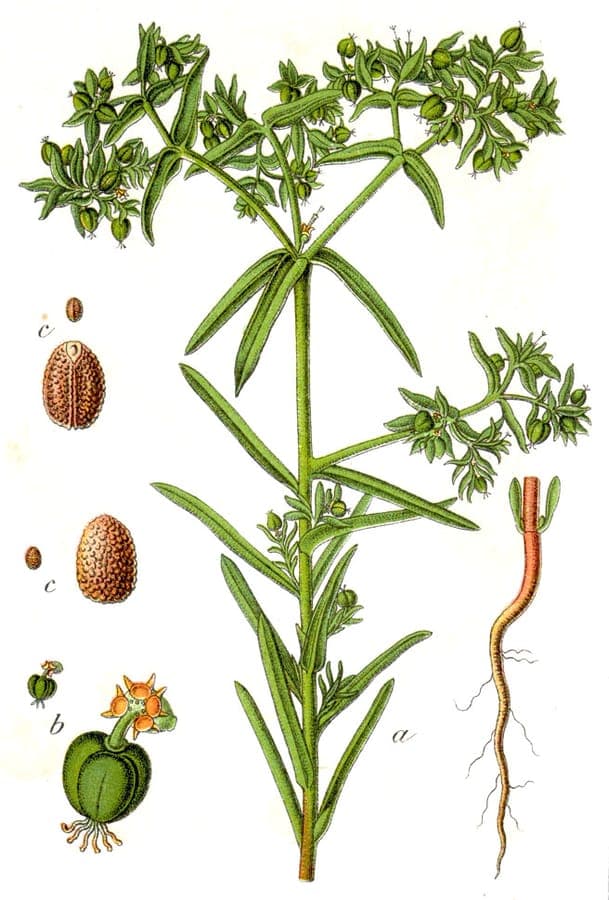
Johann Georg Sturm (Painter: Jacob Sturm) / Public domain, via Wikimedia Commons
Dwarf spurge: complete guide
Euphorbia exigua
Want to see Dwarf spurge: complete guide in your garden?
1 minute, no credit card
Overview
Dwarf spurge (Euphorbia exigua) is a modest, annual herb that rarely exceeds 15 cm in height, yet makes a quiet but valuable contribution to naturalistic garden designs. Native to rocky slopes and dry grasslands across southern Europe and the Mediterranean, it thrives in lean, well-drained soils where many other plants struggle. This unassuming member of the spurge family is perfect for gardeners who appreciate subtle structure and long seasonal interest without demanding care.
Though not flashy, dwarf spurge has a certain resilience and charm. It works well in rock gardens, gravel beds, or as a soft filler along dry pathways. On gardenworld.app, you can design a planting scheme that highlights dwarf spurge's growth pattern and seasonal rhythm, ensuring it fits seamlessly into your garden layout.
Appearance & bloom cycle
Dwarf spurge forms low, branching stems with narrow, lance-shaped leaves about 1–2 cm long. The foliage is pale green with a distinct central vein, arranged alternately along the stem. From April through October, it produces tiny yellow cyathia - the unique flower-like structures typical of Euphorbiaceae. The peak bloom occurs in June and July, offering a soft golden haze that catches the light in dry, open areas.
While the flowers aren't large, they attract beneficial insects such as hoverflies and parasitic wasps, supporting natural pest control. The plant self-seeds gently and isn't invasive. After flowering, it dries completely by late autumn, leaving behind delicate brown stems that can be left for winter texture or cleared in November.
Ideal location
Plant dwarf spurge in full sun to light shade. South- or southeast-facing spots with high heat retention work best - think rock crevices, dry banks, or between paving stones. It's ideal for gravel gardens, xeriscapes, or the front of sunny borders.
Avoid shady, damp areas. In poorly drained or cool corners, the stems become weak and prone to fungal issues. Use gardenworld.app to map sunlight patterns in your garden and pinpoint the warmest, driest zones for planting dwarf spurge successfully.
Soil requirements
This plant thrives in poor, sandy, or stony soils with excellent drainage. It tolerates a pH range from slightly acidic to slightly alkaline (5.5–7.5). Rich, fertile soil encourages weak growth and reduces hardiness. Dwarf spurge is a natural fit for low-fertility sites where lawn grass struggles to establish.
If your soil is heavy or nutrient-rich, amend the top 10 cm with coarse sand or grit to improve drainage. Avoid compost and fertilizer - they do more harm than good.
Free design
Want to see Dwarf spurge: complete guide in your garden? Make a free design now.
Watering
Dwarf spurge is highly drought-tolerant. Once established, it rarely needs supplemental water, even during prolonged dry spells. Overwatering is the main cause of failure. Soggy soil leads to root rot and collapse.
Young seedlings may benefit from a light sprinkle during exceptionally dry springs, but they usually tap into subsoil moisture within a month. Use rainwater when possible - tap water with high lime content can affect soil pH over time.
Pruning
No pruning required. As an annual, dwarf spurge completes its life cycle in one season. You can cut back dead stems in autumn if you prefer a tidy look, but leaving them supports self-seeding and adds winter interest. Never prune during active growth - it stresses the plant unnecessarily.
Maintenance calendar
- Jan: Dormant; no action needed
- Feb: Check soil for seed bank, prepare for spring
- Mar: Sow seeds directly or clear competing weeds
- Apr: Seedlings emerge; monitor moisture
- May: Early flowering begins; check for insect activity
- Jun: Peak bloom; ensure site remains dry
- Jul: Flowering continues; watch for stem lodging
- Aug: Ongoing bloom; minimal care
- Sep: Seeds ripen and disperse naturally
- Oct: Cut back or leave standing
- Nov: Clear if desired; no feeding
- Dec: Dormant; prepare for next season
Winter hardiness
Dwarf spurge is an annual and does not survive winter as a mature plant. However, its seeds overwinter reliably, tolerating frost down to -15°C. No protection is needed. In mild winters, seedlings may appear as early as February.
Excess winter moisture can reduce seed viability, so ensure the site drains well year-round.
Companion plants
Pair dwarf spurge with other drought-tolerant species like Thymus serpyllum, Sedum acre, or Bellis perennis. Avoid aggressive, moisture-loving plants such as Hosta or ferns. It works well as a ground-level accent in low borders or between stepping stones.
Combine with aromatic herbs like thyme or oregano to attract more pollinators and create a resilient, low-care planting group.
Closing
Dwarf spurge won't win any beauty contests, but it earns its place through reliability and ease. It asks for little, blooms for months, and thrives where other plants fail. Find seeds or young plants at garden centres in spring, including well-known retailers like OBI or Hornbach in Europe.
Let gardenworld.app help you place dwarf spurge where it performs best - using microclimate data and design tools to match the plant's needs with your garden's conditions.
Want to see Dwarf spurge: complete guide in your garden? Make a free design now.
Upload a photo, pick a style, and get a photorealistic design with plant list in under a minute.
No credit card required


Similar plants
Woolly mercury: complete guide
Mercurialis tomentosa
All about Mercurialis tomentosa, the woolly mercury from southwestern Europe: site, soil, watering, care and garden design tips.
Shurur: complete guide
Euphorbia fruticosa
Everything about Shurur: cultivation in dry climates, xeriscaping, care and tips for drought-resistant gardens in warm climates
Glary spurge: complete guide
Euphorbia glareosa
Everything about glary spurge: cultivation, maintenance, frost hardiness and use in Mediterranean and mountain-inspired gardens