
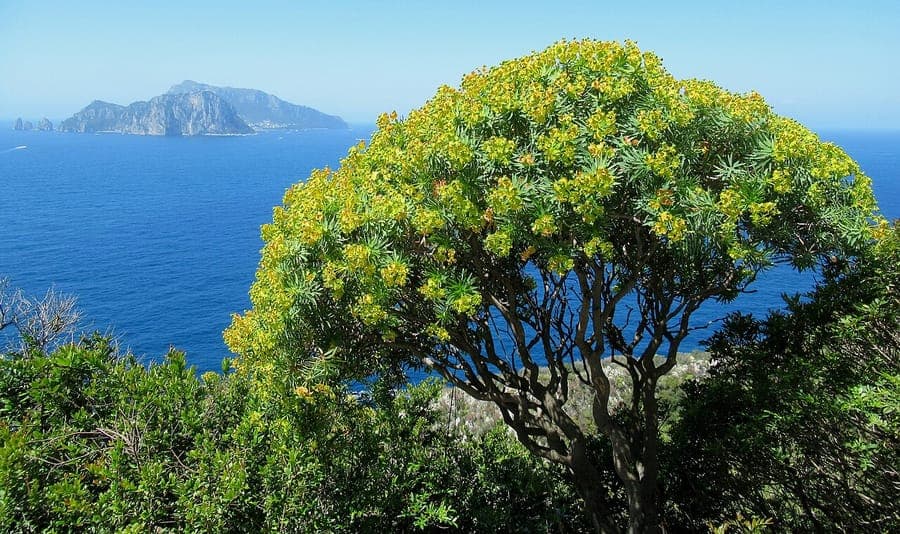
Sparrer77 / CC BY-SA 4.0, via Wikimedia Commons
Woody spurge: complete guide
Euphorbia dendroides
Want to see Woody spurge: complete guide in your garden?
1 minute, no credit card
Overview
Euphorbia dendroides, commonly known as woody spurge, is a striking deciduous shrub native to the Mediterranean basin. It thrives in hot, dry conditions and brings bold structure and vibrant color to gardens from spring through early summer. Reaching heights of 80 to 120 cm with a spread of about 60 cm, this plant stands out with its upright, tree-like form - hence the name "dendroides," meaning tree-shaped.
As a member of the Euphorbiaceae family, it produces a milky, latex-like sap that can irritate skin and eyes. Always wear gloves when handling and wash tools after pruning. Despite this, it's deer and rabbit resistant, making it a reliable choice for wildlife-prone areas.
On gardenworld.app, you can design a layout that highlights woody spurge's architectural form, ensuring it gets full sun and proper spacing.
Appearance & bloom cycle
Woody spurge develops thick, greenish-grey stems that become woody with age. The leaves are narrow, lance-shaped, and appear in whorls near the stem tips. They drop in winter, leaving an intriguing skeletal structure that adds visual interest during colder months.
From April to June, the plant produces clusters of yellow cyathia at the ends of its stems. These are not true flowers but specialized bracts that surround tiny reproductive parts. The bright yellow structures last for several weeks and attract early pollinators like hoverflies and bees.
After flowering, the plant forms three-lobed seed capsules that burst open when mature, flinging seeds up to a metre away. If you want to prevent self-seeding, deadhead spent blooms before capsules form.
Ideal location
This shrub needs full sun - rate 8 out of 10 - and performs best in south- or southwest-facing spots. It tolerates light shade but will grow leggy and bloom poorly. In cooler climates like the UK or northern Europe, plant it against a sunny wall to benefit from radiant heat and frost protection.
It's ideal for gravel gardens, rockeries, or raised beds with excellent drainage. Use it as a focal point or in groups for drama. Avoid planting near sprinklers or in lawns where moisture is consistently high.
Soil requirements
Well-drained soil is non-negotiable. Sandy, gritty, or rocky soils work best. The ideal pH is between 5.0 and 5.5 - slightly acidic to neutral. Heavy clay soils must be amended with 30% horticultural grit or perlite to improve drainage.
For container growing, use a cactus or succulent mix with extra perlite. Ensure pots have drainage holes and raise them off the ground to prevent waterlogging. Avoid organic-rich composts that retain too much moisture.
Free design
Want to see Woody spurge: complete guide in your garden? Make a free design now.
Watering
Once established, woody spurge is highly drought-tolerant. Water only during prolonged dry spells in the growing season (May to August). Deep, infrequent watering - once every 10 days in extreme heat - encourages strong root development.
In winter, no supplemental watering is needed. The plant is dormant and susceptible to root rot if the soil stays wet. Never overhead water, as this can lead to fungal issues on stems and leaf bases.
Pruning
Pruning is minimal. Remove dead or damaged stems in early spring (March–April), just after flowering. Cut back to healthy wood using clean, sharp shears. Always wear gloves and eye protection due to the irritating sap.
Shape lightly if needed, but avoid heavy cutting - new growth and flower buds form at stem tips. Over-pruning can delay or reduce blooming.
Maintenance calendar
- Jan: Check for frost damage; no action needed
- Feb: Clear debris from base to prevent rot
- Mar: Prune dead stems, inspect for pests
- Apr: Bloom begins; watch for aphids on new growth
- May: Peak flowering; no watering unless dry
- Jun: Flowers fade; remove seed heads if needed
- Jul: Monitor for drought; water deeply if no rain for 14+ days
- Aug: Dormancy begins; no maintenance
- Sep: Observe growth; no intervention
- Oct: Leave fallen debris as light mulch
- Nov: Ensure soil stays dry; protect container plants
- Dec: Full dormancy; no watering
Winter hardiness
Woody spurge is hardy to USDA zone 8b (-9°C to -7°C). In zones 7–8a, the top growth may die back in harsh winters, but the plant often resprouts from the base in spring. In colder areas, grow it in containers and move to a sheltered spot over winter.
For potted plants, wrap the container in bubble wrap and elevate it on feet. Avoid plastic covers that trap moisture. Mulch around the base with gravel or small stones to reduce freeze-thaw cycles.
Companion plants
Pair woody spurge with other drought-tolerant, sun-loving species. Good companions include Lavandula angustifolia, Rosmarinus officinalis, Cistus × hybridus, and Sedum 'Autumn Joy'. These share similar soil and water needs and create a cohesive, low-maintenance planting scheme.
Avoid moisture-loving plants like ferns or hostas. Stick to gravel, stone, or fine bark mulch to suppress weeds and reduce evaporation.
Plan your planting scheme on gardenworld.app to visualise how woody spurge complements your garden's existing elements and microclimates.
Closing
Woody spurge is a bold, architectural shrub that adds year-round structure and spring colour with minimal care. Its resilience to heat, drought, and pests makes it a top choice for modern, sustainable gardens. With proper siting and soil prep, it can thrive for many years.
You can find Euphorbia dendroides at garden centres across the UK and Europe. In the UK, check local independents or larger chains. Label confusion occurs - ensure you're buying Euphorbia dendroides, not the creeping Euphorbia myrsinites. The right plant makes all the difference.
Want to see Woody spurge: complete guide in your garden? Make a free design now.
Upload a photo, pick a style, and get a photorealistic design with plant list in under a minute.
No credit card required


Similar plants
Woolly mercury: complete guide
Mercurialis tomentosa
All about Mercurialis tomentosa, the woolly mercury from southwestern Europe: site, soil, watering, care and garden design tips.
Shurur: complete guide
Euphorbia fruticosa
Everything about Shurur: cultivation in dry climates, xeriscaping, care and tips for drought-resistant gardens in warm climates
Glary spurge: complete guide
Euphorbia glareosa
Everything about glary spurge: cultivation, maintenance, frost hardiness and use in Mediterranean and mountain-inspired gardens