
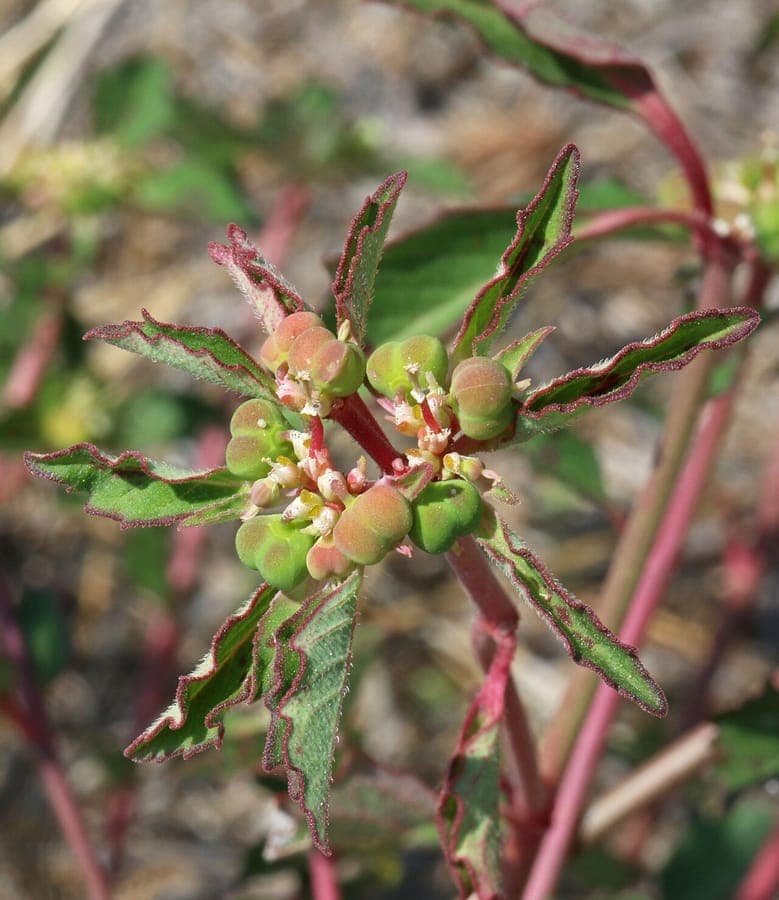
Andrey Zharkikh from Salt Lake City, USA / CC BY 2.0, via Wikimedia Commons
Euphorbia davidii: complete guide
Euphorbia davidii
Want to see Euphorbia davidii: complete guide in your garden?
1 minute, no credit card
Overview
Euphorbia davidii, commonly called toothed spurge, David's spurge, or wild poinsettia, is a compact herbaceous plant native to southwestern North America, ranging from California to New Mexico and northern Mexico, with additional populations in northeastern Argentina. In gardens, it's a striking specimen with diminutive yellow floral structures and finely toothed foliage that maintains decorative interest from summer through fall.
Popular among gardeners seeking drought-tolerant, minimal-care plants, Euphorbia davidii brings unexpected charm and colorful form to hot, dry spots. With correct placement and soil preparation, it thrives nearly unattended.
Appearance & bloom
Euphorbia davidii is a compact plant, typically 30 to 50 centimeters tall and wide, with thin, branching stems. The small, elongated leaves have characteristic toothed margins, creating a fine-textured appearance. Stems and foliage often develop reddish-purple tones under sunny conditions, especially as plants mature.
Flowers are small, yellow, arranged in distinctive cyathia (cup-shaped structures typical of Euphorbia), blooming from July through October - an extended flowering period providing color well into autumn.
After bloom, tiny seeds develop and disperse readily. Self-seeding occurs easily in moist seasons, though it's easily controlled by removing seed heads.
Ideal location
Euphorbia davidii demands full sun and warmth - a minimum of 6 to 8 hours of direct sunlight daily. This is not a plant for partial shade; insufficient light results in weak, irregular growth.
Plant in the hottest, sunniest available spot: against south or west-facing walls, in the most sun-exposed portion of gravel gardens, or on heat-absorbing pavement. The plant tolerates even reflected heat from walls and paving.
This is a warmth-loving species; it struggles in cold, exposed sites. In cooler climates, position in sheltered, warm corners or treat as an annual in very cold regions.
Soil
Euphorbia davidii thrives in well-draining, sandy to gravelly soil. Heavy, moisture-retentive soils are unsuitable and cause root rot. Amend heavy clay with coarse sand, gravel, or perlite.
The plant is unfussy about fertility and actually grows better in lean soil. Over-fertilization produces succulent, disease-prone growth. Minimal-fertility, well-draining seed compost is ideal.
Soil pH can range from acidic to neutral, though the plant also succeeds in slightly alkaline conditions. Drainage is far more critical than fertility.
Free design
Want to see Euphorbia davidii: complete guide in your garden? Make a free design now.
Watering
Once established, Euphorbia davidii is drought-tolerant and requires minimal water. This is a true desert plant capable of surviving extended dry periods. Water only if rain fails and plant beauty declines noticeably.
For young plants or container-grown specimens, water moderately but regularly during the first growing season, then drastically reduce frequency. Check soil moisture - water only when soil feels completely dry to touch.
In extremely hot, dry climates, even established plants occasionally benefit from water during severe heat events, but this is rarely necessary. Overwatering is the primary killer - ensure perfect drainage.
Pruning
Euphorbia davidii requires virtually no pruning. The plant naturally maintains a compact form. Remove only dead or frost-damaged stems in spring.
If plants become excessively large (rare under good light), light pruning helps. Wear gloves and protect eyes - the milky sap can irritate skin and mucous membranes. Wash hands thoroughly after pruning.
After severe winters, cutting back to healthy tissue stimulates vigorous new growth. The plant recovers well from judicious pruning.
Maintenance calendar
Spring: check for winter damage; carefully remove dead growth; plant new specimens in May. Summer: water minimally; enjoy yellow blooms appearing throughout season. Autumn: flowering continues through October; leave seeds for self-sowing or remove to limit volunteering plants. Winter: minimal intervention in mild climates; protect in colder regions.
Winter hardiness
Euphorbia davidii is winter-hardy in zones 8-11 (down to approximately -5 degrees Celsius, though damage often occurs). In cold regions, frost protection helps:
- Mulch with 5 centimeters of leaves before winter
- Plant in sheltered, warm microclimates
- Treat as an annual in very cold zones
- In containers, move indoors for winter protection
In warm, dry climates, it overwinters without protection. Wet winters are more problematic than cold.
Companion plants
Euphorbia davidii pairs well with:
- Other drought-tolerant, sun-loving plants such as sedums and echeveria
- Culinary sage and thyme - similar requirements
- Lavender and Catananche - identical warm-spot preferences
- Agave and yucca - sculptural partners
- Grey-foliaged plants such as artemisia varieties
It works best in contemporary, minimalist designs with significant negative space. Avoid crowding with other plantings.
Closing thoughts
Euphorbia davidii is an unpretentious yet dignified addition to sunny, dry gardens. With its golden-hued flowers and toothed foliage, it provides years of beauty with virtually zero maintenance. Plant in hot, well-draining soil, and you've secured a self-regulating companion.
Available at major garden retailers. For specialized cultivars, visit www.gardenworld.app.
Want to see Euphorbia davidii: complete guide in your garden? Make a free design now.
Upload a photo, pick a style, and get a photorealistic design with plant list in under a minute.
No credit card required


Similar plants
Woolly mercury: complete guide
Mercurialis tomentosa
All about Mercurialis tomentosa, the woolly mercury from southwestern Europe: site, soil, watering, care and garden design tips.
Shurur: complete guide
Euphorbia fruticosa
Everything about Shurur: cultivation in dry climates, xeriscaping, care and tips for drought-resistant gardens in warm climates
Glary spurge: complete guide
Euphorbia glareosa
Everything about glary spurge: cultivation, maintenance, frost hardiness and use in Mediterranean and mountain-inspired gardens