
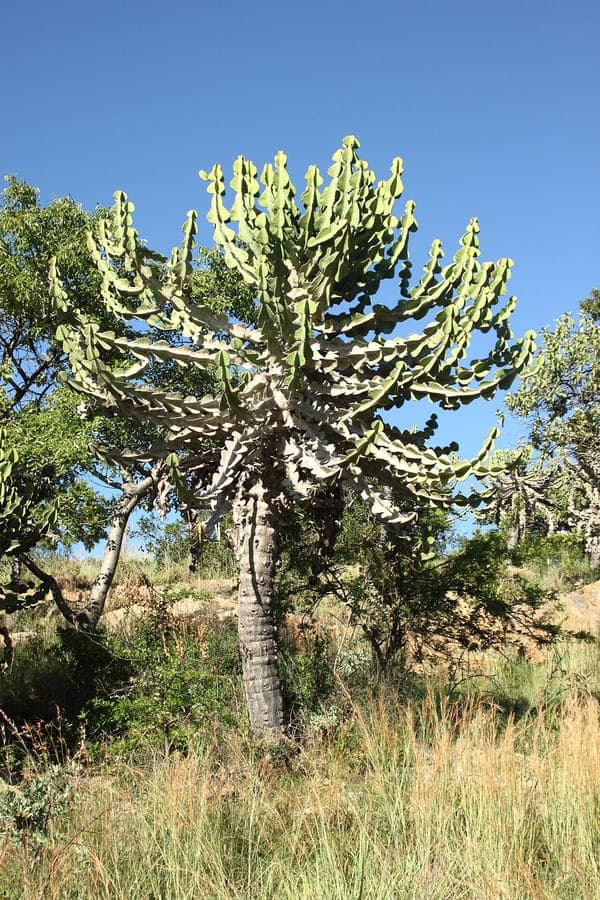
GalliasM / CC0, via Wikimedia Commons
Euphorbia cooperi: complete guide
Euphorbia cooperi
Want to see Euphorbia cooperi: complete guide in your garden?
1 minute, no credit card
Overview
Euphorbia cooperi, commonly known as candelabra tree, is a spectacular succulent from the Euphorbiaceae family. Native to southern Africa from Tanzania through Zimbabwe, this plant thrived in dry savanna landscapes. In modern gardens, it offers strikingly architectural forms and minimal water requirements.
The candelabra tree is popular among xeriscaping enthusiasts and contemporary garden designers seeking ostentatious sculptural forms. For gardenworld.app users in warm climates with water-conscious design goals, Euphorbia cooperi is an excellent choice.
Appearance & Form
Euphorbia cooperi grows as a columnar to candelabra-like succulent reaching approximately 2-4 meters tall. The plant consists of thick, fleshy green branches rising vertically with fewer branches in upper sections, creating a very contemporary candelabra structure.
Branches are angular to rhombic in cross-section, with small defensive spine-like structures at the edges. Foliage is minimal - small, deciduous leaves that quickly drop, leaving very clean lines.
Flowers are small and inconspicuous - greenish to yellow, appearing in small clusters. The true decorative value is the architectural form and textural interest.
The plant is extremely slow-growing but remarkably durable - individual specimens can exceed 50 years of age.
Ideal Location
Euphorbia cooperi requires full sun and extremely well-draining soil. Sunlight is essential - minimum 8-10 hours of direct daily sun. The plant tolerates extreme heat very well.
Prefer south or west-facing locations, ideally with some wind exposure which helps with evapotranspirative balance.
In warm climates (USDA zones 9b-11), the plant grows outdoors. In colder zones it requires container cultivation with winter protection.
Soil
Euphorbia cooperi prefers extremely well-draining, succulent-specialist soil. Standard potting mix blended with perlite and coarse sand (50-50 mix) works excellently.
In ground-based cultivation, use sand and gravel-amended soil. The plant thrives in lean, nutrient-poor soils.
PH prefers neutral to slightly alkaline (6.5-7.5).
Critical: no heavy mulch - the plant rots in overly wet conditions.
Free design
Want to see Euphorbia cooperi: complete guide in your garden? Make a free design now.
Watering
Euphorbia cooperi requires minimal water once well established. Water during growing season (spring-summer) only when soil is completely dry - typically every 2-3 weeks.
In winter, reduce watering drastically - almost no water unless plant visibly shrivels.
In containers, it is better to underwater than overwater. The plant tolerates extreme drought but rots easily in wet conditions.
Maintenance
Euphorbia cooperi requires virtually no maintenance once established.
No pruning required - allow the natural form to develop. Dead or damaged branches may be removed.
Caution: all Euphorbia species contain toxic saps - be careful when handling and avoid skin contact.
Maintenance Calendar
- January-February: Rest period, minimal watering
- March-May: Spring growth, slow water application
- June-August: Summer growth, minimal maintenance
- September-October: Pre-dormancy preparation, reduce watering
- November-December: Winter rest, virtually no water
Winter Hardiness
Euphorbia cooperi is not winter-hardy in European zones with freezing winters. The plant cannot tolerate temperatures below -5 degrees Celsius.
Suitable for USDA zones 9b-11 only - very warm climates exclusively. Container cultivation in colder zones is possible with winter protection and indoor overwintering.
In South Africa and other extremely warm climates, it grows unrestricted outdoors.
Companion Plantings
Euphorbia cooperi is a statement specimen standing conspicuously alone. Underplanting might include drought-tolerant low-growing plants:
- Sempervivum: Red-tinted accents
- Agave 'Blue Glow': Blue-tone textural contrast
- Sedum rubrotinctum: Red-accent plant
- Gravel or shell mulch: Architectural setting
Closing
Euphorbia cooperi is a perfect plant for contemporary xeriscaping and warm-climate gardens. With minimal water, it thrives for years, creates sculptural architecture without maintenance.
For gardenworld.app users in Southern Europe, Africa, or other warm zones, this spectacular succulent merits serious consideration. Import availability is reasonable - check tropical succulent suppliers for sourcing.
Want to see Euphorbia cooperi: complete guide in your garden? Make a free design now.
Upload a photo, pick a style, and get a photorealistic design with plant list in under a minute.
No credit card required


Similar plants
Woolly mercury: complete guide
Mercurialis tomentosa
All about Mercurialis tomentosa, the woolly mercury from southwestern Europe: site, soil, watering, care and garden design tips.
Shurur: complete guide
Euphorbia fruticosa
Everything about Shurur: cultivation in dry climates, xeriscaping, care and tips for drought-resistant gardens in warm climates
Glary spurge: complete guide
Euphorbia glareosa
Everything about glary spurge: cultivation, maintenance, frost hardiness and use in Mediterranean and mountain-inspired gardens