
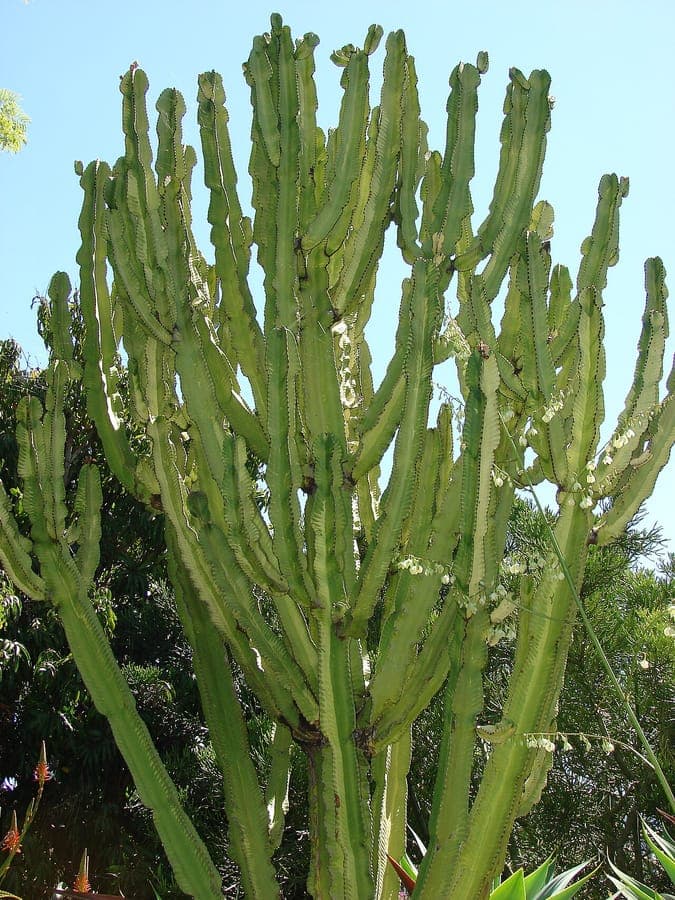
Forest & Kim Starr / CC BY 3.0, via Wikimedia Commons
Euphorbia ammak: complete guide
Euphorbia ammak
Want to see Euphorbia ammak: complete guide in your garden?
1 minute, no credit card
Overview
Euphorbia ammak, commonly known as the African candelabra or the Mammie plant, is an impressive succulent with a highly distinctive candelabra-like structure. This succulent originates from the arid mountain regions of Saudi Arabia and Yemen, where it has adapted to extreme drought and heat. With its thick, greenish stems and minimal foliage, this is truly a unique and striking houseplant.
The plant reaches heights of 5 to 6 meters in its natural environment, but when grown in pots, it remains considerably smaller, usually up to 1 to 2 meters. The characteristic candelabra formation makes it a striking addition to any room or greenhouse. Despite its imposing appearance, Euphorbia ammak is relatively low-maintenance and extremely drought-tolerant.
This article covers everything you need to know about successfully growing and maintaining this beautiful plant.
Appearance and Bloom
Euphorbia ammak is immediately recognizable by its distinctive candelabra or candlestick-like growth pattern. The plant consists of multiple thick, blue-green stems that grow vertically and branch at the tops. These stems can become 5 to 10 centimeters wide and are smooth, with a slight waxy coating.
The leaves are very small and seemingly absent for large portions of the year. This is actually an adaptation to drought - the plant minimizes water loss by maintaining minimal leaf surface area. When leaves do appear, they are small and oval-shaped, typically green to gray-green in color.
The flowers are also small and inconspicuous, yellowish-green in color. They appear at the branch points of the stems and attract bees and other pollinators. The flowers are followed by small, round fruits.
Ideal Location
Euphorbia ammak thrives in very sunny environments. In its natural habitat, it grows on hillsides with full sun exposure. For optimal growth, place the plant in a location receiving at least 6 to 8 hours of direct sunlight daily. A south or southwest-facing window is ideal.
The plant can grow both indoors and outdoors, depending on your climate. In warm regions (USDA zones 9-11), the plant can remain outdoors year-round. In cooler climates, it must be kept indoors or in a greenhouse.
Ensure the plant has protection from strong winds, as the candelabra structure can be top-heavy. Place the plant on a sturdy, stable surface to prevent tipping.
Soil
Like all succulents, Euphorbia ammak requires very well-draining soil. Use a special mixture consisting of potting soil, coarse sand, or perlite. A good ratio is 1 part potting soil to 2 parts mineral material. This prevents water accumulation and root rot, the most common cause of death for Euphorbia.
The plant grows best in slightly acidic to neutral soil with a pH between 5.5 and 7.0. Ensure the pot has good drainage holes. The soil may dry completely between waterings.
Use commercially available cactus soil or succulent soil for convenience, as these are already specially formulated for good drainage.
Free design
Want to see Euphorbia ammak: complete guide in your garden? Make a free design now.
Watering
This is where many people make mistakes with Euphorbia ammak. The plant is extremely drought-tolerant and would much rather be dry than wet. During the growing season (spring and summer), water only when the soil is completely dry - this might happen only monthly.
Test the soil by inserting your finger 3 to 5 centimeters deep. Only water if it feels very dry. An easy rule is to water monthly during the growing period and not at all in winter. Excessive water causes immediate root rot and plant death.
When you do water, water thoroughly until water runs from the drainage holes, then stop. Let all water drain completely. Never leave water standing in a saucer under the pot.
Pruning
Euphorbia ammak typically requires little pruning. Remove only dead, damaged, or diseased branches. You can prune the plant to maintain shape or to encourage growth, but this is not necessary.
Be careful when pruning - Euphorbia can exude a milky sap that can be irritating. Wear gloves and wash your hands thoroughly after pruning.
The best time for pruning is in early spring before growth begins. Pruning will encourage bushy growth.
Maintenance Calendar
In spring (March-May), the plant begins to grow again. Gradually increase watering as temperatures rise. This is the best time to repot if needed. Add fertilizer to water once monthly.
In summer (June-August), the plant needs no extra feeding beyond what has already been given. Water monthly or less. Ensure the plant has protection from extremely hot afternoon sun if it becomes very hot.
In fall (September-October), growth slows. Reduce water and stop fertilizing. The plant prepares itself for winter dormancy.
In winter (November-February), minimal care is required. Water very rarely or not at all. Keep the temperature above 10 degrees Celsius. No fertilization is needed.
Winter Hardiness
Euphorbia ammak is not fully winter-hardy in temperate climates. The plant is frost-sensitive and temperatures below 10 degrees Celsius can cause damage. In very warm climates (USDA zones 10-13), it may overwinter outdoors in protected locations.
In cooler climates, the plant must overwinter indoors. Place it in a warm, sunny spot inside. Minimal watering during winter is essential.
Protect against drafts and temperature fluctuations. A temperature between 12 and 20 degrees Celsius is ideal for overwintering.
Companion Plants
Euphorbia ammak combines well with other succulents and xeric plants. Consider these combinations:
Other Euphorbia species create interesting groupings. Cacti such as Echinocereus and Ferocactus are compatible. Echeveria, Aeonium, and other succulents form beautiful visual contrasts with the candelabra structure.
Aloes and Agaves are also good partners. For indoor combinations, try Euphorbia ammak with other minimal-care plants such as Sansevieria or Zamioculcas.
Closing
Euphorbia ammak is an impressive succulent requiring minimal maintenance and providing a stunning appearance to any space. With its unique candelabra-like form and extreme drought tolerance, this is an ideal plant for dry environments and for plant lovers who are forgetful about watering.
The only thing you need to remember is: water very rarely, use well-draining soil, and provide plenty of sunlight. Follow these simple guidelines and your Euphorbia ammak will thrive.
For more inspiration and advice on growing succulents and exotic plants, visit gardenworld.app. For purchasing this plant, you can contact local garden centers that regularly stock succulents and exotic plant collections.
Want to see Euphorbia ammak: complete guide in your garden? Make a free design now.
Upload a photo, pick a style, and get a photorealistic design with plant list in under a minute.
No credit card required


Similar plants
Woolly mercury: complete guide
Mercurialis tomentosa
All about Mercurialis tomentosa, the woolly mercury from southwestern Europe: site, soil, watering, care and garden design tips.
Shurur: complete guide
Euphorbia fruticosa
Everything about Shurur: cultivation in dry climates, xeriscaping, care and tips for drought-resistant gardens in warm climates
Glary spurge: complete guide
Euphorbia glareosa
Everything about glary spurge: cultivation, maintenance, frost hardiness and use in Mediterranean and mountain-inspired gardens