
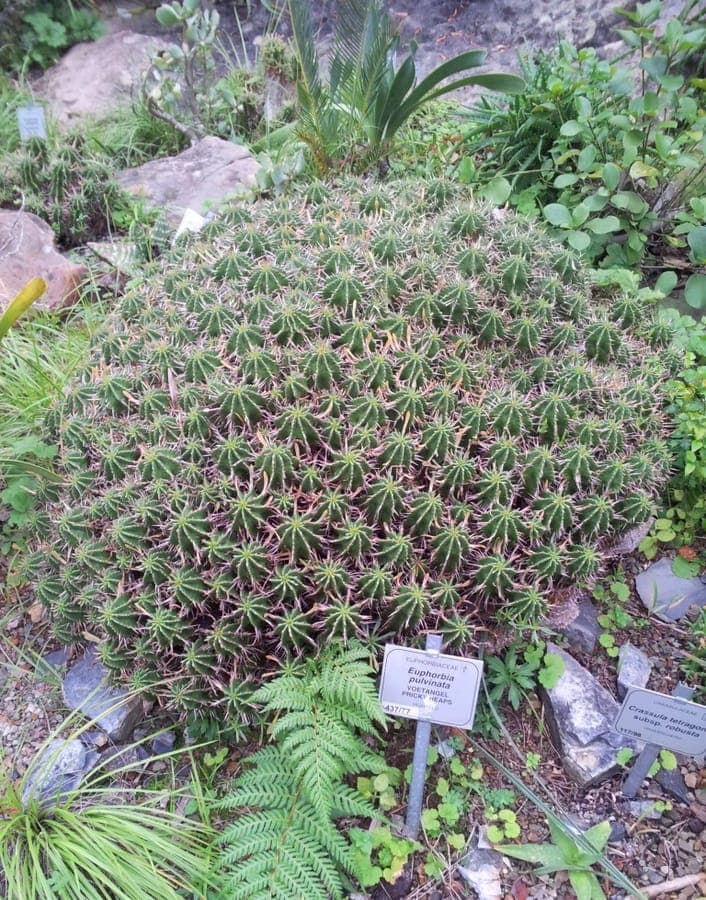
Abu Shawka / CC0, via Wikimedia Commons
Euphorbia aggregata: complete guide
Euphorbia aggregata
Want to see Euphorbia aggregata: complete guide in your garden?
1 minute, no credit card
Overview
Euphorbia aggregata, known as the pincushion euphorbia, is a fascinating and rare succulent from South Africa. This plant belongs to the Euphorbiaceae family and naturally grows in the Eastern Cape region of South Africa, where it inhabits dry rocky outcrops and grasslands. This is a collector's plant that attracts significant attention from succulent enthusiasts due to its unusual growth pattern and attractive red stems.
Appearance and Bloom
The pincushion euphorbia is a small, compact succulent normally reaching only 10 to 15 centimeters tall. The plant forms as a delightful, undulating mass of red to orange-red stems. These stems are very slender and twig-like, giving the plant a very fine, graceful texture. Small green leaves appear on the stems and drop when the plant is stressed or dormant. The highlight, however, is the growth of red stems, which become intensely red as the plant receives more light and cooler weather. Small, inconspicuous flowers appear between the stems but are more green than showy. This is a plant where the stems and growth pattern are more important than the flowers.
Ideal Location
The pincushion euphorbia thrives best in full sun. This is not a plant for shade. At least 8 hours of direct sunlight daily is essential for strong growth and red stem color development. The more sun, the redder the stems. A very warm and dry microclimate is ideal. Plant in an airy location where the plant feels wind; this promotes stronger stems and better red coloring.
Soil
The pincushion euphorbia requires extremely well-draining soil. This plant naturally grows on rocky, very dry sites. Use cactus or succulent soil mix. Add extra perlite or sand for maximum drainage. A clay pot also helps since it breathes better than plastic. pH can be neutral to basic; this plant is not picky. Heavy soil can cause serious problems, so drainage is crucial.
Watering
This is an extremely drought-tolerant plant needing little water. Water only during the growing season (spring through fall), and then sparingly. Let the soil dry thoroughly between waterings. In winter, water minimally, only occasionally when the plant is completely dry. It is better to underwater than overwater. Water stagnation is deadly for this plant and quickly leads to rot.
Free design
Want to see Euphorbia aggregata: complete guide in your garden? Make a free design now.
Pruning
The pincushion euphorbia forms an attractive shape naturally and needs no pruning. Let the plant grow as it wishes. Remove only dead or diseased stems. If the plant has damaged stems, you can gently break these off. The plant will form new stems from the base.
Maintenance Calendar
Spring (March-May): Begin regular but moderate watering. The plant begins growing. Ensure plenty of direct sunlight.
Summer (June-August): Continue moderate watering. This is the growing season. Stems become larger and brighter red. Avoid overheating in plastic pots.
Autumn (September-October): Gradually reduce watering. Growth slows. Red coloring may actually intensify due to lower temperatures.
Winter (November-February): Minimal care. Little to no water. The plant is in deep dormancy. Ensure temperature does not fall below 10 degrees Celsius for extended periods.
Winter Hardiness
The pincushion euphorbia is not hardy outdoors. In the Benelux, this plant must overwinter in a greenhouse, conservatory, or on a sunny windowsill. The plant suffers frost damage at temperatures below 10 degrees Celsius. Ideally, temperature stays above 15 degrees. For indoor container cultivation, this is ideal; the plant thrives on a sunny windowsill or under grow lights.
Companion Plants
The pincushion euphorbia combines well with other compact succulents in a dry garden or succulent collection. Associate with other Euphorbias, echeveria, sedums, and other miniature succulents. In containers, it pairs nicely with rocky elements, grit, and other dry-garden plants. It also grows well in an alpine trough or rock garden setting among stones.
Conclusion
Euphorbia aggregata is a true gem for the succulent collector. With its unusual growth, attractive red stems, and minimal maintenance requirements, it is a pleasure to grow. This South African treasure asks only for a dry, sunny spot and minimal care. It is the perfect plant for those creating xeriscaping or dry gardens. For lovers of bonsai-like miniature garden effects, this is a fascinating addition. Gardenworld.app offers succulent soil mixes and special container types perfectly suited to this unique plant. Gardenworld.app also advises on composing entire dry-garden schemes with multiple interesting succulents.
Want to see Euphorbia aggregata: complete guide in your garden? Make a free design now.
Upload a photo, pick a style, and get a photorealistic design with plant list in under a minute.
No credit card required


Similar plants
Woolly mercury: complete guide
Mercurialis tomentosa
All about Mercurialis tomentosa, the woolly mercury from southwestern Europe: site, soil, watering, care and garden design tips.
Shurur: complete guide
Euphorbia fruticosa
Everything about Shurur: cultivation in dry climates, xeriscaping, care and tips for drought-resistant gardens in warm climates
Glary spurge: complete guide
Euphorbia glareosa
Everything about glary spurge: cultivation, maintenance, frost hardiness and use in Mediterranean and mountain-inspired gardens