
Robert Flogaus-Faust / CC BY 4.0, via Wikimedia Commons
Greek spiny spurge: complete guide
Euphorbia acanthothamnos
Want to see Greek spiny spurge: complete guide in your garden?
1 minute, no credit card
Overview
Greek spiny spurge (Euphorbia acanthothamnos), also known as Greek spiny euphorbia, is a remarkable, robust shrub from the Euphorbiaceae family native to the Greek islands and Turkish coast. This exceptional plant distinguishes itself through its densely-branched, thorny shrubby growth with small yellow flowers. Adapted to arid Mediterranean conditions, it thrives on rocky slopes and through crevices. With its extreme drought tolerance and fascinating spiny texture, this spurge is an excellent choice for desert and rock gardens.
Appearance and bloom
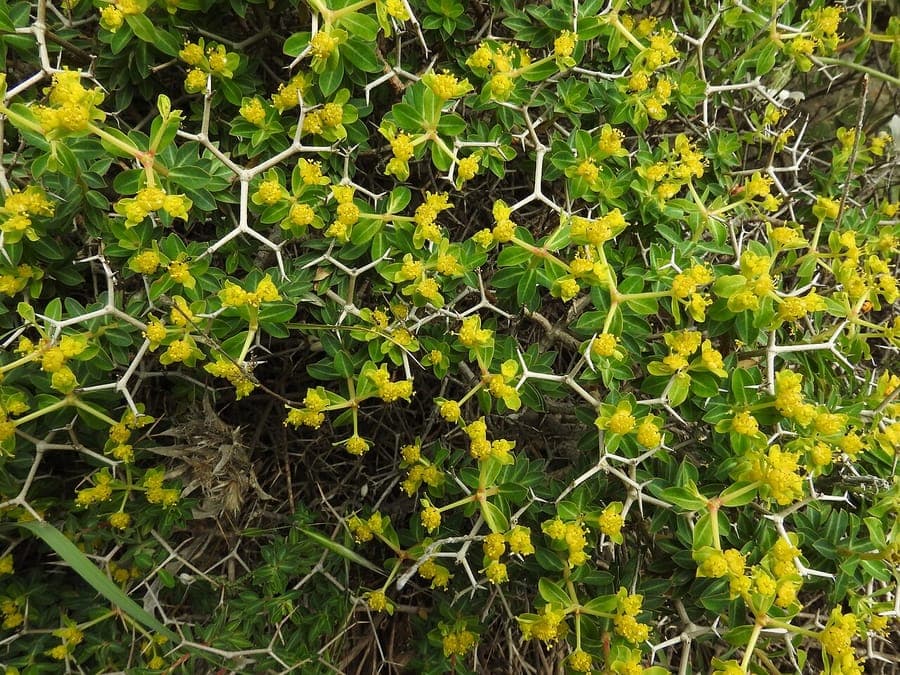
Greek spiny spurge grows as a compact, densely-branched, thorny shrub, typically 30-60 cm tall. The stems are dark green with sharp spines along the branches, giving the plant a corrugated texture. Leaves are minimal, linear, and highly reduced. The flowers are yellow nectary blocks appearing in small cyathium structures (characteristic of Euphorbia). The flowering period extends from spring through early summer. The plant produces small seed capsules after bloom, providing bird food.
Ideal location
Select a very sunny, warm site for Greek spiny spurge. This is a full-sun plant requiring 8+ hours of direct sunlight daily. Do not protect from heat - this plant tolerates scorching conditions. Wind is not problematic; air movement actually helps. Avoid shaded locations or damper microclimates. Against south-facing walls or in Mediterranean gardens, this is an ideal partner. On rock gardens and in sheltered courtyards, this species flourishes.
Soil
Greek spiny spurge requires very well-draining soil. Heavy, moist clay is unsuitable. Ideal is a mixture of sand, gravel, and minimal organic matter. pH can be neutral to slightly acidic; this plant is not fussy. Water storage is undesirable - dry is better than wet. In container culture or rock gardens, plant this in specialized xerophyte potting soil with at least 50% mineral material. Few nutrients are required; poor soil is acceptable.
Free design
Want to see Greek spiny spurge: complete guide in your garden? Make a free design now.
Watering
Water very carefully and sparingly. Once established, this plant requires minimal water. During the growing period (spring to early summer), water monthly only if completely dry. Summer: no water needed unless extremely dry. Winter: virtually no water. Overwatering is the most common cause of failure. This is a plant that prefers drought to wet feet. In container culture, water only when the soil feels completely dry.
Pruning
Pruning is generally unnecessary. The plant forms a compact shape naturally. Remove only dead branches or seriously damaged parts. Avoid heavy pruning as this plant recovers slowly. Light shaping in early spring is possible but optional. This is a plant you can largely leave alone.
Maintenance calendar
March-May: Flowering period, minimal maintenance. May-July: Seed setting, no action needed. August-October: Rest, no watering. November-February: Winter rest, protection in extreme frost. Year-round: Remove dead material, inspect for pests.
Winter hardiness
Greek spiny spurge is moderately hardy to USDA zone 8 (minimum temperatures around -12 to -9 degrees Celsius). In colder regions, protection may be beneficial. Planting location beneath south-facing walls or in sheltered corners helps. Winter cloth can be used in severe seasons. In very cold climates, container culture with overwintering in a cold frame is better. In temperate Mediterranean climates, this plant survives outdoor wintering without issue.
Companion plants
Pair Greek spiny spurge with other xerophytes and Mediterranean plants: sedums, sempervivums, other Euphorbia species, lavender, rosemary, and sage. Stones and gravel work well around this plant. Avoid moisture-loving plants or fresh-growing greenery. Other spiny species like Acanthus or Carlina are excellent neighbors. It works best in a dedicated xerophyte garden bed.
Closing thoughts
Greek spiny spurge is a specialist for extreme conditions. This is not a plant for the average wet European garden, but rather for gardeners willing to tackle dry situations. If you have a rocky slope, a sunny corner, or a fully dry garden, this is an excellent choice. The fascinating thorn structure offers year-round texture and form, while spring flowers provide bird food. Begin carefully with watering, and you'll see how this Greek beauty flourishes in your garden.
Want to see Greek spiny spurge: complete guide in your garden? Make a free design now.
Upload a photo, pick a style, and get a photorealistic design with plant list in under a minute.
No credit card required


Similar plants
Woolly mercury: complete guide
Mercurialis tomentosa
All about Mercurialis tomentosa, the woolly mercury from southwestern Europe: site, soil, watering, care and garden design tips.
Shurur: complete guide
Euphorbia fruticosa
Everything about Shurur: cultivation in dry climates, xeriscaping, care and tips for drought-resistant gardens in warm climates
Glary spurge: complete guide
Euphorbia glareosa
Everything about glary spurge: cultivation, maintenance, frost hardiness and use in Mediterranean and mountain-inspired gardens