
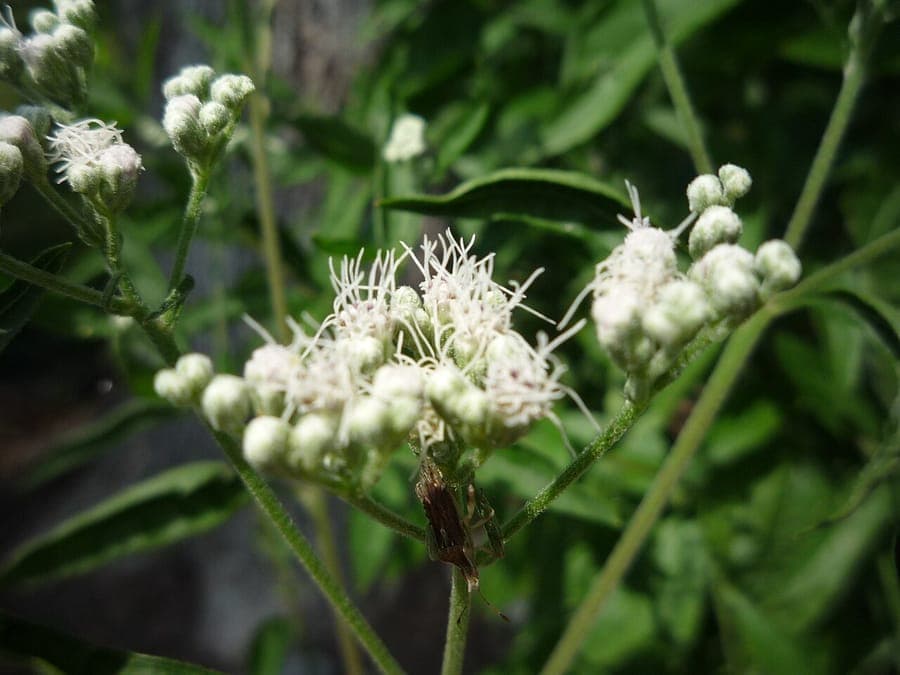
Jim Kingdon Kingdon / Public domain, via Wikimedia Commons
Fall Boneset: complete guide
Eupatorium serotinum
Want to see Fall Boneset: complete guide in your garden?
1 minute, no credit card
Overview
Eupatorium serotinum, better known as Fall Boneset or Late Eupatorium, is a robust North American wildflower from the Asteraceae family. This long-blooming plant is renowned for its dense clusters of small white flowers appearing from August through December, much later than its close relative Eupatorium perfoliatum. Growing naturally in moist areas of central and eastern America, Eupatorium serotinum is valuable in gardens as a late-season bloomer and essential food source for migrating Monarch butterflies in autumn.
With its extended blooming period and attractiveness to pollinators, Fall Boneset is a favorite of ecological and wild gardeners. Gardenworld.app helps you design season-extended borders with continuous flower and nectar supply.
Appearance and Bloom
Eupatorium serotinum grows as an upright, slender plant, typically between 60 and 150 centimeters tall. The plant bears elongated, toothed-margin leaves, much greener than related Eupatorium perfoliatum. The stem structure is often somewhat slender and less branched.
The flowers appear in loose, fluffy white clusters at stem tips. Unlike Boneset, this species blooms much later in season, from August through first frost. This makes it invaluable for autumn forage, especially for Monarch butterflies needing energy for their migration to Mexico. The flowers are highly attractive to all pollinators.
Ideal Location
Eupatorium serotinum grows best in moist soils with full sun to half-shade. The plant is flexible and tolerant. In deeper shade, the plant will produce fewer flowers. In very dry environments, foliage may wilt. The plant prefers slightly warmer climate than Eupatorium perfoliatum, so plant it more in southern regions.
The plant is suitable for natural gardens, autumn borders, butterfly gardens, and wild zones. It thrives well in British, Belgian, and northern German climates. In warmer Mediterranean regions it may grow well in half-shade.
Soil
Eupatorium serotinum grows optimally in moist, humus-rich soils. The ideal pH is between 5.5 and 7.5. The plant tolerates variable soil types as long as moisture content is moderately elevated. In poor soils add well-rotted compost or leaf mold.
When container-grown, specimens need regular moisture retention without stagnation. A mixture of garden soil with peat and compost works well. The plant also tolerates wet winters.
Free design
Want to see Fall Boneset: complete guide in your garden? Make a free design now.
Watering
Eupatorium serotinum loves moist conditions and must receive regular water during the growing season. Especially during autumn season (August through November), provide adequate water so blooming can fully manifest. Water during dry periods.
Once established, the plant tolerates more drought. In moist soils, rainwater usually suffices.
Pruning
Eupatorium serotinum requires minimal pruning. Remove only dead or damaged stems. After first frost in November/December you can leave the plant standing for bird and insect food, or cut back to 15 centimeters height in spring. Leave dead foliage for insect shelter.
Deadheading is not needed; allow flowers to age for seed.
Maintenance Calendar
- Spring (March-May): Plant from previous year grows out. Prune in March to 15 cm height. Add compost. Start watering.
- Summer (June-July): Normal growth. Thin around plant for better air circulation. Water regularly.
- Autumn (August-November): BLOOM PEAK. Water regularly. Enjoy flowers and pollinators, especially butterflies.
- Winter (December-February): Plant dies back. Leave dead material for wildlife food and shelter. Prune in February.
Winter Hardiness
Eupatorium serotinum is hardy to -15 to -20 degrees Celsius. The plant grows back as a perennial from the root crown. In Britain, Belgium, and Germany, plants overwinter without protection, though in very wet winters protection may help. The plant dies back above ground at frost.
Natural mulching with fallen leaves helps.
Companion Plants
Eupatorium serotinum combines beautifully with other autumn bloomers such as Aster, Coneflower, Sedum, Black-eyed Susan, and other Eupatorium species. The plant is spectacular when grouped in clusters of 3 to 5. In butterfly gardens it is a must-have plant.
Monarch butterflies will be attracted to the late flowers for fuel for their migration.
Closing Thoughts
Eupatorium serotinum is an essential plant for ecological gardeners and lovers of extended blooming. The white autumn flowers create a soft, natural appearance in the garden as other plants fade. Especially valuable for butterfly conservation, as Monarchs depend on this late nectar for their long migration.
With minimal care and extended blooming period, Eupatorium serotinum is a versatile, essential plant for any ecological garden.
Want to see Fall Boneset: complete guide in your garden? Make a free design now.
Upload a photo, pick a style, and get a photorealistic design with plant list in under a minute.
No credit card required


Similar plants
Calendula stellata: complete guide
Calendula stellata
Complete guide to Calendula stellata, the star-flowered marigold from Sicily: location, soil, watering and companion planting tips.
Korean chrysanthemum: complete guide
Chrysanthemum x rubellum
Chrysanthemum x rubellum is a hardy autumn perennial with single pink to copper flowers from August to November. Care and combinations.
Helianthus divaricatus: complete guide
Helianthus divaricatus
Helianthus divaricatus is a North American woodland sunflower with yellow summer blooms, ideal for naturalistic borders and shady edges.