
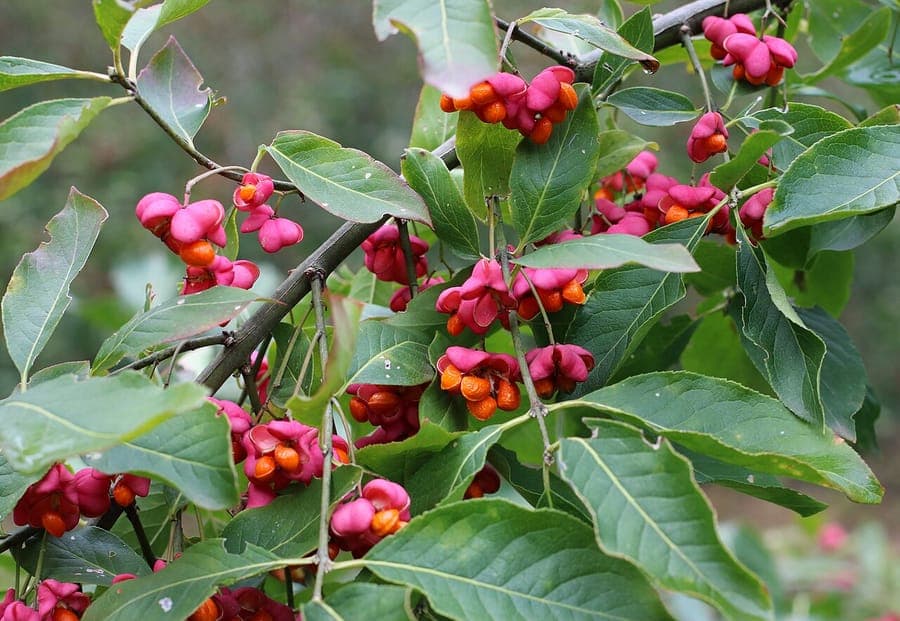
George Chernilevsky / CC BY 4.0, via Wikimedia Commons
Spindle: complete guide
Euonymus europaeus
Want to see Spindle: complete guide in your garden?
1 minute, no credit card
Overview
Euonymus europaeus, commonly known as spindle, is a deciduous shrub or small tree native to woodlands across central and eastern Europe. In the UK and Ireland, it occasionally pops up in hedgerows and scrubland, especially on calcareous soils. Often overlooked, spindle delivers one of the most striking autumn displays in the garden. Its pink fruit capsules split open to reveal vivid orange seeds, creating a surreal, almost alien-like visual effect. It's not just for show - the seeds feed birds like bullfinches and thrushes, and the spring flowers attract early pollinators.
If you're designing a wildlife-friendly or naturalistic garden, spindle fits right in. On gardenworld.app, you can visualise how spindle integrates into layered planting schemes or mixed hedges. Despite its bold looks, it's surprisingly low maintenance once established, making it a smart choice for both beginner and experienced gardeners.
Appearance & bloom cycle
Spindle typically grows 3–6 metres tall with a spread of up to 2.5 metres. It has an upright, open habit with angular, green-tinged stems. In April and May, small greenish-white flowers appear in the leaf axils. They're subtle but valuable for bees and hoverflies on cool spring days. The real magic happens in autumn.
From September, pink fruit capsules develop, gradually swelling and splitting open in October to reveal bright orange seeds wrapped in a fleshy aril. This lasts well into November, offering late-season interest. The leaves turn a soft yellow before dropping, adding to the autumn palette. The bark is smooth and grey, sometimes with corky ridges on older stems - a nice winter feature.
Ideal location
Spindle thrives in light shade to partial sun (light level 6/10). Full sun works if the soil stays reliably moist, but in dry, exposed spots, the plant may struggle. Deep shade reduces flowering and fruiting. The best spot is under open tree canopies, along woodland edges, or in mixed native hedges.
Keep in mind: all parts of spindle are toxic if ingested. While the seeds attract birds, they're dangerous for pets and children. Avoid planting near play areas or where curious animals roam. A naturalistic border or back-of-border position works best.
Soil requirements
Spindle prefers neutral to slightly alkaline soils (pH 7.0–7.5). It grows well on chalk, limestone, and well-drained loams. Avoid waterlogged or highly acidic soils - it won't thrive in peat or coniferous woodland conditions. When planting, mix in some garden compost and grit to improve drainage. If your soil is acidic, apply ground limestone at planting time to raise the pH.
Free design
Want to see Spindle: complete guide in your garden? Make a free design now.
Watering
Young spindle plants need consistent watering during their first two growing seasons. Give them 10 litres weekly during dry spells. Once established, spindle is drought-tolerant thanks to its deep root system. Mature plants rarely need supplemental watering, except during prolonged summer droughts. Mulching in spring helps retain moisture and suppress weeds.
Pruning
Spindle rarely needs pruning. It flowers on old wood, so avoid cutting it back in autumn or winter - you'll lose next year's fruit display. If you're using it in a hedge or want to control its size, prune lightly in March before bud break. Use gloves when handling - the sap can irritate sensitive skin. Never burn spindle trimmings; the smoke is toxic.
Maintenance calendar
- Jan: Check for winter damage, protect young stems from rabbits
- Feb: Inspect for signs of dieback or pests
- Mar: Light pruning if needed, apply lime if soil is acidic
- Apr: Flowers emerge, pollinators active
- May: Bloom continues, no care required
- Jun: Fruit begins to form, monitor for aphids
- Jul: Minimal care, water only in extreme drought
- Aug: Keep an eye out for scale insects or powdery mildew
- Sep: Fruits start colouring up, avoid disturbing branches
- Oct: Peak ornamental value, leave fruits for wildlife
- Nov: Leaves fall, apply mulch to conserve moisture
- Dec: Final check before winter, ensure young plants are protected
Winter hardiness
Spindle is fully hardy down to -25°C (USDA zone 5). Mature plants handle harsh winters with ease. Young specimens may suffer tip dieback in exposed sites, so consider using fleece or spiral guards in the first few winters. The plant is also resistant to urban pollution, making it suitable for city gardens.
Companion plants
Pair spindle with other native plants like hawthorn, dogwood, or hazel for a natural woodland edge. It works well with spring bulbs such as wood anemone or bluebell. For structure, combine with holly or yew - the contrast between dark evergreens and spindle's autumn colours is striking. Use the plant combination tool on gardenworld.app to explore design options.
Closing
Spindle is a quiet achiever in the garden. It's tough, wildlife-friendly, and delivers unmatched autumn drama. With minimal care and the right planting conditions, it becomes a long-term focal point. Sold at garden centres across the UK and Ireland. Just remember: keep it away from curious mouths, and let nature do the rest.
Want to see Spindle: complete guide in your garden? Make a free design now.
Upload a photo, pick a style, and get a photorealistic design with plant list in under a minute.
No credit card required


Similar plants
Fringed grass of Parnassus: complete guide
Parnassia fimbriata
Everything about Fringed grass of Parnassus (Parnassia fimbriata): growing, soil, watering and care. A delicate mountain perennial with white fringed flowers.
Euonymus cornutus: complete guide
Euonymus cornutus
Horned spindle is an intriguing shrub from central China with distinctive winged seed capsules. Learn how to grow this unique plant.
Large-Winged Spindle: complete guide to this Far Eastern shrub
Euonymus macropterus Rupr.
Discover Large-Winged Spindle (Euonymus macropterus), an elegant Japanese shrub prized for spectacular winged fruits. Perfect for Asian gardens and woodland plantings.