
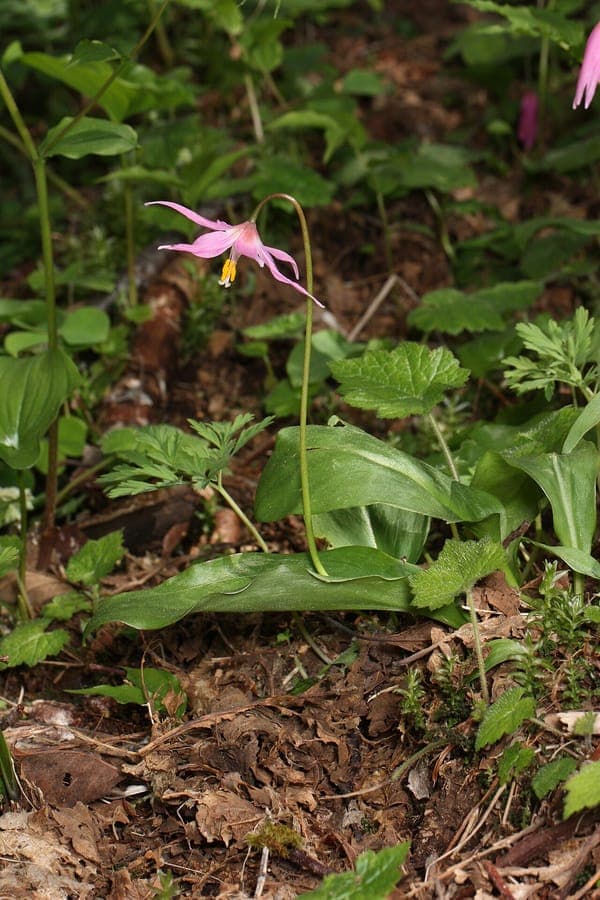
Walter Siegmund (talk) / CC BY-SA 3.0, via Wikimedia Commons
Pink Fawn-Lily: complete guide
Erythronium revolutum
Want to see Pink Fawn-Lily: complete guide in your garden?
1 minute, no credit card
Overview
Erythronium revolutum, known as the Pink Fawn-Lily or Mahogany Fawn-Lily, is a beautiful spring-flowering bulb native to the Pacific Northwest, from British Columbia to northern California. This elegant plant belongs to the lily family and is renowned for its distinctive backward-curved flower petals in shades of pink to deep mahogany. With its delicate appearance and almost fairytale-like charm, Erythronium revolutum is a favorite among shade-gardening enthusiasts and woodland gardeners.
The plant grows from underground bulbs and blooms for only a few weeks in spring (March to May), which heightens its value as a unique, fleeting natural beauty. Gardenworld.app can help you design a complete spring border featuring multiple Erythronium varieties and other shade-tolerant flowering bulbs.
Appearance and Bloom
Erythronium revolutum forms a compact, low-growing plant, typically 15 to 30 centimeters tall, perfect for foreground placement in shaded borders. Each bulb usually produces two to three grass-like leaves, with gray-green undersurfaces that may have reddish mottling.
The flowers are the true highlight: pale pink to deep mahogany, with six reflexed petals that may turn deep reddish-violet at the center. The flowers appear on slender stems rising several centimeters above the foliage. They bloom from March to May, depending on climate and spring temperatures.
Ideal Location
Erythronium revolutum thrives in part shade to light shade, typically beneath deciduous trees where ample light penetrates in spring. In deep dark shade, the plant will produce few or no flowers. Full sun locations can cause scorching or drying of flowers.
The plant is perfectly suited for woodland edges, natural gardens, alpine troughs, and borders beneath shrubs. The climates in Britain, Belgium, Netherlands, and northern France are ideal, provided winters are not excessively dry and summers not overly hot. In warmer climates, some shade may be needed year-round.
Soil
Erythronium revolutum prefers well-drained, humus-rich soils with abundant organic matter. A mixture of garden soil, leaf mold, and sand creates ideal conditions. The pH should be between 5.5 and 7.5. In heavy clay soils, add sand and leaf mold to improve structure.
The plant thrives in alpine troughs with a mix of garden soil, grit, and leaf mold. Ensure excellent drainage, especially in winter when stagnant water can cause bulb rot. Light annual applications of organic matter help the plant.
Free design
Want to see Pink Fawn-Lily: complete guide in your garden? Make a free design now.
Watering
Erythronium revolutum requires moderate moisture. During the growing season (January to May), keep soil regularly moist but not waterlogged. After flowering, gradually reduce watering as the plant enters dormancy. During summer and autumn, water very little as bulbs must rest dry.
Rainfall normally moistens soil adequately. During very dry spring periods, supplemental water may be needed. Ensure stagnant water is avoided, especially in winter.
Pruning
Erythronium revolutum requires minimal pruning. Gently remove spent flowers. After flowering, allow foliage to remain until it naturally yellows and dies back, as this sends energy to the bulb for next year. Remove dead leaves only when completely gone.
Disease-infected or damaged bulbs should be removed to prevent disease spread.
Maintenance Calendar
- Winter (November-January): Cold initiates bulb formation. Plant new bulbs in October-November. Water only if very dry.
- Spring (February-May): Growth and bloom. Keep soil moist. Enjoy flowers, remove spent blooms.
- Early Summer (June): Foliage dies back. Stop watering. Allow foliage to remain to send energy back to bulb.
- Summer-Autumn (July-October): Plant rests in ground. No water, minimal care needed. Bulbs enlarge for next spring.
Winter Hardiness
Erythronium revolutum is hardy to -15 degrees Celsius, making it perfect for European gardens. The plant actually requires cold stratification for bulb formation and flowering, so European winters are ideal. However, ensure bulbs do not sit in waterlogged soil for extended periods, which causes rot.
In very wet winters, container-grown bulbs can be moved to a dry location. The plant is adapted to temperate climates with wet winters and dry summers.
Companion Plants
Erythronium revolutum combines beautifully with other shade-tolerant spring bloomers such as snowdrops, dwarf iris, ornamental alliums, and woodland flowers. Group at least 5 to 7 bulbs together for effect. Larger flower displays develop from colonies of the same species.
In alpine troughs, pair with saxifrages, winter-green plants, and small alpine specimens. The combination creates a natural, woodland atmosphere.
Closing Thoughts
Erythronium revolutum is a beautiful, elegant plant for gardeners wishing to fill shaded spots with transient but exceptional spring blooms. The rosy-pink flowers with their characteristic reflexed petals bring something surprising and exotic to your garden. You will find bulbs regularly through specialized growers and online suppliers. Gardenworld.app helps you design complete woodland-edge borders featuring this and similar plants.
Despite its brief blooming period, Erythronium revolutum offers unique beauty that many spring-blooming bulbs cannot provide. With minimal care once planted, your bulbs will return yearly.
Want to see Pink Fawn-Lily: complete guide in your garden? Make a free design now.
Upload a photo, pick a style, and get a photorealistic design with plant list in under a minute.
10,000+ gardens designed already
No credit card required


Similar plants
Reverchon's gagea: complete guide
Gagea reverchonii
Full guide to Gagea reverchonii, Reverchon's gagea: rare Pyrenean bulb with bright yellow spring flowers, soil needs and companion planting.
Leafy gagea: complete guide
Gagea foliosa
Gagea foliosa is a rare Mediterranean bulb with bright yellow star-shaped flowers blooming February to March in well-drained rocky settings.
Tubular gagea: complete guide
Gagea fragifera
Gagea fragifera is a mountain bulb with golden-yellow star flowers blooming May to July on subalpine slopes from Europe to the Himalaya.