
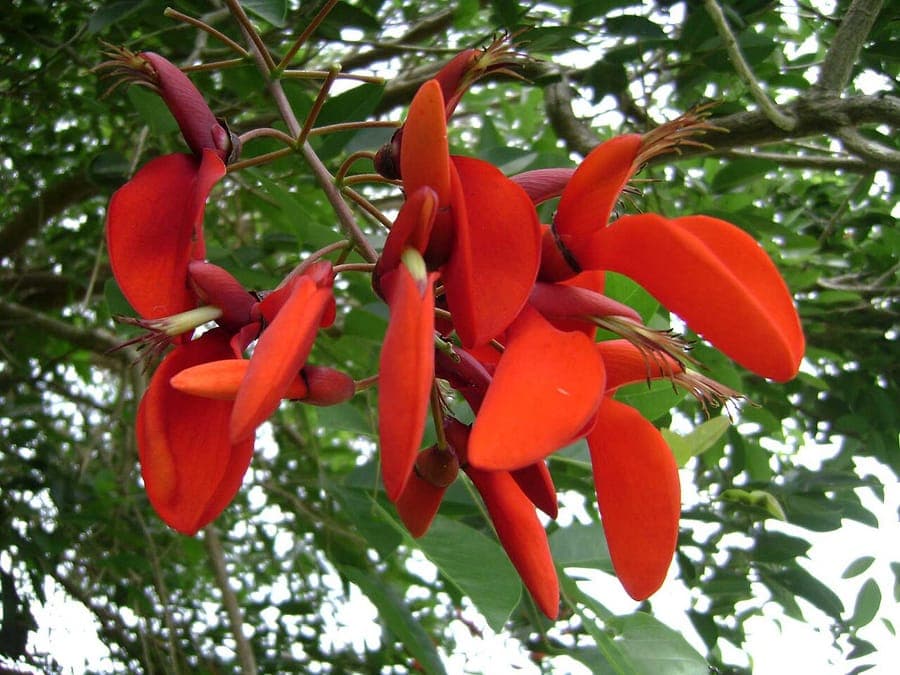
Tauʻolunga / CC BY-SA 3.0, via Wikimedia Commons
Erythrina fusca: complete guide
Erythrina fusca
Want to see Erythrina fusca: complete guide in your garden?
1 minute, no credit card
Erythrina fusca, also known as the Coral-bean tree or Bocare, is an impressive tropical tree native to Central and South America. This plant is renowned for its vibrant scarlet flowers and decorative seed pods. It is a very frost-sensitive plant that can only grow in warm climates.
Overview
Erythrina fusca is a medium to large tree that can grow up to 10-15 meters high under optimal conditions. In cultivation, it is usually kept much smaller. The tree is native to tropical America from Mexico to Peru and is naturalized in large parts of Africa and Asia. It is a deciduous tree that loses its leaves in the dry season. In warm regions, it blooms in late winter to early spring.
Appearance and Bloom
Erythrina fusca has large trifoliate (three-parted) leaves that are often blue-green in color. The stems have spiny thorns. The flowers are the true attraction: they are large, scarlet red to orange, and grow in long clusters. The flowers strongly resemble orchids with their unique shape. After blooming, brown seed pods form filled with toxic scarlet seeds that can be used as ornaments.
Ideal Location
Erythrina fusca needs lots of light and grows best in full sun. The plant can grow in partial to moderate shade but will bloom less. Provide shelter from strong wind, especially in cultivation. In warm regions, you can grow this outdoors; in cooler climates, you must cultivate it as a potted plant and overwinter it indoors.
Soil
The plant grows well in nutrient-rich, well-draining soil. A mixture of garden soil, compost, and sand is ideal. The plant tolerates various soil types but feels most at home in neutral to slightly acidic soil. Ensure adequate drainage as waterlogging can be harmful.
Watering
Water regularly during the growing season (spring and summer). During the dry season, you can water less, especially in warm areas. Do not let the plant dry out completely. In winter (if the plant is indoors), water minimally. The plant appreciates a clear wet/dry cycle.
Pruning
Pruning can be done to maintain form, especially in cultivation. After blooming, you can remove dead branches. Heavy pruning can weaken the plant, so do it carefully.
Maintenance Calendar
Spring: Blooming period begins in warmer regions. Water and feed. Summer: Growth period. Water regularly. Continue feeding. Autumn: Plant prepares for winter. Reduce feeding. Winter: Minimal water. Usually an inactive period in cultivation.
Winter Hardiness
Erythrina fusca is very frost-sensitive and cannot tolerate temperatures below 10 degrees Celsius. In areas with night frost, you must overwinter the plant indoors. Provide good light access even in winter. Keep dry during winter dormancy.
Companion Plants
The Coral-bean tree can be clustered with other tropical trees such as ficus and mango. In gardens, it grows well with other bird-attracting plants. You can also use it as a specimen tree because of its impressive appearance.
Closing
Erythrina fusca is a fascinating choice for tropical plant enthusiasts. With its scarlet flowers, it is a real eye-catcher in any warm garden. For gardeners in cooler climates, it can be cultivated as a special potted plant. Handle the scarlet seeds carefully as they are toxic. This is truly a plant that makes a strong impression. Discover more tropical plants on gardenworld.app.
Want to see Erythrina fusca: complete guide in your garden? Make a free design now.
Upload a photo, pick a style, and get a photorealistic design with plant list in under a minute.
No credit card required


Similar plants
Tall Silky Lupine: complete guide
Lupinus elatus
Tall silky lupine is a fast-growing Californian perennial with silvery foliage and blue-purple flower spikes, ideal for a prairie-style garden.
Garfield Lupine: complete guide
Lupinus garfieldensis
The Garfield lupine is a rare, fast-growing American perennial for alkaline, dry grassland gardens, with striking blue flower spikes.
Lupinus elegans: complete guide
Lupinus elegans
Lupinus elegans, the elegant lupine, is a spectacular blooming plant from Mexico with blue flower spikes. Care, cultivation and garden use.