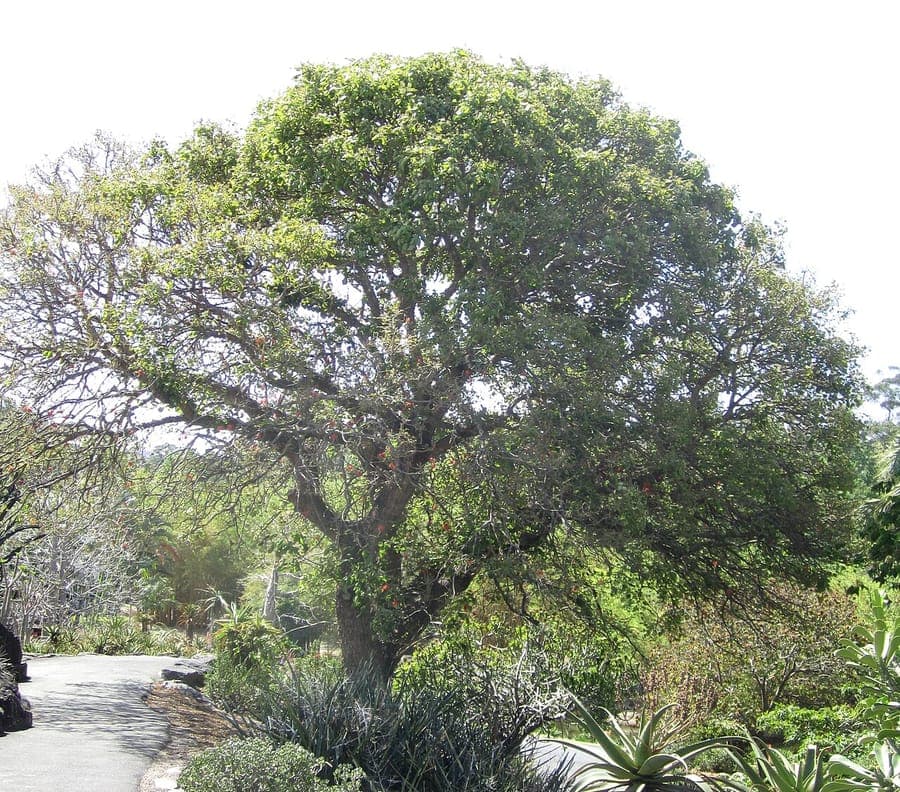
Craig Franklin / CC BY-SA 3.0 au, via Wikimedia Commons
Erythrina abyssinica: complete guide
Erythrina abyssinica
Want to see Erythrina abyssinica: complete guide in your garden?
Full design in HD: €7.99
Look after your Erythrina abyssinica with the GardenWorld app
Identify plants with your camera and get a care calendar with reminders for this plant.


Overview
Erythrina abyssinica, commonly known as Abyssinian coral tree or red coral tree, is a spectacular tree from the Fabaceae (legume/pea family). Native to Central Africa from Eritrea through Botswana, this tree thrived in savanna landscapes and mountain forests. In modern gardens, it offers dramatic scarlet blooms and sculptural architecture.
The Abyssinian coral tree is beloved by landscape designers seeking boldly colored, monumental specimen trees. For gardenworld.app users with south-facing properties in warm climates, Erythrina abyssinica is a statement plant.
Appearance & Bloom
Erythrina abyssinica grows as a mid-sized tree reaching 10-15 meters in natural habitat (often smaller in gardens, 5-8 meters). The tree structure is architectural - sparse branching with thick, silvery branches that grow sculpturally.
Flowering is spectacular in early spring (March-May), producing dense clusters of deep scarlet, papilionaceous flowers along the branches. Each bloom is approximately 3-4 centimeters long, intensely red colored, and highly attractive to hummingbirds and other pollinators.
The foliage is trifoliate (three-part), graceful and grass-green in tone. The tree is semi-deciduous - leaf drop occurs after flowering in dry seasons.
Seeds are produced in long pods, red-colored and decorative through late summer.
Ideal Location
Erythrina abyssinica requires full sun and space - it is a relatively large tree unsuitable for small gardens. Sunlight is essential - minimum 8 hours daily direct sun.
The tree prefers protected locations away from strong wind, though it tolerates wind exposure moderately. Place on sites where water runoff doesn't create severe muddy conditions.
Tropical and subtropical climates are ideal - the tree is unsuitable for colder European zones except in protected microclimates (such as warm garden walls in southern France or Spain).
Soil
Erythrina abyssinica prefers well-draining, reasonably fertile soil. In nature, it grows in mountain forests with well-draining silty soils.
Sandy loam is suitable, not heavy clay. pH prefers neutral to slightly alkaline (6.5-7.5).
Application of compost or aged manure at planting helps. No special acidity requirements.
Free preview
Want to see Erythrina abyssinica: complete guide in your garden? Make a free preview of your design.
Watering
Erythrina abyssinica requires regular water during growing season, especially in dry summers. Water once to twice weekly depending on rainfall.
In dry seasons, reasonable drought stress is tolerated - in nature it grows through exceptional dry periods. However, established trees bloom better with adequate moisture.
Ensure deep water infiltration at planting, but avoid permanent waterlogging.
Maintenance
Erythrina abyssinica requires minimal maintenance once well established.
Light formative pruning can be done after flowering to maintain shape, but heavy pruning isn't needed. Remove dead branches yearly.
The tree may self-seed if seed pods are allowed to mature - manage seed-pod spread by preference.
Maintenance Calendar
- January-February: Blooming preparation, minimal intervention
- March-May: Flowering season, spectacular display, moderate water
- June-August: Growth season, regular watering, seed ripening
- September-November: Leaf-drop period, reduce watering
- December: Winter dormancy preparation
Winter Hardiness
Erythrina abyssinica is not winter-hardy in colder European zones. The tree cannot tolerate temperatures below -5 degrees Celsius.
Suitable for USDA zones 10-11 only - very warm climates exclusively. Container cultivation in colder zones is possible with winter protection, but not practical.
In Mediterranean climates (southern Spain, southern France) it may thrive with protection during extreme winters.
Companion Plantings
Erythrina abyssinica stands conspicuously as a solo specimen tree. Underplanting might include:
- Duranta erecta: Blue flowers for color contrast
- Bougainvillea: Magenta flower contrast
- Thevetia thevetoides: Yellow flower contrast
- Ground cover: Subtle underplanting
Closing
Erythrina abyssinica is a statement tree for warm-climate gardens. With regular watering, it grows for years, flowers reliably each spring, and adds unique scarlet architectural blooms.
For gardenworld.app users with south-facing properties in warm zones, this tree merits serious consideration. Import availability varies - check specialized tropical tree nurseries for sourcing.
Frequently asked questions about Erythrina abyssinica
Is Erythrina abyssinica winter hardy?
Erythrina abyssinica is not winter-hardy in colder European zones. The tree cannot tolerate temperatures below -5 degrees Celsius.
How much water does Erythrina abyssinica need?
Erythrina abyssinica requires regular water during growing season, especially in dry summers. Water once to twice weekly depending on rainfall.
Where does Erythrina abyssinica grow best?
Erythrina abyssinica requires full sun and space - it is a relatively large tree unsuitable for small gardens. Sunlight is essential - minimum 8 hours daily direct sun.
What soil does Erythrina abyssinica need?
Erythrina abyssinica prefers well-draining, reasonably fertile soil. In nature, it grows in mountain forests with well-draining silty soils.

See it in your garden
See Erythrina abyssinica in your garden
One photo of your garden and a few questions. You see the result in about a minute.
Try it with a photoIdentify this plant in your own garden. Identify a plant
Similar plants
Pineapple broom (Argyrocytisus battandieri): complete guide
Argyrocytisus battandieri
Everything about pineapple broom (Argyrocytisus battandieri), the Moroccan wall shrub with silver leaves and pineapple-scented flowers: site, pruning and hardiness.
Blue false indigo: complete guide
Baptisia australis
Everything about blue false indigo (Baptisia australis): position, soil, watering, cutting back, hardiness and toxicity. A long-lived prairie perennial with indigo flowers.
Warminster broom (Cytisus × praecox): complete guide
Cytisus × praecox
Everything about Warminster broom (Cytisus × praecox): position, poor soil, pruning after flowering, hardiness and what you need to know about its toxicity.
