
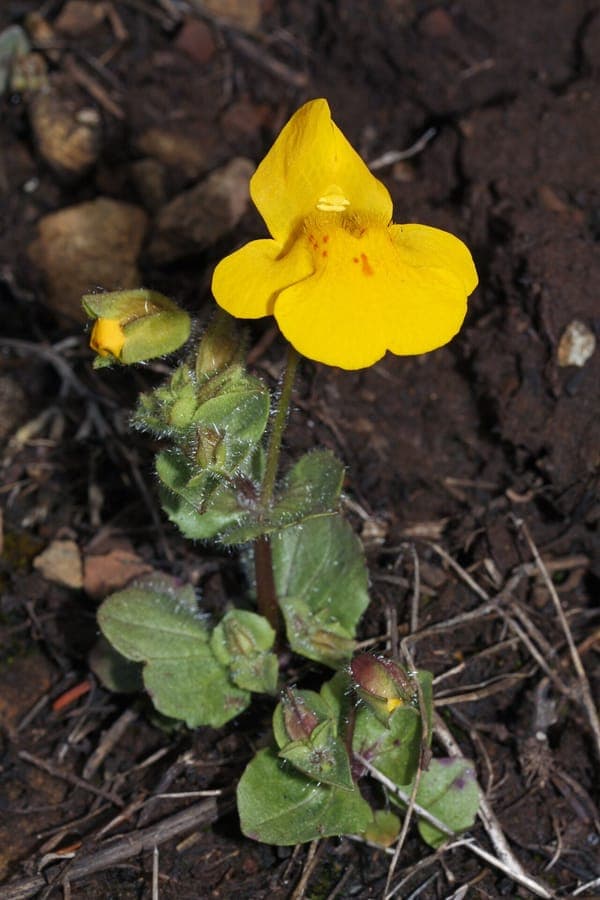
Walter Siegmund (talk) / CC BY-SA 3.0, via Wikimedia Commons
Seep monkeyflower: complete guide
Erythranthe guttata
Want to see Seep monkeyflower: complete guide in your garden?
1 minute, no credit card
Overview
The Seep monkeyflower, scientifically known as Erythranthe guttata, is a beautiful North American flowering plant occurring from Alaska through northwestern Mexico. This plant belongs to the Phrymaceae family and is also known as "spotted monkeyflower" because of the characteristic red spots on the yellow petals.
The plant naturally grows in and around water: mountain streams, wet meadows, and banks. This makes it excellent for gardens with wet conditions, water features, and marshy zones where many other plants cannot grow. The name "monkeyflower" refers to the flower shape - it resembles a mask because of the open mouth appearance.
Appearance and Bloom
Erythranthe guttata grows as a low, soft-hairy herb, typically 20-60 centimeters tall. The plant forms thick, green leaf mass with oval to lanceolate leaves. The leaves feel soft and sticky due to small hairs that adhere.
The flowers are the most striking feature of this plant. They are bright yellow, approximately 2-3 centimeters long, and have a characteristic spotted pattern of red to orange dots on the petals - from which the scientific name "guttata" (spotted) comes. The flowers appear from July through October in a long, sustained display.
The flower has bilateral symmetry with two upper and three lower petals. The two lower petals form almost a lower lip, which strengthens the mask-like appearance. A fascinating feature is that much pollen is absent from the sides of flowers, causing many insects to look toward the center of the flower.
Ideal Location
Erythranthe guttata grows best in full sun to partial shade, with at least 3-5 hours of direct sunlight daily being ideal. However, it is highly tolerant of many light conditions, including considerable shade, especially if soil is wetter.
What is more important than light is moisture: this plant is a water lover that naturally grows in and around water. It performs excellently in wet zones where traditional plants fail.
Soil
Erythranthe guttata performs best in constantly moist to wet soils. This can have high humus content, such as compost-rich garden soils or wet clay. The plant accepts both acidic and basic pH, so pH preference is not critical.
The key is consistent moisture - not necessarily saturated (waterlogged), but always moist. In traditional garden soils, plant at the base of drainage systems or in wet corners.
Free design
Want to see Seep monkeyflower: complete guide in your garden? Make a free design now.
Watering
This is where Erythranthe guttata differs from many garden plants. Instead of drought tolerance, this plant requires regular, sustained moisture levels. Even during rainy seasons, the plant must remain consistently moist, though waterlogging (prolonged submersion without oxygen) can be problematic.
If planting in the garden, ensure water can regularly infiltrate. In dry climates, daily watering may be necessary.
Pruning
Minimal pruning is required. If the plant grows spindly, you can pinch (remove the tip) to encourage more bushiness. After blooming, spent flowers can be removed for neat appearance, though the plant will naturally ripen many seeds.
Maintenance Calendar
Spring (March-May): Plant seedlings after last frost. Ensure constantly moist conditions.
Summer (June-August): Monitor moisture levels, especially during dry periods. Plant may start flowering.
Autumn (September-October): Enjoy extended bloom. Moisture requirements remain high.
Winter (November-February): In freezing climates, plant will die. In milder areas it can overwinter.
Winter Hardiness
Erythranthe guttata is not hardy in the traditional sense. In temperate climates it must be treated as an annual or overwintered indoors. In milder Mediterranean and subtropical climates it can overwinter and regrow in spring.
Companion Plantings
In wet conditions, Erythranthe guttata pairs beautifully with:
- Astilbe species - Feathery flowers
- Hosta varieties - Foliage contrast
- Primula japonica - Japanese Primrose
- Iris species - Especially moisture-loving types
- Filipendula - Queen of the Meadow
Closing Thoughts
Erythranthe guttata is a fascinating choice for gardeners with wet soils and parts of gardens where water accumulates. The bright yellow flowers with red spots are incredibly attractive, and the sustained bloom lasts right through frost. For those with water problems in their garden, this plant offers a solution that is also beautiful.
Visitors to gardenworld.app can learn how to plant water features and wet zones in their gardens with original, flowering plants that are also beneficial for aquatic insects and pollinators.
Visitors to gardenworld.app receive specialized advice on working with difficult, wet soils and how to bring flowers and beauty to them.
Want to see Seep monkeyflower: complete guide in your garden? Make a free design now.
Upload a photo, pick a style, and get a photorealistic design with plant list in under a minute.
No credit card required


Similar plants
Field monkeyflower: complete guide
Erythranthe arvensis
Complete growing guide for Erythranthe arvensis - a cheerful yellow wildflower for pond margins, rain gardens and moist borders across western North America.
Allegheny monkeyflower: complete guide
Mimulus ringens
Everything about Mimulus ringens, the Allegheny monkeyflower: waterside location, soil, care, pruning and companion plants for your garden.
Musk monkeyflower: complete guide
Erythranthe moschata
Everything about growing musk monkeyflower in your garden: ideal site, soil, watering, pruning, and companion planting tips.