
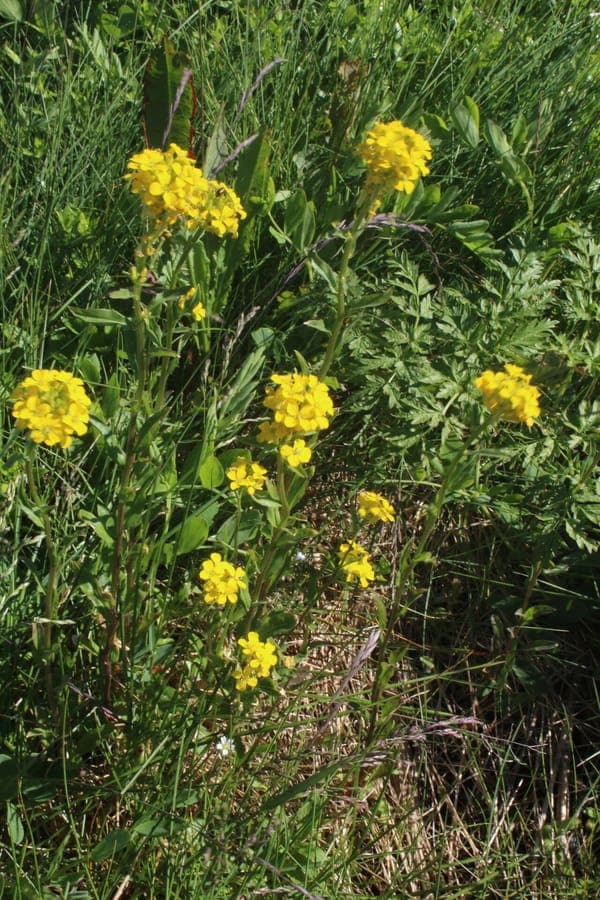
Dmitriy Bochkov / CC BY 4.0, via Wikimedia Commons
Smelly wallflower: complete guide
Erysimum odoratum
Want to see Smelly wallflower: complete guide in your garden?
1 minute, no credit card
Overview
Smelly wallflower (Erysimum odoratum) is a charming biennial plant from the cabbage family (Brassicaceae). This Central European wildflower distinguishes itself through its strong, pleasant scent - hence the name "odoratum" - and vibrant yellow flowers that bloom in dense clusters. Standing 30-50 cm tall, it brings both fragrance and color to gardenworld.app gardens, making it a sensory delight.
This is a plant for those who value scent as much as form.
Appearance and Bloom
Smelly wallflower is characterized by:
- Stems: Green, upright, finely hairy
- Leaves: Lanceolate, smooth, dark green
- Flowers: April through June, yellow cruciferous flowers in dense clusters (12-15 mm)
- Fragrance: Strong sweet-herbal, especially in morning
- Growth: 30-50 cm tall, 20-30 cm wide, modest growth pattern
Flowers shift from yellow to lighter pale yellow as they age. Scent radiates and attracts insects throughout bloom.
Ideal Location
Smelly wallflower thrives best in:
- Full sun (minimum 6 hours direct light)
- Warm, sheltered locations
- Well-draining soils
- Front and spring borders in gardenworld.app
- Mixed with early spring bloomers
Soil
- Type: Well-draining, moderately fertile soil
- pH: Neutral to slightly alkaline (6.8-7.5)
- Nutrients: Moderately fertile; not poor
- Moisture: Moderately dry to normal
- Preparation: Loose, well-aerated soil ideal
Watering
- Growth period (March-May): Regular watering during dry spells
- Bloom: Water when soil feels dry
- After bloom: Less water; let plant dry gradually
- Tip: Drip better than overhead; avoid wetting foliage
Free design
Want to see Smelly wallflower: complete guide in your garden? Make a free design now.
Pruning and Maintenance
- No pruning required; plant grows naturally upright
- Faded flowers can be removed to encourage continuity
- Plant self-seeds readily; seedlings appear spontaneously
- Two-year lifecycle: first year foliage, second year flowers
- Expect seedlings from previous year to establish themselves
Maintenance Calendar
| Month | Activity |
|---|---|
| Jan-Feb | Protect seedlings from frost |
| Mar-Apr | Water during dry spells |
| May-Jun | Support bloom; let seeds mature |
| Jul-Aug | Plant recedes; seeds scatter |
| Sep-Oct | Young seedlings appear |
| Nov-Dec | Seedlings grow slowly through winter |
Winter Hardiness
- USDA zone: 4b-8a (down to -29°C, hardy but cautious)
- Protection: Young seedlings may need frost protection
- Preparation: Reed mulch during extreme freezes
- Microclimate: Warm sheltered spot helps enormously
Companion Plants
Smelly wallflower works beautifully with:
- Forget-me-not (Myosotis sylvatica)
- Columbine (Aquilegia vulgaris)
- Golden garlic (Allium moly)
- English wallflower (Cheiranthus cheiri)
- Sweet violet (Viola odorata)
Combine with other biennial summer-blooming materials.
Final Thoughts
Smelly wallflower deserves more recognition in gardenworld.app gardens. Its strong scent, vibrant yellow color, and modest growth make it ideal for spring borders offering both visual and olfactory pleasure. Let it self-seed and you'll enjoy years of fragrant spring joy with minimal effort. This is a plant you notice - and a plant that's worth noticing.
Want to see Smelly wallflower: complete guide in your garden? Make a free design now.
Upload a photo, pick a style, and get a photorealistic design with plant list in under a minute.
No credit card required


Similar plants
Brassica cretica: complete guide
Brassica cretica
Brassica cretica, the Cretan cabbage, grows wild on Aegean cliffs. Discover how to grow this drought-tolerant, yellow-flowered Mediterranean perennial.
Corsican cabbage: complete guide
Brassica insularis
Corsican cabbage is a rare Mediterranean rock cabbage with white flowers and blue-green leaves. Location, soil and winter protection.
Prostrate cabbage: complete guide
Brassica procumbens
Prostrate cabbage is a creeping North African cliff plant with yellow flowers. Discover location, soil type and winter protection.