
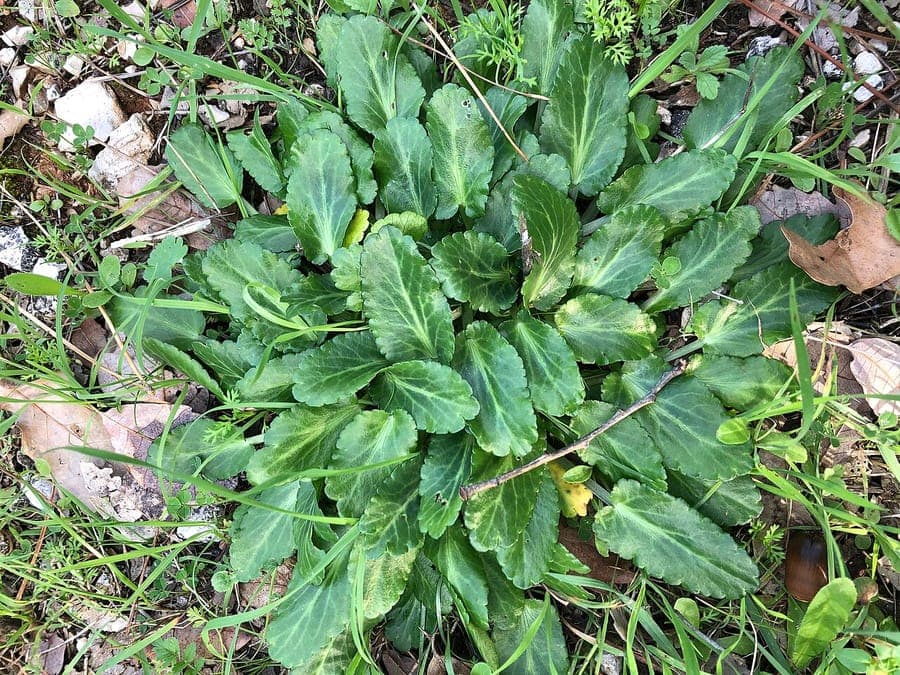
Romy Azar / CC BY-SA 4.0, via Wikimedia Commons
Eryngium creticum: complete guide
Eryngium creticum
Want to see Eryngium creticum: complete guide in your garden?
1 minute, no credit card
Overview
Eryngium creticum, commonly known as Cretan eryngo or Cretan sea holly, is a spectacular plant from the Apiaceae (carrot family). Native to the Eastern Mediterranean region from Greece through Iran, this plant thrived in dry, rocky mountainous terrain. In modern garden designs, it offers dramatic architectural form and unique blue flowers.
Cretan eryngo is popular with designers favoring drought-tolerant plants and sculptural plant material. For gardenworld.app users seeking water-sparing front-yard designs, Eryngium creticum is a perfect choice.
Appearance & Bloom
Eryngium creticum grows as a mid-sized plant, 40 to 70 centimeters tall. The plant builds itself as a dense, rosette-like mound of gray-green foliage with spiny leaf margins. Leaves are deeply divided with defensive-looking prickles.
Flowering is profuse in July and August, producing deep blue to violet-blue, spiky-looking flower heads on rigid stems. These flower heads are impressive sculptural elements - roughly spherical, bristling with spines, and deep blue colored. Each flower head lasts for weeks, first green then gradually deepening to rich blue, remaining ornamental even after natural drying.
The structure is exceptionally architectural and highly photogenic - popular in dried flower arrangements.
Ideal Location
Eryngium creticum requires full sun and well-draining soil. Sunlight is essential - minimum 8-10 hours of direct daily sun. It thrives in hot, dry situations where many garden plants experience stress.
Prefer south or west-facing locations with minimal shade. The plant tolerates strong wind well, making it suitable for exposed sites.
Avoid low, wet locations - this plant despises waterlogging.
Soil
Eryngium creticum prefers well-draining, dry soil. A sandy, lean soil is ideal - the plant actually thrives on nutrient-poor terrain.
Nutrient content is less important than drainage. Heavy clay soils require substantial amendment with coarse sand, gravel, and possibly perlite to improve drainage.
The plant prefers neutral to slightly alkaline pH (6.5-7.5), so it flourishes in calcareous soils.
Apply minimal mulch - heavy mulch promotes moisture retention risking rot.
Free design
Want to see Eryngium creticum: complete guide in your garden? Make a free design now.
Watering
Eryngium creticum requires minimal water once well established. Moderate watering in the first growing season (spring-summer) supports root establishment.
Once established (after year 1), the plant tolerates drought stress well and requires little supplemental water beyond normal rainfall. In exceptional droughts, single deep watering helps, but the plant actually grows better with some drought stress.
Overwatering is the primary cause of mortality - the plant rots easily in wet winters.
Maintenance
Eryngium creticum requires minimal maintenance. No fertilizing needed. No pruning required - natural form suffices.
Remove spent flower heads in autumn if aesthetic preference dictates, but leave them for winter interest and seed spread.
The plant is virtually disease-free when in appropriate dry conditions.
Maintenance Calendar
- January-March: Spring growth begins, minimal intervention
- April-May: Explosive growth, water only in prolonged drought
- June-August: Flowering season, no intervention
- September-October: Seed ripening, remove only if preference
- November-December: Winter dormancy, minimal maintenance
Winter Hardiness
Eryngium creticum is reasonably hardy, tolerating approximately -8 to -10 degrees Celsius. The plant survives many European winters outdoors without protection.
In very severe winter zones, snow loading on rosette foliage can cause problems - careful removal helps. In zones with warm wet winters, the plant may experience rot problems - improved drainage helps.
Companion Plantings
Eryngium creticum combines beautifully with other drought-tolerant plants:
- Santolina chamaecyparissus: Silver-foliaged contrast plant
- Achillea: Yellow or red-flowering bloom balloons
- Centranthus ruber: Red flower contrast
- Stipa pennata: Fine grassy texture
- Nepeta cataria: Blue flowers for color crossing
These combinations create Mediterranean-toned dry-plant gardens.
Closing
Eryngium creticum is ideal for water-sparing front-yard designs via gardenworld.app and other modern landscape schemes. With minimal care, it thrives for years in the same location, flowers reliably each year, and adds architectural drama without water demands.
For designers preferring drought-tolerant, ecologically responsible planting schemes, this Mediterranean eryngo is indispensable. Availability is increasing - check specialized seed suppliers for sourcing.
Want to see Eryngium creticum: complete guide in your garden? Make a free design now.
Upload a photo, pick a style, and get a photorealistic design with plant list in under a minute.
No credit card required


Similar plants
Whorled carrot: complete guide
Daucus involucratus
Daucus involucratus is a Mediterranean umbellifer with white flower heads framed by lacy bracts. Growing this gravel garden gem.
Daucus muricatus: complete guide
Daucus muricatus
Daucus muricatus, the spiny wild carrot, grows wild on Mediterranean coasts. Discover sowing, June-July bloom, and wildflower meadow use.
Daucus pumilus: complete guide
Daucus pumilus
Daucus pumilus is a dwarf wild carrot relative with white lacy umbels, thriving on dunes and coastal rock in poor, fast-draining soil.