
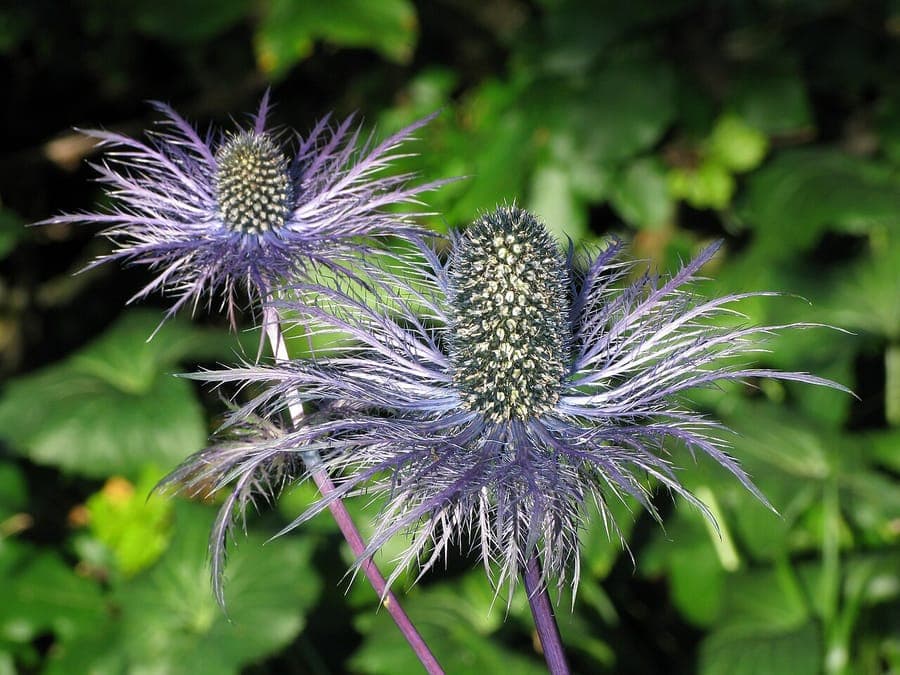
Heinz Staudacher / CC BY-SA 4.0, via Wikimedia Commons
Alpen-mannstreu: complete guide
Eryngium alpinum
Want to see Alpen-mannstreu: complete guide in your garden?
1 minute, no credit card
Overview
Eryngium alpinum, commonly known as Alpen-mannstreu, is a striking perennial native to the mountainous regions of Austria, France, Italy, and Switzerland. This bold plant has carved a niche in modern gardens for its architectural form and resilience. Belonging to the Apiaceae family - yes, the same as carrots and parsley - it couldn't look less like its edible cousins. Instead, it stands tall with spiky, thistle-like blooms that command attention from midsummer onwards. If you're after a plant that combines rugged beauty with low maintenance, this one's worth serious consideration.
On gardenworld.app, you can design a garden layout that highlights the vertical presence of Eryngium alpinum, pairing it with complementary textures and heights for maximum impact.
Appearance & bloom cycle
Alpen-mannstreu grows 60 to 80 cm tall with a spread of about 40 cm. Its stems are stiff, upright, and often slightly branched. The foliage is dark green with a silvery underside, deeply veined and slightly toothed, giving it a rugged, almost prehistoric feel. The leaves are most lush in spring and early summer.
Flowering occurs from July to August. The flowers are technically white, but appear as a striking blue-white or silvery hue due to the metallic sheen of the bracts. Each flower head is 3–4 cm wide, surrounded by spiny, rigid bracts that create a starburst effect. These aren't petals - they're modified leaves - but they last for weeks and even months when dried. Cut stems can be used in dried arrangements, retaining their shape and color well into winter.
Ideal location
This plant thrives in full sun - aim for a light level of 8 out of 10. It performs best in open, unshaded spots with good air circulation. Avoid planting it in dense shade; growth will be leggy, flowering sparse, and fungal issues more likely. A south- or west-facing border is ideal.
It shines in rock gardens, gravel beds, or dry stone walls where excess moisture drains quickly. Its architectural form also works well in contemporary planting schemes with minimal maintenance. On gardenworld.app, use the sun exposure planner to map out the best spot in your garden for sun-loving plants like Eryngium alpinum.
Soil requirements
Alpen-mannstreu prefers well-drained, chalky or limestone-rich soil with a pH between 7.0 and 7.5. It struggles in acidic, heavy clay soils. If your soil is dense, amend it with horticultural grit, sand, or small gravel to improve drainage. A mix of topsoil, grit, and compost in a 2:1:1 ratio works well.
The key is preventing waterlogged roots. Raised beds, slopes, or crevices in stone walls help keep the crown dry. Avoid mulching with organic matter - it retains moisture and can lead to rot. Instead, use gravel or crushed stone as a top dressing.
Free design
Want to see Alpen-mannstreu: complete guide in your garden? Make a free design now.
Watering
Once established, Eryngium alpinum is highly drought-tolerant. In its first growing season, water young plants weekly during dry spells. After that, supplemental watering is rarely needed unless you're experiencing prolonged drought (over 14 days without rain).
Always water at the base to avoid wetting the foliage, which can encourage fungal diseases. Deep, infrequent watering encourages deeper root development, making the plant even more resilient.
Pruning
After flowering, cut back spent flower stems to just above the basal rosette. This keeps the plant tidy and prevents excessive self-seeding. If you want some naturalization, leave a few stems to drop seed in late summer.
In late winter or early spring (February to March), trim back any remaining foliage to 5–10 cm above ground level. This clears space for fresh growth and reduces the risk of crown rot.
Maintenance calendar
- Jan: Check crown for moisture; ensure good drainage
- Feb: Cut back old foliage
- Mar: New growth emerges; light application of lime-rich fertilizer
- Apr: Watch for slugs on new shoots
- May: No special care needed; monitor soil dryness
- Jun: Check for drought stress, especially in sandy soils
- Jul: Bloom begins; water during dry spells
- Aug: Peak bloom; deadhead spent flowers
- Sep: Decide whether to leave seed heads for self-sowing
- Oct: Leave foliage for winter structure
- Nov: Ensure soil remains well-drained
- Dec: Protect crowns in wet winters with gravel mulch
Winter hardiness
Eryngium alpinum is hardy in USDA zones 5 to 9 (-20°C to -15°C). In colder zones, a light gravel mulch helps protect the crown without trapping moisture. In containers, move pots to a sheltered spot or wrap them with hessian to prevent frost heave.
Avoid covering with organic mulch like bark or leaves - it holds moisture and increases rot risk. The plant is more likely to succumb to wet winters than cold ones.
Companion plants
Pair Alpen-mannstreu with late-summer bloomers like Echinacea, Sedum 'Matrona', and Verbena bonariensis. Its vertical form contrasts beautifully with mounding or airy plants. Silver-leaved companions like Artemisia or Stachys byzantina enhance its metallic tones.
Avoid moisture-hungry plants like Astilbe or Hostas, which create competition and increase humidity around the base. Stick to drought-tolerant species for a harmonious planting scheme.
Closing
Eryngium alpinum isn't for every garden, but if you love architectural drama and low-input perennials, it's a standout. Its spiky blooms attract pollinators, and its form adds interest long after flowering. It's perfect for gravel gardens, rockeries, or contemporary borders. Find it at garden centres like B&Q, Thompson & Morgan, or local independents from May onwards. For layout ideas, visit gardenworld.app and build a custom planting plan that puts drought-resistant, sun-loving perennials front and center.
Want to see Alpen-mannstreu: complete guide in your garden? Make a free design now.
Upload a photo, pick a style, and get a photorealistic design with plant list in under a minute.
No credit card required


Similar plants
Whorled carrot: complete guide
Daucus involucratus
Daucus involucratus is a Mediterranean umbellifer with white flower heads framed by lacy bracts. Growing this gravel garden gem.
Daucus muricatus: complete guide
Daucus muricatus
Daucus muricatus, the spiny wild carrot, grows wild on Mediterranean coasts. Discover sowing, June-July bloom, and wildflower meadow use.
Daucus pumilus: complete guide
Daucus pumilus
Daucus pumilus is a dwarf wild carrot relative with white lacy umbels, thriving on dunes and coastal rock in poor, fast-draining soil.