
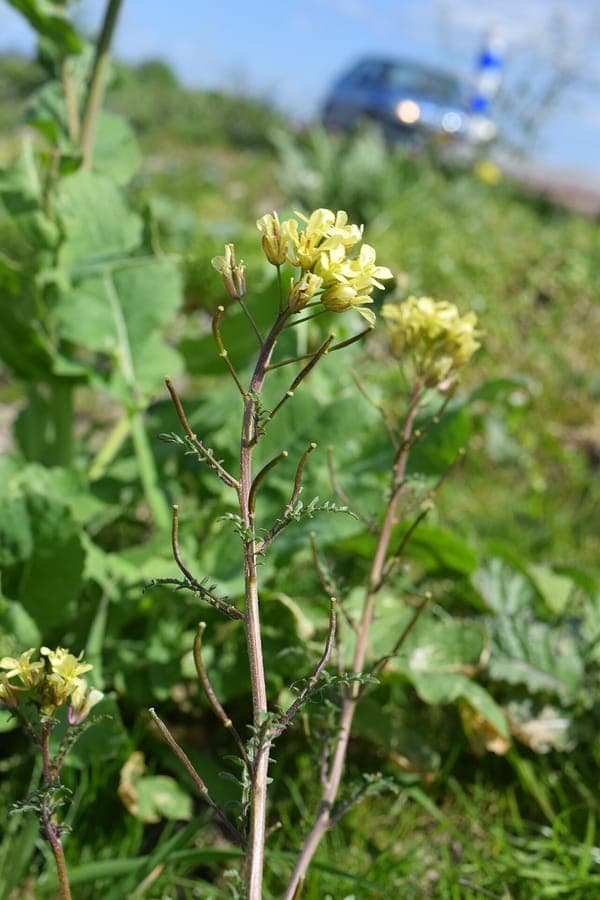
TeunSpaans / CC BY-SA 4.0, via Wikimedia Commons
Common dogmustard: complete guide
Erucastrum gallicum
Want to see Common dogmustard: complete guide in your garden?
1 minute, no credit card
Overview
Common dogmustard (Erucastrum gallicum) is a robust, annual forb that thrives in open, dry, and often disturbed soils. Native to much of western and central Europe, it's increasingly spotted in wildflower meadows and low-maintenance gardens across the UK and northern Europe. Standing between 40 and 80 cm tall, it brings a wild, natural charm to borders, pathways, and gravel gardens. While not a traditional ornamental plant, its resilience and long bloom period make it a smart addition for gardeners seeking low-input, ecological planting.
As a member of the Brassicaceae family, it shares traits with wallflowers and rocket, but unlike its edible relatives, common dogmustard is not suitable for consumption-its foliage is intensely bitter and unpalatable. Still, it plays a vital role in supporting pollinators. On gardenworld.app, you can design a planting scheme that integrates common dogmustard into a drought-resistant or wildlife-friendly garden, balancing aesthetics with function.
Appearance & bloom cycle
The plant grows upright with a single, branching stem covered in short, stiff hairs. Basal leaves form a loose rosette early in the season but often wither as flowering begins. Stem leaves are lance-shaped, slightly toothed, and grey-green, clasping the stem with small auricles.
From May through September, it produces tall racemes of small, bright yellow flowers. Each bloom has four petals arranged in a classic cross shape, typical of the cabbage family, measuring about 8–12 mm across. The flowering progresses upward along the stem, ensuring a long visual presence. After pollination, slender seed pods (siliques) develop, reaching 3–5 cm in length. These mature to a greyish-brown and split open to scatter dark brown seeds, which may self-sow readily in suitable conditions.
Ideal location
Common dogmustard thrives in full sun-rate it an 8 out of 10 for light needs. Choose south- or southwest-facing spots with minimal shade. It's ideal for gravel gardens, dry borders, rocky slopes, or even cracks in paving where soil is thin and drainage is excellent.
Avoid placing it in shaded areas or near vigorous perennials that will outcompete it. It performs best in open settings where air circulates freely, reducing fungal risks. If you're unsure whether your garden layout suits this plant, gardenworld.app offers visual planning tools to test plant compatibility based on sun exposure, spacing, and neighboring species.
Free design
Want to see Common dogmustard: complete guide in your garden? Make a free design now.
Soil requirements
This species prefers well-drained, alkaline soils with a pH between 7.5 and 8.0. It's particularly adapted to chalky or limestone-based substrates. Sandy or gravelly soils work well, as long as they don't retain water. Heavy clay or acidic soils should be amended with grit, sand, and garden lime to improve structure and pH.
Interestingly, common dogmustard doesn't need rich soil-in fact, it grows more compact and floriferous in poorer conditions. Avoid adding compost or fertilizer, which can lead to leggy growth and reduced flowering.
Watering
Once established, common dogmustard is highly drought-tolerant. Water only during prolonged dry spells in the first few weeks after sowing or transplanting. After that, it relies entirely on rainfall. Overwatering is a common mistake-soggy soil will cause root rot and collapse.
If watering is necessary, do so at the base early in the morning to minimize leaf wetness and reduce the risk of fungal diseases like downy mildew.
Pruning
Pruning isn't required for this annual. Deadheading won't significantly extend blooming, though it may slow self-seeding. If you want to prevent spread, cut the seed heads before they split. Otherwise, let the plant complete its lifecycle and remove dead stems in autumn.
Maintenance calendar
- Jan: No action needed
- Feb: No action needed
- Mar: Sow seeds directly in prepared ground
- Apr: Watch for seedlings; protect from slugs if needed
- May: Flowers emerge; monitor for aphids
- Jun: Peak bloom; ensure good airflow
- Jul: Continue flowering; watch for dry conditions
- Aug: Seed pods begin to form
- Sep: Final blooms; collect seeds if desired
- Oct: Clear plant debris to control self-seeding
- Nov: No action
- Dec: No action
Winter hardiness
As an annual, common dogmustard completes its life cycle in one year and dies back in autumn. However, its seeds overwinter well in the soil and germinate naturally in spring. It's hardy in USDA zones 6 to 9. In milder climates, some late-germinating plants may survive mild winters as rosettes.
Companion plants
Pair common dogmustard with other sun-loving, drought-tolerant species such as Echinops ritro, Gaura lindheimeri, or Achillea millefolium. It also combines well with silver-foliaged plants like Artemisia schmidtiana or Santolina chamaecyparissus.
For pollinator value, grow it near Phacelia, catmint, or wild thyme. Avoid planting near moisture-loving species like hostas or astilbes, which have conflicting cultural needs.
Closing
Common dogmustard may not be a headline plant, but it's a reliable, unpretentious performer in the modern garden. Its ability to thrive in tough conditions with minimal care makes it ideal for sustainable landscaping. Look for seeds or young plants at garden centres across the UK, especially in eco-focused ranges. And remember, whether you're planning a gravel garden or a pollinator patch, gardenworld.app helps you visualize how common dogmustard fits into your space-before you plant a single seed.
Want to see Common dogmustard: complete guide in your garden? Make a free design now.
Upload a photo, pick a style, and get a photorealistic design with plant list in under a minute.
No credit card required


Similar plants
Brassica cretica: complete guide
Brassica cretica
Brassica cretica, the Cretan cabbage, grows wild on Aegean cliffs. Discover how to grow this drought-tolerant, yellow-flowered Mediterranean perennial.
Corsican cabbage: complete guide
Brassica insularis
Corsican cabbage is a rare Mediterranean rock cabbage with white flowers and blue-green leaves. Location, soil and winter protection.
Prostrate cabbage: complete guide
Brassica procumbens
Prostrate cabbage is a creeping North African cliff plant with yellow flowers. Discover location, soil type and winter protection.