
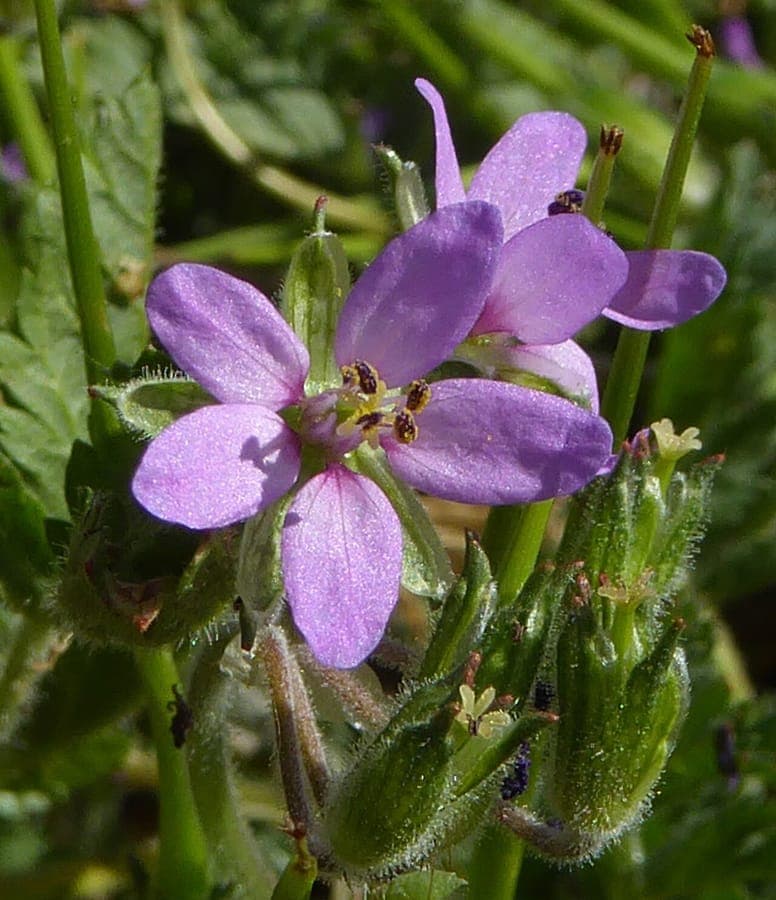
E Wusk / CC BY-SA 4.0, via Wikimedia Commons
Musk stork's-bill: complete guide
Erodium moschatum
Want to see Musk stork's-bill: complete guide in your garden?
1 minute, no credit card
Overview
Erodium moschatum, commonly known as musk stork's-bill, is a resilient herbaceous annual that brings quiet charm to sunny, dry garden spots. Native to Mediterranean regions like Algeria, Cyprus, and the Canary Islands, it thrives in USDA zones 8–10 but can be grown as an annual in cooler climates. A member of the Geraniaceae family, it's often overlooked in UK and US gardens, yet it's a reliable performer in rockeries, gravel gardens, and cottage-style borders. The plant earns its 'musk' name from the faint aromatic scent released when its leaves are brushed or crushed.
On gardenworld.app, you can design a low-maintenance, drought-tolerant garden layout featuring musk stork's-bill as a ground cover or edging plant, especially in xeriscape or Mediterranean-inspired designs.
Appearance & bloom cycle
Musk stork's-bill grows 8–12 inches (20–30 cm) tall with a spreading, herbaceous habit. Its deeply lobed, grey-green leaves are softly hairy, giving them a velvety texture. The foliage forms a low, mounding base from which delicate flower stems arise.
From April through September, it produces small purple flowers, each about 0.6 inches (1.5 cm) across, with five notched petals and darker veining. The blooms appear in loose clusters and are especially abundant in full sun. As the season progresses, the seed pods develop a long, beak-like shape-reminiscent of a stork's bill-hence the common name. These pods twist as they dry, aiding in seed dispersal.
Ideal location
This plant thrives in full sun, rated at 8 out of 10 for light needs. Aim for at least 6 hours of direct sunlight daily. South-facing walls, dry slopes, or gravel pathways are ideal. It performs best in sheltered spots where heat builds up during the day, like against stone or brick walls.
Avoid shady, damp areas under trees or dense shrubs-musk stork's-bill won't bloom well and may become leggy. While it tolerates summer heat, young plants in May can still be sensitive to late frosts, so plant out after the last frost date in your area.
Check your sun exposure with a site analysis tool on gardenworld.app to ensure your musk stork's-bill gets enough light without being scorched.
Soil requirements
Musk stork's-bill doesn't need fertile soil-in fact, rich soil encourages leafy growth at the expense of blooms. It prefers well-draining, slightly acidic to neutral soils with a pH between 5.5 and 6.5. Sandy or gravelly soils are ideal. If your garden has heavy clay, amend it with coarse sand or grit to improve drainage.
For containers, mix 30% perlite or horticultural grit into standard potting mix. The plant adapts well to poor soils, alkaline conditions, and shallow substrates, making it great for green roofs or wall plantings with minimal soil depth.
Free design
Want to see Musk stork's-bill: complete guide in your garden? Make a free design now.
Watering
Once established, musk stork's-bill is drought-tolerant. Water young plants weekly in dry spells during spring and early summer. After that, reduce watering-overwatering leads to root rot, especially in cool, wet conditions.
Water at the base to avoid wetting foliage, which can encourage fungal diseases. Use rainwater when possible, as tap water high in lime can raise soil pH over time. Avoid overhead watering, especially in the evening.
Pruning
Pruning is minimal. This is not a shrub or formal plant-just a simple herb. Remove spent flowers regularly (deadheading) to encourage more blooms and maintain a tidy appearance.
In mid-summer, if the plant looks straggly, you can cut it back by one-third. This promotes bushier growth and a second flush of flowers. Use clean, sharp shears and avoid cutting into old wood-this species doesn't regenerate from woody stems.
Maintenance calendar
- apr: Sow seeds indoors or direct-sow outdoors after frost risk passes. Space 10 inches (25 cm) apart.
- may: Watch for late frosts. Water young plants moderately.
- jun–aug: Peak bloom. Deadhead regularly. No feeding needed.
- sep: Reduce watering. Allow some seed pods to mature for self-seeding.
- oct–mar: Dies back in colder zones. Collect and store seeds for next year.
Winter hardiness
Musk stork's-bill is generally grown as an annual in USDA zones below 8. It's not reliably hardy in colder climates, though mild winters may allow a few plants to survive. In zone 7b and lower, it won't persist through winter. For overwintering, start seeds indoors in late winter. Transplant outdoors after all danger of frost has passed.
Companion plants
Pair musk stork's-bill with other drought-tolerant species like thyme, sedum, or lavender. These companions share similar sun and soil needs and create a low-water, pollinator-friendly garden. Use it as a soft edging plant in gravel beds or between stepping stones.
Avoid planting near moisture-loving perennials such as hostas or astilbes, which require more water and richer soil. Musk stork's-bill performs best in simple, uncluttered groupings with minimal competition.
Closing
Musk stork's-bill is an understated but dependable choice for sunny, dry gardens. It asks for little-just sun, sharp drainage, and occasional deadheading-and rewards with months of delicate blooms. Pick up seeds or young plants at garden centres in spring, especially from April to May. Try combining it with Mediterranean herbs or succulents for a cohesive look.
Designing around its growth habit helps. On gardenworld.app, you can plan a planting scheme where musk stork's-bill enhances texture and colour without overwhelming other elements.
Want to see Musk stork's-bill: complete guide in your garden? Make a free design now.
Upload a photo, pick a style, and get a photorealistic design with plant list in under a minute.
No credit card required


Similar plants
Pelargonium acetosum: complete guide
Pelargonium acetosum
Discover the Sorrel-leaf Geranium: a South African plant with aromatic foliage. Perfect for containers and warm locations. Learn cultivation and care.
Erodium foetidum: complete guide
Erodium foetidum
Rock stork's-bill is a delicate alpine plant with purple flowers and fine foliage. Learn how to grow this Mediterranean charmer in your front garden.
Pelargonium crithmifolium: complete guide
Pelargonium crithmifolium
Discover Samphire-leaf pelargonium: an exotic South African geranium with distinctive foliage. Growing tips, care advice and garden inspiration.