
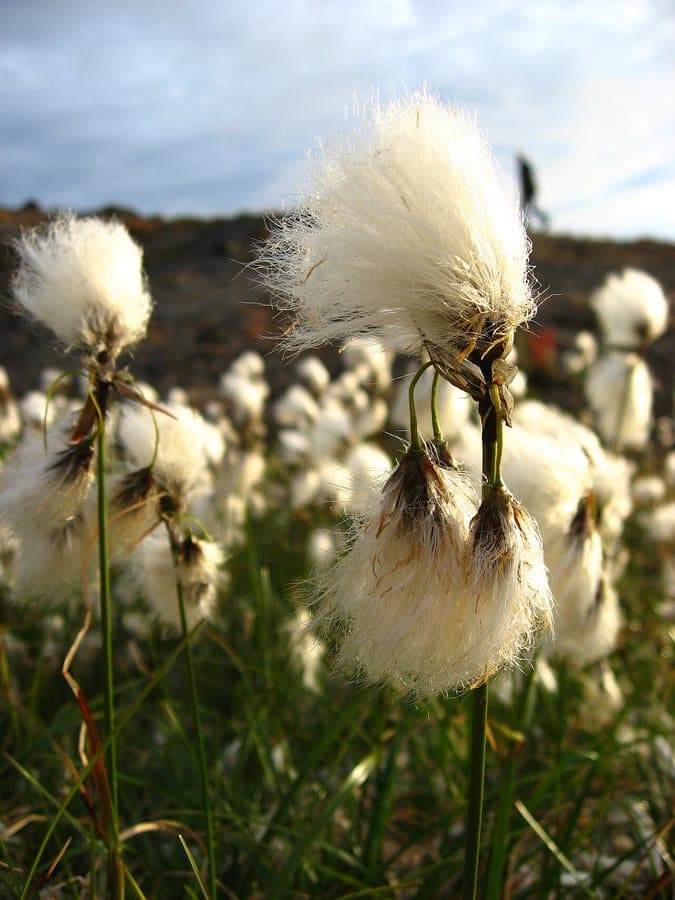
Kim Hansen / CC BY-SA 3.0, via Wikimedia Commons
Common cotton-grass: complete guide
Eriophorum angustifolium
Want to see Common cotton-grass: complete guide in your garden?
1 minute, no credit card
Overview
Common cotton-grass (Eriophorum angustifolium) is a striking, clump-forming sedge that brings delicate texture and seasonal drama to wetland gardens. Native to acidic bogs, heaths, and marshes across northern Europe, Canada, and Alaska, this hardy perennial thrives in conditions where most plants struggle. Standing 30 to 50 cm tall, it forms dense tufts of narrow, grass-like green foliage and produces iconic white, cottony plumes in late spring. It's a standout choice for rain gardens, pond margins, and naturalistic planting schemes, especially in areas prone to waterlogging.
Common cotton-grass is not just decorative-it plays a vital role in its native ecosystem, stabilising peaty soils and providing food and shelter for insects and birds. On gardenworld.app, you can design a moisture-rich planting plan that features cotton-grass alongside complementary species like bog rosemary or creeping jenny, ensuring year-round interest and ecological value.
Appearance & bloom cycle
The plant's narrow green leaves grow 20–40 cm long and emerge in tight, radial clusters from the base. In April, upright stems rise above the foliage, each tipped with a single greenish bract. By May, these develop into soft, white, cotton-like seed heads up to 3 cm wide. These fluffy plumes persist from May through July, catching the light and swaying gently in the breeze. Even after the seeds disperse in late summer, the spent heads often remain intact into autumn, adding soft texture to the garden. The plant maintains a neat, mounded habit and doesn't spread aggressively.
Ideal location
Common cotton-grass needs full sun to light shade (light level 8/10), meaning at least six hours of direct sunlight daily. It performs poorly in deep shade, where flowering is sparse and growth becomes leggy. Plant it at the edge of a pond, in a bog garden, or in a low-lying area that collects water after rain. Group 5–7 plants together for a natural drift effect. It also works well in large containers filled with acidic, moisture-retentive compost. Use gardenworld.app to simulate how cotton-grass will look in your garden layout, especially when paired with purple moor grass or marsh marigold.
Soil requirements
The soil must be consistently wet and acidic, with a pH between 4.0 and 6.5. Avoid chalky or neutral soils, as they inhibit nutrient uptake and can cause yellowing. Ideal conditions mimic natural peat bogs: a mix of peat, loam, and sand with high organic matter. Do not add lime or general-purpose fertiliser-this plant thrives in low-nutrient conditions. If your soil is heavy clay, consider raising the bed and amending it with leaf mould and sphagnum moss.
Free design
Want to see Common cotton-grass: complete guide in your garden? Make a free design now.
Watering
Keep the soil saturated at all times, particularly from March to September. In dry spells, check daily and top up with rainwater if possible-tap water can raise pH over time. For bog gardens, maintain a water table within 5 cm of the surface. In containers, stand pots in saucers filled with water, but ensure roots aren't sitting in stagnant water for weeks.
Pruning
No pruning is required during the growing season. Wait until early March to trim back old foliage and spent flower stems using sharp secateurs. This clears space for new growth and keeps the clump tidy. Avoid cutting back in autumn-leaving the plumes intact adds winter structure and supports overwintering insects.
Maintenance calendar
- Jan: Check plant condition; no action needed
- Feb: Inspect for rodent damage or frost heave
- Mar: Cut back old growth; divide overcrowded clumps if needed
- Apr: Monitor for new shoots; ensure consistent moisture
- May: Plumes emerge; no feeding required
- Jun: Peak bloom; enjoy full display
- Jul: Seed heads mature; reduce intervention
- Aug: Watch for drying out in heatwaves
- Sep: Leave undisturbed; plant enters dormancy
- Oct: No pruning; let seed heads remain
- Nov: Remove only debris, not plumes
- Dec: Winter care-no protection needed, keep moist
Winter hardiness
Common cotton-grass is fully hardy in USDA zones 3–8, tolerating temperatures down to -35°C. It remains semi-evergreen in milder winters, with foliage turning bronze or tan. The plant resprouts reliably each spring from its deep, fibrous root system. No mulching or covering is required, even in wet, frozen soil.
Companion plants
Pair cotton-grass with moisture-loving, acid-tolerant species like marsh marigold (Caltha palustris), bogbean (Menyanthes trifoliata), or purple moor grass (Molinia caerulea). For contrast, plant with dark-leaved sedge (Carex elata 'Aurea') or heather (Calluna vulgaris). In containers, combine with dwarf rushes or water forget-me-nots.
Closing
Common cotton-grass is a low-effort, high-impact plant for wet, acidic areas. It demands constant moisture and dislikes rich soils, but in the right spot, it rewards with months of airy beauty. Its ethereal plumes bring movement and light to boggy corners where few plants survive. Buy Eriophorum angustifolium at garden centres like B&Q, Wyevale, or online nurseries from March onwards. With a little planning-perhaps using gardenworld.app to map moisture zones-you can turn problematic damp patches into stunning, naturalistic features.
Want to see Common cotton-grass: complete guide in your garden? Make a free design now.
Upload a photo, pick a style, and get a photorealistic design with plant list in under a minute.
No credit card required


Similar plants
Flat-stemmed club-rush: complete guide
Bolboschoenus planiculmis
Everything about Bolboschoenus planiculmis: growing conditions, watering, care, and use as a pond margin or wetland plant in garden design.
Great Plains flatsedge: complete guide
Cyperus lupulinus
Everything about Great Plains flatsedge (Cyperus lupulinus): growing conditions, care, garden uses, and ecological value. Tips for pond margins and dry sandy soils.
Golden beak sedge: complete guide
Rhynchospora corymbosa
Everything about golden beak sedge (Rhynchospora corymbosa): a dramatic tropical marginal for pond edges, bog gardens, and wet habitats.